
 Chloe
One engine for search, data and recommendations Blazing fast, from laptop to cluster
Full text, vectors, columns and graphs over the same rows, in one SQL query. Start with a file in your app and grow to a sharded cluster without changing a query. Your coffee breaks will need a new excuse.
First overall against thirteen engines when every kind of query counts
Read the reportfind “wireles controller” despite the typo
WHERE MATCH(title, 'wireles~ controller')rank by words and meaning in one ORDER BY
ORDER BY rrf(bm25(title, :q), similarity(emb, :v))recommend what a shopper's last purchases lead to
ppr(bought_with, (SELECT item FROM reviews WHERE usr = :user …))keep two items per brand in the top ten
… DESC MAX 2 PER brand LIMIT 10suggest as you type, typos and all
WHERE PREFIX(id, :typed, fuzzy => 'auto') ORDER BY n DESC LIMIT 10search images and sound by what's in them
photo_emb VECTOR OPTIONS(embed = 'image', model = 'siglip-base-patch16-224')find places near me, on the phone itself
POST /v1/admin/slices {"table": "places", "text": "name", "lat": "lat", "lon": "lon"}rank with your LightGBM or XGBoost model, inside the query
ORDER BY gbdt('docs_ltr', bm25(title, :t), coalesce(rating, 0)) DESCreplace five systems and their 3 a.m. pages
chloedb-server --db shop.chloedb # the whole stackhand results to pandas and Arrow without a copy
db.query_arrow("SELECT id, year, rating FROM books").to_pandas()keep your scoring logic in the database
CREATE FUNCTION boosted(s FLOAT, w FLOAT) RETURNS FLOAT AS :s * (1 + :w)follow your Postgres tables, a moment behind, with no Kafka
chloedb-server follow-postgres --source postgres://…answer apps written for OpenSearch, unchanged
chloedb-server --opensearch-listen 127.0.0.1:9200run inside your app as one file, like SQLite
db = chloedb.open("shop.chloedb")grow to shards on Kubernetes with the same queries
kubectl apply -f operator.yaml -f cluster.yamllose a primary and lose no write
chloedb-server --seq-no --failover-after-ms 2000take in logs over OpenTelemetry and keep the old ones on S3
chloedb-server --directory --cold-store s3://my-bucket/logs/ --cold-keep-local-gb 50give Claude Code your tables over MCP
claude mcp add --transport http chloedb http://127.0.0.1:7700/v1/mcpgive Claude Code a memory that outlives its sessions, with ChloeCtx
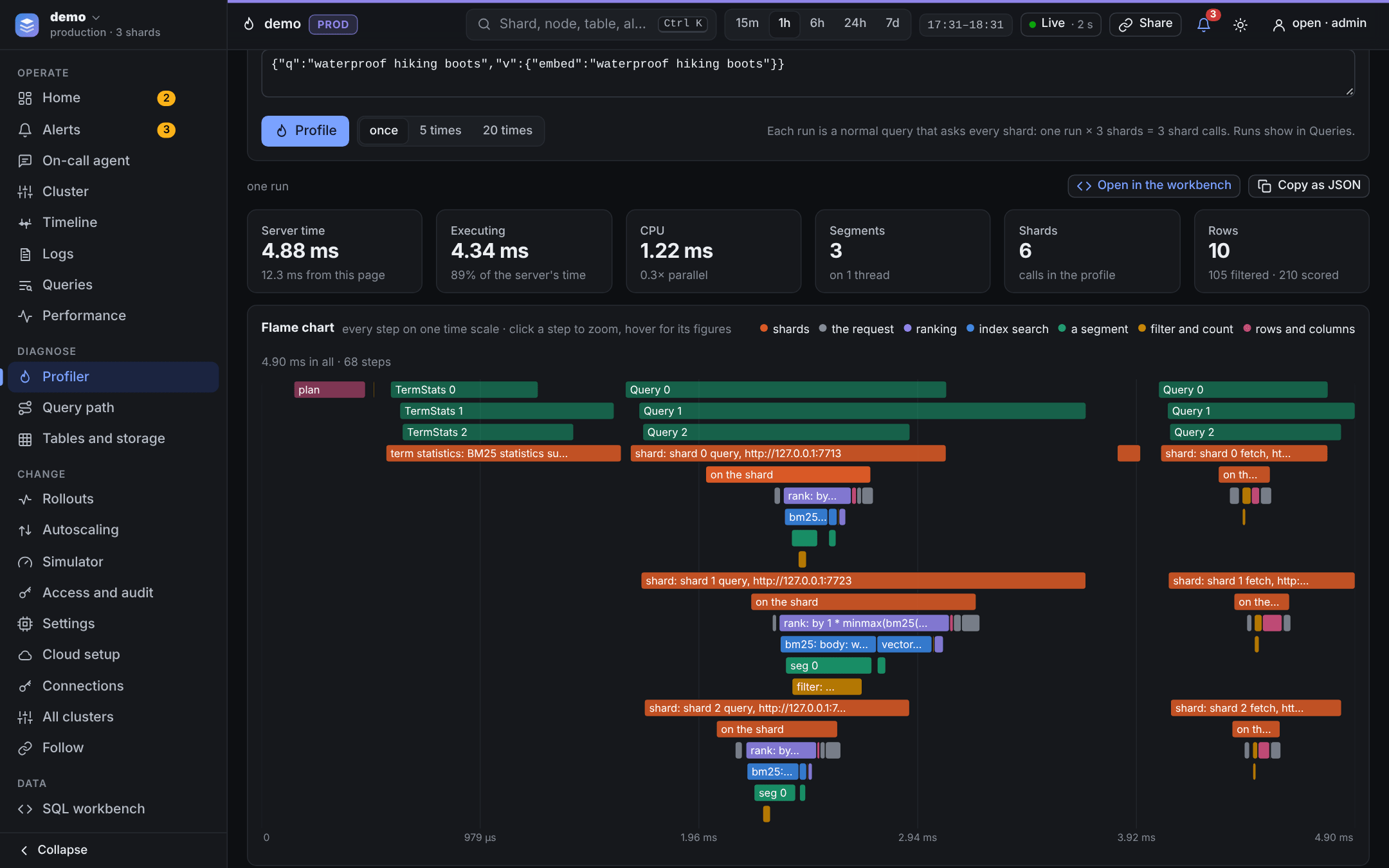
claude plugin install chloectx --marketplace chloetech-ai/chloedbexplain your slow query before your boss asks
EXPLAIN SELECT … -- or click ProfileEverything a search application needs, in one place
Each row is stored once and indexed four ways. One statement can use all of them.
Full-text search
BM25, phrases, typos, synonyms and autocomplete.
Vector search
Filtered HNSW and IVF, hybrid fusion, multi-vector MaxSim.
SQL and columns
Joins, aggregates, JSON fields and ACID transactions.
Graphs
Paths, reachability and personalised PageRank inside a query.
Recommendations
Next-item models, bought-together walks and business rules.
Ranking
Rank expressions, LightGBM and XGBoost models, cross-encoders.
Where ChloeDB stands out
Each one is in main, documented and tested.
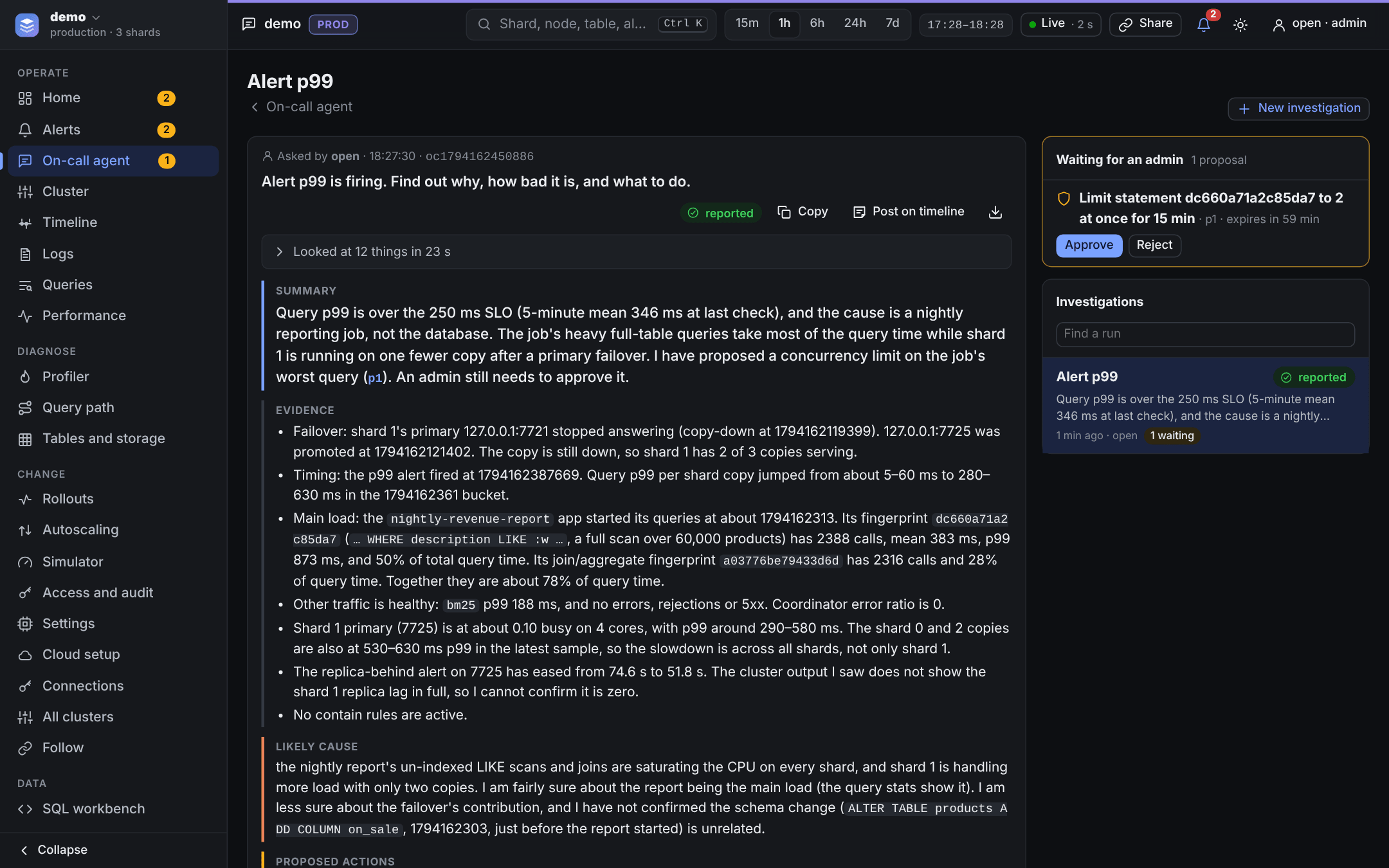
Claude on call
An alert fires. The on-call agent goes through the cluster's metrics, slow queries and recent events, writes up the likely cause, and proposes a fix that waits for an admin to approve it.
- Alert p99 is firing
- Evidence, likely cause, how bad it is
- A proposed fix: Approve or Reject
The OpenSearch API
Gitea and Mastodon index and search through it unchanged: 42 of 42 and 112 of 114 of their searches return what OpenSearch 2.11 returns.
chloedb-server --opensearch-listen 127.0.0.1:9200
Data in
Follows Postgres
Search over your Postgres tables, a moment behind, by logical replication. Every insert, update and delete arrives, with no Kafka in between.
chloedb-server follow-postgres --source postgres://…
On the device
Search on the phone
A slice of a table near the user, by place or by meaning, is searched on the device. It answers when it can prove its top results, and asks the server when it can't.
AgentsAgents over MCP
Claude Code and other agents list the tables, read their schemas, check a statement before it runs, then query and write.
claude mcp add --transport http chloedb http://127.0.0.1:7700/v1/mcp
Four indexes, one statement
Other stacks join a database, a search engine, a vector store and a recommender in application code. In ChloeDB it is one query, and the planner decides how to run each part.
- Full text finds "wireles controller" despite the typo
- Columns keep the price range and two items per brand
- Vectors add what is close in meaning
- Graph adds what this user's recent purchases lead to
SELECT id, title, price, score() FROM products
WHERE MATCH(title, 'wireles~ controller')
  AND price BETWEEN 20 AND 60 AND in_stock = TRUE
ORDER BY rrf(
    bm25(title, 'wireless controller'),
    similarity(emb, :query_vector),
    ppr(bought_with, (SELECT item FROM reviews
        WHERE usr = :user ORDER BY ts DESC LIMIT 5)))
DESC MAX 2 PER brand LIMIT 10;Words, meaning, or both
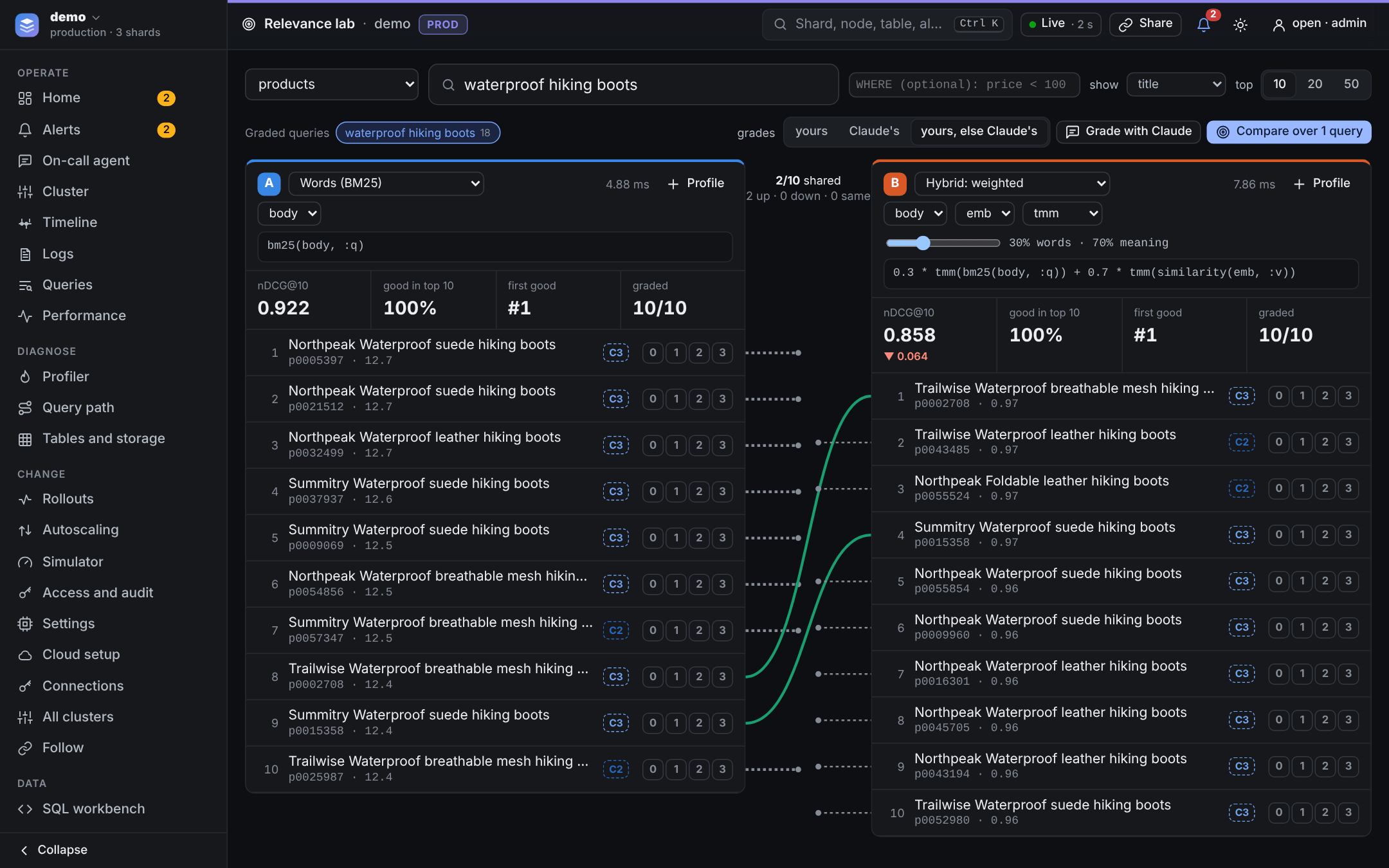
Search 40 sample products. Slide from BM25 on the words to similarity in meaning and watch the order change, typos and all.
This runs in your browser, not on ChloeDB: BM25 as ChloeDB scores it (k1 1.2, b 0.75), and small hand-made vectors standing in for an embedding model. The statement beside it is what you would send ChloeDB for the same ranking.
Start with a file. Grow to a cluster. Keep your queries.
The same schema, the same SQL and the same file format at every step.
A file, like SQLite
Open it from Python, JavaScript, Java or Rust. No server to run.
db = chloedb.open("shop.chloedb")HTTP, gRPC and a console
Serve the same file, with API keys and replicas when you need them.
chloedb-server --db shop.chloedb
Shards on Kubernetes
An operator that scales, upgrades and fails over a sharded cluster.
kubectl apply -f operator.yaml -f cluster.yaml
Use it from the language, or the API, you already use
Each one opens a local file or talks to a server, with the same methods. Apps written for OpenSearch keep their client.
Your memory, for every model
ChloeCtx, built on ChloeDB, keeps what you tell AI assistants in one file on your machine, and Claude, GPT or a local model can query it. On questions about a person's past chats, Opus answered 89% right from it, at 79 times fewer tokens than the whole history. In Claude Code it records every session on its own: /plugin marketplace add chloetech-ai/chloedb then /plugin install chloectx@chloedb installs it, with nothing to compile.
Install it
As a plugin, for every session on the machine, or for one project to try it.
What it recalls
A briefing of the rules and decisions at the start, and the history a prompt needs with each one.
See what it kept
A local inspector of each project and session, where you can forget what should not stay.
Blame a line
From a line of code back to the edit, the prompt behind it and what memory had shown the agent.
Try a query
Every example runs against the same shop: products, reviews and users.
SELECT id, title, price, score() FROM products
WHERE MATCH(title, 'controler~ OR gamepad', synonyms => 1)
  AND price BETWEEN 20 AND 60 AND in_stock
ORDER BY bm25(title, 'controller gamepad') DESC LIMIT 10;
SELECT id, title, score() FROM products WHERE in_stock
ORDER BY rrf(bm25(title, :q), similarity(emb, :v)) DESC LIMIT 10;
SELECT id, title, brand FROM products WHERE in_stock
ORDER BY similarity(emb, encode('next',
  (SELECT item, ts FROM reviews WHERE usr = :u ORDER BY ts DESC LIMIT 200)))
DESC MAX 2 PER brand LIMIT 10;
SELECT id, title, hops() FROM products WHERE REACHABLE(bought_with, 'B07XYZ', hops => 2, dir => 'both') AND in_stock ORDER BY hops(), id LIMIT 20;
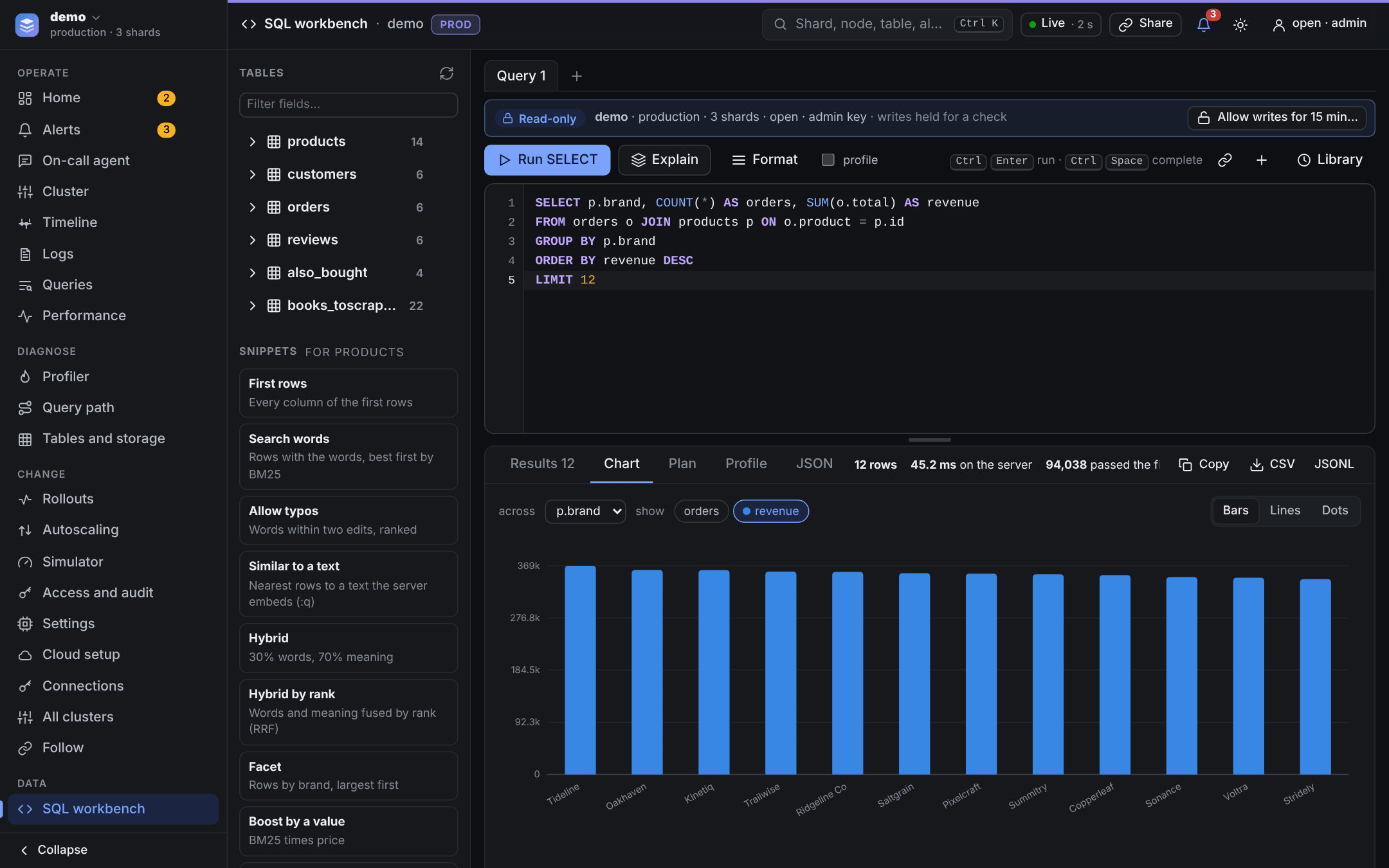
SELECT p.brand, COUNT(*) AS reviews, AVG(r.stars) AS stars
FROM reviews r JOIN products p ON r.item = p.id
WHERE r.ts >= '2026-01-01'
GROUP BY p.brand ORDER BY reviews DESC LIMIT 10;
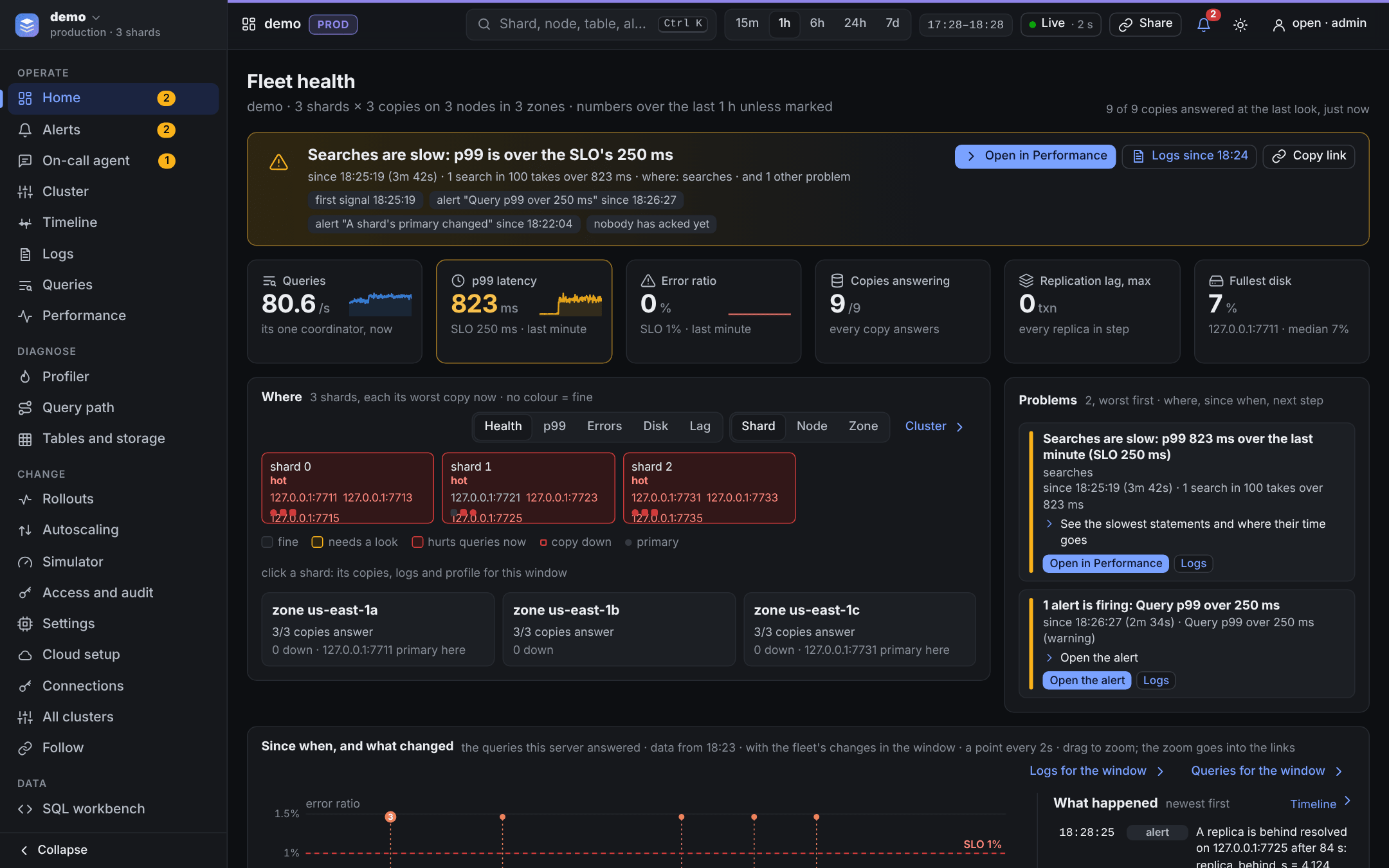
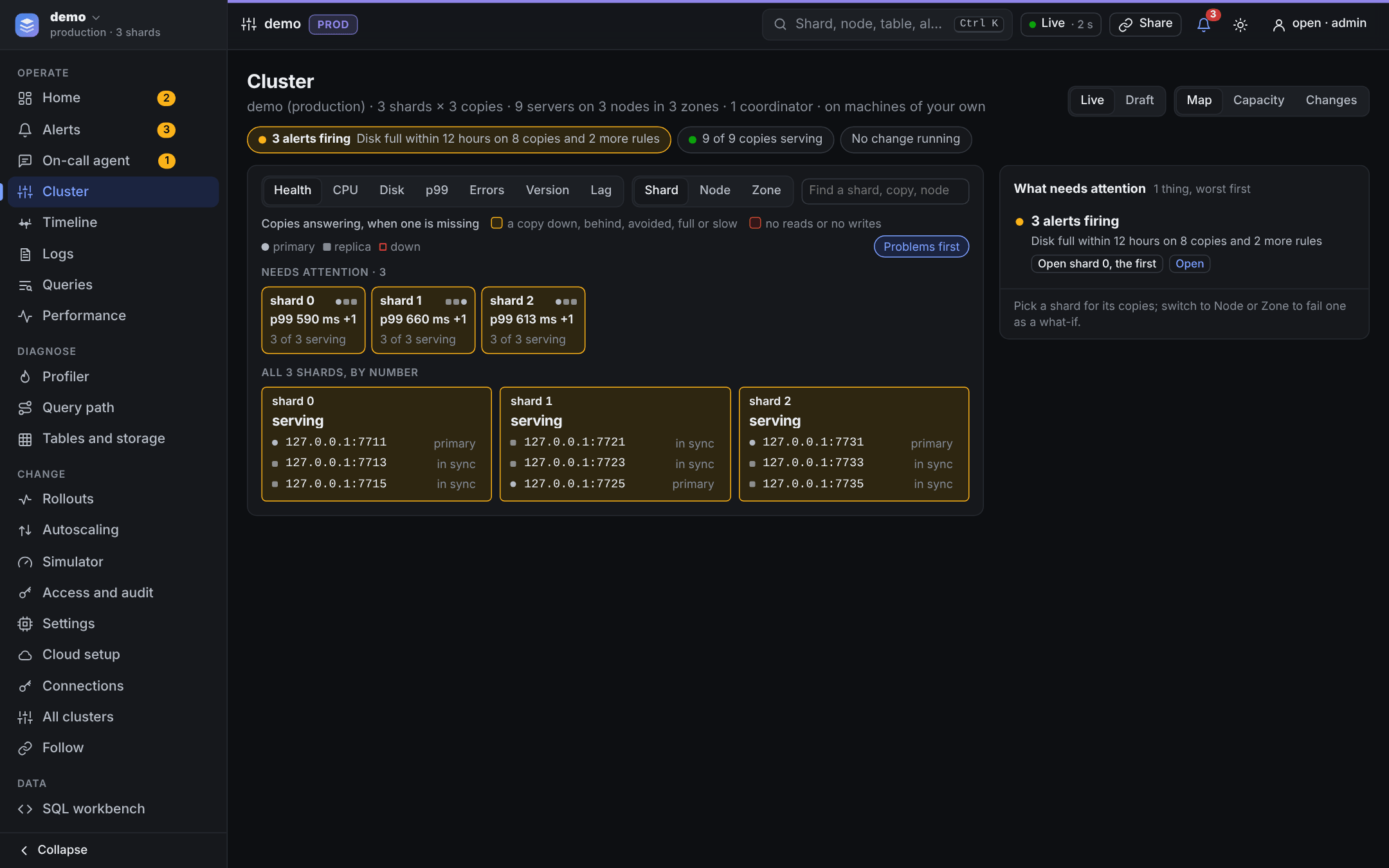
A console in every server
Open the server's address to see the cluster, its queries and its changes, live. Nothing extra to install.
First overall when one system has to do it all
Fourteen kinds of query against thirteen search engines and databases, with the same CPUs and memory for each and the answers checked. At 1M every engine ran on 16 November, ChloeDB 0.3.5 among them, with every result cache off: ChloeDB is first with 130 points, against Elasticsearch's 268. At 10M ChloeDB, Elasticsearch and OpenSearch ran again that day, the others on 3 November.
Faster hybrid search than SQLite, DuckDB or LanceDB on five BEIR collections, every system on one node with ChloeDB of 17 November, and as fast with ChloeDB held to one thread.
Graph · arXiv citations1st of 5Against Neo4j, Memgraph, FalkorDB and ArangoDB on places summed over 16 tests, on one laptop: 31 points, Memgraph 60, and 21 against 24 without PageRank, which only ChloeDB and Neo4j run. Memgraph and FalkorDB answer one to three hops in about half ChloeDB's time.
Specialists still win some kinds, such as typo search and key lookups. Each report shows where.
What people build with it
One engine instead of four systems and the code that keeps them in step.
App search
Replace SQLite and a search engine with one file that ranks, filters and counts facets.
Recommendations
Similar items, a home feed and next items, with rules, in SQL.
Retrieval for agents
Hybrid retrieval with reranking for RAG, filtered by who may see what.
Images and sound
Media embedded on write, searched by text or by example.
Start with a file in your app
Install the Python package, a prebuilt wheel for Linux and macOS (Python 3.10 or later), then open a file and query it. Nothing to compile.
pip install chloedb
python3 - <<'EOF'
import chloedb
db = chloedb.open("shop.chloedb", schema={"table": "products", "key": "id",  # a new file needs a schema
    "fields": [{"name": "id", "type": "keyword"}, {"name": "title", "type": "text"}]})
db.upsert({"id": "p1", "title": "Trail running shoes"})
print(db.search("shoes").dicts())
EOF
Or run the server, prebuilt, with SQL over HTTP and the command center in your browser:
curl -fsSL https://chloetech-ai.github.io/chloedb/install.sh | sh
On Windows (outside WSL 2) or Alpine there is no wheel yet: build the package from source, which needs Rust and a C compiler.