
 Chloe
chloedb-server
Reference, rendered from docs/chloedb/server.md.
These docs follow main, which can be ahead of the latest release, 0.3.11 (its docs): a change made after it says so where it is described.
On this page
chloedb-server serves a ChloeDB database over HTTP JSON and gRPC. Every server has a command center in the browser, with a query console and an agent that answers questions by writing SQL. Run several servers as shards behind one more as a coordinator, and the coordinator answers like one database.
New to it? Build an app goes from an empty server to search, stock, holds, events counted once and a cluster in one page. This page is the reference:
| part | sections |
|---|---|
| Start it | Run it (every flag), Schemas, Loading rows |
| Models and media | Embedded vector fields, Media fields, Semantic IDs |
| The API | HTTP API, Security, gRPC |
| A cluster | Sharding, Replication, On Kubernetes |
| Running it | Deadlines, admission and metrics: limits, health, logs, alerts |
| The command center | The UI, The agent, The on-call agent, Agents over MCP |
Old names. ChloeDB was called Strata until November 2026. The names on this page are the new ones, and the old ones (strata-server, STRATA_* settings, x-strata-* headers) still work for a release: Compatibility lists them.
Run it#
A prebuilt server needs no Rust, no C compiler and no first build of several minutes. Each server release (tagged chloedb-server-v<version>) has one archive a platform: linux-x86_64 and linux-aarch64 (glibc 2.35 or later: Debian 12, Ubuntu 22.04 and newer), macos-arm64 and macos-x86_64 (macOS 11 or later), each with its .sha256 beside it.
v=0.3.11 p=linux-x86_64   # or linux-aarch64, macos-arm64, macos-x86_64
curl -LO https://github.com/chloetech-ai/chloedb-releases/releases/download/chloedb-server-v$v/chloedb-server-$p.tar.gz
tar xzf chloedb-server-$p.tar.gz
chloedb-server-$p/chloedb-server --demo 20000 --db products.chloedb   # a demo catalogue
# open http://127.0.0.1:7700
The archive holds chloedb-server, and strata-server, its old name, beside it; release 0.1.0, from before the rename, was published as strata-server-v0.1.0. macOS keeps an archive a browser downloaded from running until xattr -d com.apple.quarantine chloedb-server-$p/chloedb-server; curl sets no such mark.
since 0.3.7 The same binary is on PyPI as chloedb-server, a wheel per platform, so pip, uv and pipx install it (or run it without installing it), with no archive to unpack:
pipx install chloedb-server                              # or uv tool install chloedb-server: onto the PATH
uvx chloedb-server --demo 20000 --db products.chloedb    # or run it without installing it (pipx run chloedb-server too)
pip install chloedb-server                               # or into a virtualenv, beside the code that uses it
The wheels are tagged for what the binary needs: manylinux_2_34 (glibc 2.34 or later: RHEL 9, Ubuntu 22.04, Debian 12 and newer) on Linux x86_64 and aarch64, macosx_11_0 on macOS, so pip takes one only where it runs; there is none for Windows or Alpine, and no source distribution. The program lands in the environment's bin; python -m chloedb_server ARGS runs it where that is not on the PATH, and chloedb.serve() starts one from Python and returns a client of it (pip install "chloedb[server]" installs the client and the server of the same release). The server-release workflow makes the wheels from the archives above, installs and runs each on its platform, and publishes them on the tag.
From source (Rust stable and a C compiler; the first build takes several minutes). --bin chloedb-server builds the server alone: without it, cargo also builds the ten tools and benchmarks in the crate's src/bin/ (the simulator, chloedb-server-bench and others), each about as big as the server:
cd chloedb-server && cargo build --release --bin chloedb-server
target/release/chloedb-server --demo 20000 --db products.chloedb
cargo build --release --bin chloedb-server --no-default-features builds a server without DataFusion, Parquet and s3:// paths, from 321 crates rather than 412: joins, groups and sorts then run on ChloeDB's own operators (CHLOEDB_ENGINE, below), and import and export take no Parquet files or s3:// paths.
Or from the image every merge to main publishes (linux/amd64 and linux/arm64). Beyond the container's own loopback the server needs a token, which the command center then asks for:
docker run --user 10001:10001 -p 127.0.0.1:7700:7700 -e CHLOEDB_TOKEN=pick-a-secret -v chloedb:/data \
  ghcr.io/chloetech-ai/chloedb-server:latest --db /data/my.chloedb --listen 0.0.0.0:7700
# open http://127.0.0.1:7700; add --demo 20000 for the demo catalogue
The image has a user 10001 (chloedb) that owns its /data: run it as that user, not root, with --user 10001:10001 as above, and a new volume works. A volume or directory a root image wrote before needs to be given to that user once: docker run --rm -v chloedb:/data --entrypoint chown ghcr.io/chloetech-ai/chloedb-server:latest -R 10001:10001 /data. The image's own user stays root for now, so that an operator installed before 0.2.1, which runs new images on volumes a root image wrote and gives its pods no user, keeps working; the operator from 0.2.1 runs the servers, the coordinators and the pre-flight as user 10001 itself, and gives the shards' volumes to its group (fsGroup). The benchmark tools (chloedb-server-bench, engine-compare) are not in the image; docker build --target bench builds an image with them. A server that embeds pictures or sound (built with the features vision and audio, which bring BERT's embedding models too) is published as the same image at the tag with -full after it: latest-full, the commit's <sha>-full and a release's <version>-full (docker build --target full builds it). The models are not in either image: the server downloads those its tables name at start, or reads them from --models with --no-fetch-models.
A --db that does not exist is created: with --schema's table, with --demo's, or with neither as a database with no tables yet, which CREATE TABLE and the loads fill. Until its first table exists it lists none, and a write that names no table is refused; then that table is the one requests naming none go to, as a database's first table is. The tables of the apps beside a server do not count: their own state (Sheets' sheets_* and ChloeCtx's ctx_*, which they make before anyone else, and the app engine's sa_*) never takes a request that names no table, and the data they fill (a crawl's crawl_*, network operations' netops_*) takes them only while the database has no other table. (Such a database keeps an empty first table named _placeholder, which listings, exports and writes leave alone; an older version of ChloeDB opens the file and lists it.)
--demo N creates a product catalogue of N rows (titles, descriptions, brands, categories, tags, prices, ratings, sales and a 64-dimension vector) to try things on. Its emb field is declared as the hash:64 model's embedding of the title and description (below): hashed bags of words, not a learned model, so "similar" means "shares words".
| flag | default | effect |
|---|---|---|
--db PATH |
the database to serve; created if missing, with --schema or --demo, else with no tables |
|
--schema FILE |
the schema of a new database: a JSON file, or the JSON itself (below) | |
--directory |
off | create the new database as a directory of segment files instead of one file |
--wal-drop-damaged |
off | open a database whose write-ahead log was damaged after it was durable, dropping the transactions from the damage on (the log is copied to <log>.damaged first); without it the server refuses to start on one |
--seq-no |
off | number the database's writes, for conditional writes and seq_no(); it cannot be undone, and versions of ChloeDB from before it refuse the database |
--replicas URL,URL,… |
be the primary of this database: ship its writes to these replicas' gRPC addresses; needs --seq-no. With --replica: the shard's other copies (its primary and the other replicas), which it ships to once promoted, and the only ones a promotion asked for with a key may name |
|
--replica |
off | be a replica: apply the writes a primary ships here, and refuse writes from clients; needs --seq-no and --grpc |
--promote |
off | start as the primary of a new term, above every term the database knows, shipping to --replicas if any: needed to start a database that was a replica, or whose primary another replaced, as a primary (promotion) |
--write-acks A |
all |
with --replicas: the copies that hold a write before it is answered: all, majority or primary |
--failover-after-ms N |
0 | in a cluster: a replica that hears nothing from its primary for this long asks its shard's copies to elect it primary, and a primary that does not hear from a majority of its copies for most of it serves no reads (0: failover by hand only) |
--ship-log-mb N |
64 | with --replicas or --replica: the latest transactions kept in memory to ship; a replica further behind is sent a copy of the primary |
--scrub-every-s N |
86400 | on a database server: how often it reads every segment against its checksum while it serves, at --scrub-mib-s (64 MiB/s) at most, to find data damaged on disk (0: only when asked, POST /v1/admin/scrub); the first scrub starts within ten minutes |
--disk-probe-s N |
60 | on a database server: how often it times reads of its database's file around the page cache (the disks), which fleet health compares between copies (0: only when asked, POST /v1/admin/disk/probe) |
--evict-free-ratio R |
0.15 | under Kubernetes, the free share of the node's disk under which the kubelet evicts the node's pods (DigitalOcean's imagefs.available): a database on that disk is judged by the room left above it (the disks) |
--merge-nice N |
10 | on Linux, the nice value (0 to 19) merges run at, so that a merge gets the cores reads and writes leave idle; 0 runs them at the priority of reads and writes |
--verify-every-s N |
600 | with --replicas: how often each replica's rows are compared with the primary's; a replica whose rows differ is sent a copy of the primary (0: only when asked, POST /v1/admin/verify) |
--verify-checksums |
off | check every segment against its checksum before serving (reads the whole database once); a damaged newest version is skipped for the one before it |
--shards URL,URL,… |
run as a coordinator over these shard servers' gRPC addresses | |
--coordinator-listen ADDR |
with --db, --grpc and --shards: also serve a coordinator over --shards at this HTTP address, in this server's process, which calls this server's shard in-process (a coordinator beside a shard) |
|
--local-shard URL |
with --coordinator-listen: the URL of --shards that is this server's own gRPC address |
|
--peer-url URL |
$CHLOEDB_PEER_URL, else $CHLOEDB_POD_IP and the --listen port, else the --listen address |
on a coordinator: the address other coordinators reach its HTTP API at; it names itself so to its shards |
--contain FILE |
contain.json beside --alerts; in memory without either |
on a coordinator: where its Contain rules and their removals are kept across a restart |
--slot-map FILE |
equal runs, epoch 1 | with --shards: the slot map to route writes by, which the shards are given |
--shard-timeout-ms N |
0 | with --shards: give up on a shard after this many milliseconds (0: at the query's deadline) |
--partial |
off | with --shards: answer without the shards that have no copy answering, flagged "partial"; a request's own "partial" overrides it |
--listen ADDR |
127.0.0.1:7700 |
HTTP: the API, /metrics and the UI |
--grpc ADDR |
127.0.0.1:7701 |
gRPC (off to disable) |
--opensearch-listen ADDR |
off | also answer OpenSearch's REST API here, for applications written for OpenSearch or Elasticsearch 7 (Elasticsearch 8's clients refuse it: use OpenSearch's); --opensearch-version V is the version it reports (2.11.0; 7.10.2 for clients of Elasticsearch 7) |
--token T |
$CHLOEDB_TOKEN |
require Authorization: Bearer T on the API and on gRPC; needed to listen beyond loopback (security) |
--no-token |
off | listen beyond loopback without a token anyway |
--allow-host NAME |
also answer HTTP requests for this host name (repeatable) | |
--tls-cert FILE, --tls-key FILE |
serve HTTP and gRPC over TLS with this PEM certificate chain and key | |
--header-timeout-secs N |
30 | the longest a client may take to send a request's headers (or a TLS handshake, 10 s at most), and the longest an idle HTTP/1 connection stays open; then the server closes it |
--idle-timeout-secs N |
300 | the longest any connection, HTTP/2 and gRPC too, stays open with no request under way (an HTTP/2 client that answers the server's pings would otherwise hold its connection for ever); 0: no limit |
--body-timeout-secs N |
30 | the longest a request body may pause; one that has taken longer than this must also have averaged 1 KiB a second, so that a client that trickles a byte at a time is cut off; not on gRPC, whose streams of writes pause between batches; 0: no limit |
--write-timeout-secs N |
60 | the longest a write may wait for the client to read its answer before the server closes the connection; 0: no limit |
--max-connections N |
0 | connections each listener (HTTP, OpenSearch, gRPC) holds open at once; past it new ones wait to be accepted, but for 8 kept for /livez, /readyz and /v1/health (two at once per client address), which answer any other request 503 (0: three quarters of the process's open-file limit, over every listener together, which the server raises to its hard limit, up to 2^20, at start; connections) |
--max-connections-per-client N |
0 | connections one client address may hold of a listener's; a connection past it is closed at once, before any request (the client sees a reset; the server logs it at info, a line a second at most, and counts it in chloedb_connections_closed_past_share_total) (0: half of --max-connections). Behind a proxy that keeps a few connections to the server the default does; one that opens a connection per client may need more |
--stop-grace-ms N |
20000 | once the server stops taking connections, how long the requests under way have to finish before it stops anyway (a follower's feed ends at once) |
--cluster-token T |
$CHLOEDB_CLUSTER_TOKEN, else --token |
the token the servers of a cluster send each other (a coordinator its shards, a primary its replicas); give every server of the cluster the same one. With it, only it makes the calls between servers, and --token is an admin's (security) |
--shard-ca FILE |
a CA certificate (PEM) a coordinator trusts for https:// shards, and a primary for https:// replicas, besides the public roots |
|
--timeout-ms N |
5000 | default query deadline |
--max-timeout-ms N |
60000 | the longest deadline a request's timeout_ms may ask for |
--max-concurrent N |
64 | queries running at once; more wait for a slot until their deadline |
--admission-wait-ms N |
0 | how long a client's query waits for a slot before it is refused with 429 and Retry-After (admission); 0: until its deadline |
--max-result-window N |
10000 | the most rows a query may reach, OFFSET included (limits), and a scroll's page; 0: no limit |
--max-scroll-rows N |
1000000 | the rows the open scrolls of ordered queries, groups and joins hold between them (a plain scan holds none); 0: only plain scans scroll |
--answer-cache-mb N |
64 | memory for answers kept between queries (answer cache); 0: none |
--max-groups N |
65536 | the most groups a GROUP BY may make (limits); 0: no limit |
--max-rerank N |
20 | the most rows a cross-encoder's rerank phase may score, on a database or a coordinator, whether the model runs here or is served elsewhere; 0: no limit |
--query-memory-mb N |
a third of the cgroup memory limit, or of RAM | memory the running queries may hold together (limits); 0: no limit |
--filter-cache-mb N |
64 | memory for filters kept between queries, per segment (limits); 0: none kept |
--max-queued-writes N |
1024 | write requests held at once; more are refused with 429 (limits); 0: no limit |
--model-calls-per-key-day N |
10000 | model calls an API key may make a day (UTC) with this server's own credentials: /v1/agent and the on-call agent a call a step, /v1/judge a call a row, llm() a call a question it asks (answers kept in memory are free); past it they answer 429 until the next day. The --token, the cluster's token and a caller that brings its own api_key are not counted; GET /v1/admin/model-budget shows today's counts by key id; 0: no limit |
--max-body-mb N |
256 | the largest body of a write or an import, and of a gRPC message; other requests take up to 16 MiB |
--max-statement-bytes N |
1048576 | the longest SQL statement a request may send (/v1/query, /v1/sql, /v1/explain, gRPC and the MCP tools that run them), in bytes; a longer one is a 400 query_invalid before it is parsed. A list of values passed as a parameter (id IN (:ids)) does not count; 0: no limit since 0.3.4 |
--max-statement-elements N |
250000 | the most elements (words, values and symbols) such a statement may hold, as ClickHouse's max_ast_elements bounds; id IN ('a', 'b', ...) is two an id; 0: no limit since 0.3.4 |
--statement-budget SPEC |
none | what one statement may cost, checked once its stored functions and rank profiles are written out and as it runs: name=n pairs apart by commas, of nodes, depth, list, plan_ms and rows_read (nodes=50000,rows_read=10000000); a key's budget and a request's budget lower it, never raise it (statement budgets) since 0.3.4 |
--otlp-retain PERIOD |
none (kept for ever) | how long a table OpenTelemetry logs make keeps its rows ('30 days', '12h'); tables already there keep theirs |
--model ID |
claude-haiku-5-5 |
the agent's default model |
--models DIR |
$CHLOEDB_MODELS, else ~/.local/share/chloedb/models (or ~/.local/share/strata/models, on a machine that has that folder from before the rename; before 0.3.2, always) |
where the models of embedded vector fields, ranking models (<name>/gbdt.json) and cross-encoders (<name>/config.json, tokenizer.json, model.safetensors) are |
--no-backfill |
off | leave the rows stored while their embedded field had no model open without vectors; by default they get them once the model opens |
--no-fetch-models |
off | do not download the models ChloeDB knows that an embedded field names and --models lacks |
--copy-from PATH |
fill the new database (--db with --schema) with this database's rows, re-embedding the vector fields whose embedding changed |
|
--synonyms FILE |
the synonym list for synonyms => 1 searches (format): read at start if it exists, written by PUT /v1/synonyms |
|
--backup-dir DIR |
where POST /v1/admin/checkpoint writes checkpoints (backups); created if missing |
|
--cold-store URL |
keep segments cold on object storage: an s3://bucket/prefix/ URL, or a directory; the database must be a directory (--directory) |
|
--cold-cache-gb N |
8 |
the cold tier's cache of fetched parts, segments' headers and keys apart |
--cold-keep-local-gb N |
keep the newest segments local up to this many GiB and make the older ones cold; without it, none goes cold by itself | |
--cold-min-segment-mb N |
16 |
segments smaller than this stay local |
--cold-cache-dir DIR |
cold in the database's directory |
the cold tier's cache |
--media-fetch LIST |
nothing | what writes to media fields may fetch, comma-separated: file:/srv/images (a directory), cdn.example.com (HTTPS), *.example.com, http://host:port |
--media-store DIR |
where files written as bytes are kept, by hash (media:<sha256>); created if missing |
|
--media-max-bytes N |
52428800 (50 MiB) | the largest file a media value may name |
--media-timeout-s N |
30 | how long one fetch may take |
--log FILTER |
$CHLOEDB_LOG, else info |
what to log: a level (error, warn, info, debug, trace), or levels per module (info,chloedb=debug); debug logs every request |
--log-format F |
$CHLOEDB_LOG_FORMAT, else text |
log lines as text or json (one object per line) |
--slow-ms N |
1000 | log queries and writes that take this many milliseconds or more, with their SQL, and keep such queries' profiles (0: none); PUT /v1/profile/settings changes it while the server runs |
--log-store PATH |
DB.logs beside the database; none on a coordinator |
the log store: a ChloeDB database where the server keeps its log lines, queries and events, searched with SQL; off for none (a coordinator without one keeps its latest events on its shards) |
--log-retain PERIOD |
7 days |
how long the log store keeps a line or a query ('12h', '2 weeks') |
--log-store-mb N |
1024 | the most the log store may take on disk; past it the oldest go |
--log-queries N |
200 | the queries a second the log store keeps of those that ended well and took less than --slow-ms; every slow or failed one is kept |
--keep-params |
off ($CHLOEDB_KEEP_PARAMS) |
keep the values of queries' parameters (up to 1 KB a query) in the running and finished queries, the statements and the log store; without it only their types are kept ({"q": "text"}), and the statement's text with its placeholders either way (who sends the queries) |
--no-read-stats |
off | do not count the documents queries return and the keys reads ask for (the index inspector's reads); its statistics of each table still work |
--node-name NAME |
$CHLOEDB_NODE_NAME, else HOST:PORT (the host name and the HTTP port) |
what the log store calls this server, in its node column |
--app NAME=URL |
$CHLOEDB_APPS |
an app the command center shows as a view (repeatable, or comma-separated): the server forwards /v1/apps/NAME/... to it |
--app-token T |
$CHLOEDB_APP_TOKEN |
the token the server sends its apps (Authorization: Bearer T) |
--start-apps auto\|off\|NAMES |
auto ($CHLOEDB_START_APPS) |
the apps the server starts itself, as child processes: auto starts the crawler, Sheets and ChloeCtx when chloedb-crawl, chloedb-sheets and chloectx are installed beside chloedb-server; names (sheets,chloectx) start those, looked for on the PATH too |
chloedb-server import, chloedb-server fetch-model, chloedb-server quantize-model, chloedb-server promote and chloedb-server restore are subcommands: loading rows, embedded vector fields, promotion and restoring a checkpoint.
CHLOEDB_ENGINE chooses the engine of joins, groups and sorts over joined or derived rows, over a database's own tables and on a coordinator above its shards' rows. The default, auto, uses DataFusion when a query's single-table parts read more than 4,096 rows and ChloeDB's operators below that. The other values are operators, datafusion and datafusion-only. Build with --no-default-features to leave DataFusion out of the server.
since 0.3.2 chloedb-server doctor checks a machine for the guides and changes nothing: this server's version against the latest release on GitHub (--offline skips asking), whether the Python package chloedb is ChloeDB or PyPI's placeholder (--python picks the interpreter), the models folder and what is in it (a model this build cannot run, such as a BERT model in a release build, is a warn that says why), whether port 7700 is free (--port), and on Linux glibc against what the prebuilt programs and wheels need. Each line is ok, warn or FAIL with the command that fixes it; it exits 1 when a line is FAIL.
chloedb-server upgrade PATH copies a database written by a version of ChloeDB from before field ids, which this one refuses to serve, into this version's format in its place, and keeps the old one as PATH.before-field-ids (field ids). Stop the server that has it open first. A database started with --seq-no is not copied: create a new one and fill it with --copy-from.
Schemas#
A database starts with the table its schema names, or with none, and the schema is set when the database is created (--schema FILE, chloedb-server import --schema FILE, the query console's schema designer, or chloedb.Database.create in Python). CREATE TABLE and DROP TABLE over POST /v1/sql add and drop more, ALTER TABLE adds, drops and renames the columns of any table while it serves, and the server serves every table: SQL names its tables, write operations and imports name theirs ("table", ?table=; the first table when they name none), GET /v1/tables lists the schemas and GET /v1/schema?table= gives one. CREATE RANK PROFILE and DROP RANK PROFILE keep rankings with a table the same way. A primary takes all five and ships them to its replicas as it ships writes, and answers once the copies its acks name hold them. A schema is JSON: the table's name, its key, and its fields by type, with options only where they differ from the defaults.
{
  "table": "docs",
  "key": "id",
  "fields": [
    {"name": "id", "type": "keyword"},
    {"name": "title", "type": "text"},
    {"name": "body", "type": "text"},
    {"name": "tags", "type": "keyword", "multi": true},
    {"name": "published", "type": "int"},
    {"name": "emb", "type": "vector", "embed": {"from": ["title", "body"], "model": "potion-retrieval-32M"}},
    {"name": "splade", "type": "sparse"}
  ]
}
| type | holds | used by |
|---|---|---|
text |
words, searched by relevance | MATCH, bm25() |
keyword |
exact values: ids, categories, tags | =, IN, GROUP BY (facets) |
int, float |
numbers | ranges, sorting, sums, boosts |
bool |
true or false | conditions (WHERE done), GROUP BY |
timestamp |
a moment in UTC, to the microsecond, as ISO 8601 text ("2026-10-01T12:30:00Z") |
ranges, sorting, MIN/MAX, boosts by age |
vector |
a fixed number of floats; with multi, a list of them, [[...], [...]] |
similarity(), distance(); maxsim() |
sparse |
learned term weights (SPLADE, BGE-M3), {"term": weight} |
similarity() |
media |
an image, audio, video or PDF file by URI, with its hash, type and size (media fields) | = and IN on the hash, GROUP BY |
edges |
links to other rows by key, a JSON array | graph queries |
| option | types | default | what it does |
|---|---|---|---|
stored |
all | true; false for vectors and generated text | the value is kept and returned in results |
indexed |
all | true | the value can be searched and filtered on |
multi |
keyword, int, vector |
false | a list of values per row (stored, not the key); a list of vectors, ranked by maxsim |
keep_f32 |
multi vector |
false | keep the float32 vectors to score with instead of 8-bit codes |
pool |
multi vector |
merge a row's vectors at least this similar (cosine, such as 0.9) into their mean at write |
|
pool_factor |
multi vector |
cluster a row's vectors into one group for every this many (such as 2, half as many) by Ward's linkage, and keep each group's mean at write; not with pool |
|
positions |
text |
true | keep word positions, for phrase searches |
substring |
text, keyword (one value, stored) |
false | a substring index of the values, from which LIKE and ILIKE with any pattern are answered (substrings) |
analyzer |
text |
"english" |
how text becomes words to search: "english" drops stopwords and stems (running finds run), "simple" keeps every word as written, "standard" reads text in any language and script, "cjk" is standard with pairs of characters for Chinese and Japanese, and a language ("french", "arabic", "hindi", "chinese", ...) is standard with its stemmer; another than "english" makes the database format 3 |
from |
text |
generated: the named fields' text joined, such as a body of title and description to search at once |
|
dim |
vector |
the model's, for a known embed model |
the number of dimensions |
index |
vector |
"hnsw" (m 16, ef_construction 200) |
"flat" (an exact scan), {"hnsw": {"m": 32, "ef_construction": 400}} or {"ivf": {"nlist": 1024}} |
codes |
vector |
"sq8" (a byte a dimension) |
"binary": a bit a dimension, 1/32 of the vectors, rescored; "rabitq1", "rabitq2" or "rabitq4": RaBitQ codes of that many bits a dimension, whose error bounds skip rescoring rows that cannot rank (results); RaBitQ makes the database format 3 |
partition |
one-vector vector with "hnsw" |
{"by": "rating", "bounds": [1, 2, 3, 4]}: one more graph per range of a stored, indexed int or float column (below 1, 1 to 2, ..., 4 and up), or {"by": "category"}: per value of a keyword column (a segment's 64 most frequent), walked instead of the field's graph by a search whose WHERE limits that column (partitions); makes the database format 3 |
|
kind |
media |
any | "image", "audio", "video" or "pdf": the files the field takes |
embed |
vector |
{"from": [fields], "model": name}: the vectors are that model's embedding of those fields (below) |
|
not_null |
all but the key | false | a write must give the field a value (NOT NULL) |
default |
single-valued text, keyword, int, float, bool, timestamp, not the key or generated |
the value a write that leaves the field out gets; "now" on a timestamp is the time of the write, one time for all the rows of a request, statement or file |
key names the primary key, a keyword or int field; rows are upserted and deleted by it, and a table without one only takes inserts. "shard_by": "usr" places the table's rows on shards by that field instead of by the key, "cluster_by": "usr" keeps each segment's rows sorted by that field, so that a user's history is read in one run, and "retain": "400 days" drops rows older than that (by the table's TIMESTAMP field, or the one "retain_by" names) when segments are flushed and merged (table options). "references": "authors" on a keyword or int field records that it holds keys of that table (references); a new database's first table can reference only itself. An option a type does not know is an error, so a typo does not pass silently. GET /v1/schema returns the first table's schema (?table= another's) in this form as short (and in the long form ChloeDB stores, as schema); POST /v1/schema/check validates one and returns both, with the CREATE TABLE statement that makes the table as sql. The long form is accepted wherever a schema is read. The query language page describes the types further.
Loading rows#
Rows come as JSON Lines (an object per line), a JSON array of objects, or CSV or TSV with a header row. Each column goes to the field of its name; columns the schema has no field for are skipped and reported. A row's values are what a write takes: true or false for a bool (or 1, 0, "true", "false"), ISO 8601 text for a timestamp, a list for a multi field, an array of numbers for a vector, an object of weights for a sparse field. In CSV and TSV an empty cell takes the column's default when it has one and is null otherwise, a list is a|b|c or a JSON array, and vectors, sparse weights and edges are JSON. A field a row leaves out (a key the object lacks, a column the file lacks) gets its default, while an explicit null stays null; a field with not_null refuses a row that ends up without a value, naming the row. Vectors of embedded fields that a row leaves out are computed from its other fields.
From the command line, into a database no server has open (an open database is locked). A file of rows needs no schema: since 0.3.10 the table is made from its columns and values, as the command center's import makes it (whole numbers INT, numbers FLOAT, true/false BOOL, ISO dates TIMESTAMP, lists of words KEYWORD[] and of whole numbers INT[] (tags, categories), objects JSON, titles, names and longer text TEXT, other text KEYWORD; a column id whose values are all there and all different is the key; since 0.3.10 a cell that says it has no value, such as N/A, NA, null, none, NaN, - or ?, is left out of the guess and loads as null in a number, date or BOOL column), and the log shows the CREATE TABLE it ran; a file whose rows then fail to load leaves no table behind, nor a database the import made for it (nor does POST /v1/import, which drops a table it made for rows that failed). since 0.3.10 A table with prose (TEXT columns) also gets emb, a vector of it by potion-retrieval-32M, so that it searches by meaning as well as by words: the server that serves it downloads the model once (130 MB) and fills the vectors in, and searches by words meanwhile; --no-meaning leaves it out:
chloedb-server import --db films.chloedb movies.csv                                  # makes the database and its table movies
chloedb-server import --db books.chloedb --schema books.json books.jsonl more.csv  # a schema of your own (--schema only creates)
chloedb-server import --db books.chloedb --table reviews reviews.csv                 # another table, made when missing
Without --table, a file's rows go to the table named as the file (movies.csv to movies), else to the only table of the database when it has at least half of the file's columns, else to a new table named as the file.
Into an empty table the rows are bulk-loaded straight into segments, in one commit: a bad row is reported with its line or row number, and nothing is written. Into a table that has rows they are upserted, 10,000 rows a transaction, and so they are into any table of a database that numbers its writes (--seq-no): a bulk load writes no log record, so replicas would never get its rows. The format comes from each file's extension (.jsonl, .ndjson, .json, .csv, .tsv) or --format.
A SQLite database's tables import the same way, each into the table of its name, created from SQLite's declarations when missing, and chloedb-server export writes a database to a new SQLite file (SQLite in and out):
chloedb-server import --db shop.chloedb shop.sqlite
chloedb-server export --db shop.chloedb copy.sqlite
Parquet files and directories of them (what Spark, DuckDB, polars and pandas write) import into one table each, created from the columns' types when missing, and export writes Parquet when the name ends in .parquet or /; any file may be an s3:// URL (Parquet and S3):
chloedb-server import --db lake.chloedb s3://lake/raw/events/
chloedb-server export --db lake.chloedb --tables events events.parquet
To a running server, POST /v1/import with the rows as the body, the format as ?format= (or the content type) and the table as ?table=. since 0.3.10 A table that is not there is made from the rows' columns, as above (a statement that needs an admin key; the answer's create_table is the statement it ran, and ?create=false refuses instead; ?key= names the key column; its prose gets a vector to search by meaning when the server has potion-retrieval-32M or downloads it, unless ?meaning=false):
curl -s -X POST 'localhost:7700/v1/import?table=movies' -H 'content-type: text/csv' --data-binary @movies.csv
# {"written": 5, "table": "movies", "create_table": "CREATE TABLE IF NOT EXISTS movies (id INT PRIMARY KEY, title TEXT, ...)", ...}
Without ?table= the rows go to the only table of the database when it has at least half of their columns (the others are skipped and listed in skipped_fields). Rows that do not fit it, or a database of several tables or of none, are refused with what to name, rather than written into a table they do not belong to.
The content type must not be text/plain, a form or missing (a web page on another site can send those without asking; see security): text/csv, text/tab-separated-values, application/x-ndjson, application/json or application/octet-stream all work. A CSV or TSV header that names a field twice, or names no field of the table, is refused (a file split by ; reads as one column). A row with more or fewer values than its header is counted in the answer's ragged_rows (its missing cells empty, its extra ones left out), and refused with its line by ?strict=true. The server reads every row once before it writes any, so a bad row writes nothing, then reads them again 1,000 at a time and upserts each thousand through its writer while it reads the next (a coordinator routes them to the shards), so an import holds its body and two thousand rows, not every row. A request may be up to --max-body-mb (256 MiB). The UI's Schema and import tab uploads a file this way, and Python has import_file both in-process and as a client.
A SQLite file goes the same way, as ?format=sqlite (or the content type application/vnd.sqlite3, or no format at all: the server knows the file by its first bytes), and GET /v1/export sends the database back as a SQLite file (over HTTP):
curl -s -X POST 'localhost:7700/v1/import?format=sqlite&plan=true' -H 'content-type: application/vnd.sqlite3' --data-binary @shop.sqlite   # the plan
curl -s -X POST 'localhost:7700/v1/import?format=sqlite' -H 'content-type: application/vnd.sqlite3' --data-binary @shop.sqlite
curl -s 'localhost:7700/v1/export' -o copy.sqlite
The server flushes the memtable into segments on a thread of its own: a write that fills it (10,000 rows and deletes not yet flushed) returns without waiting for the segments to build, and writes go on meanwhile. Once the memtable holds twice that, writes wait for the flush under way. Segments build their vector indexes on every core.
Embedded vector fields#
A VECTOR field can say what its vectors are: a model's embedding of other fields.
{"name": "emb_title", "type": "vector", "embed": {"from": ["title"], "model": "potion-retrieval-32M"}},
{"name": "emb_both", "type": "vector", "embed": {"from": ["title", "description"], "model": "potion-retrieval-32M"}}
The sources are stored (or generated) TEXT or KEYWORD fields, and the text embedded is their non-empty values joined by newlines, as for a generated field; or one media field of kind image or audio, whose files a model of images and text, or of sound and text, embeds (vectors of images, of sound). The declaration is kept in the database, returned by /v1/schema and shown by the UI ("emb_title ← title") and the agent. When the server starts it opens each field's model from --models and logs what each field is. With the model open:
- writes that leave the vector out get it computed:
/v1/writedocuments and SQLINSERT, and anUPDATEthat changes a source recomputes it, all before the write queues for the writer (on as many writes at once as there are cores), so the writer never waits for a model (with bge-small on 4 cores, an in-placeUPDATEbeside two clients inserting rows went from 4.7 to 500 a second, and four inserting clients from 10 to 23 rows a second: results); a vector a write supplies is kept as given; - an
UPDATEthat changes a source recomputes the vector; merges do not (they keep the stored vectors); - a parameter
{"embed": "some text", "field": "emb_title"}is the text's vector by that field's model, so queries and rows are always embedded alike (fielddefaults to the first embedded field with a model; with notable, it is the field of the table the statement queries, refused when it reads two tables with such a field, and only for a statement that queries none the first table that has one, of those the key may read;{"vector_of": key}resolves alike); the query console's "Similar to: a description" uses the chosen vector field's model.
A vector a token#
A multi-vector field ("multi": true; VECTOR(d)[] in SQL) embedded from text holds a vector for each token of its text, by a model of late interaction, ColBERT, and maxsim ranks rows by the sum over the query's tokens of each one's best match in the row:
{"name": "tok", "type": "vector", "dim": 96, "multi": true, "embed": {"from": ["body"], "model": "answerai-colbert-small-v1"}}
ChloeDB reads a checkpoint of the colbert-ai library (its artifact.metadata beside the BERT's config.json, tokenizer.json and model.safetensors, whose linear.weight projects each token) as the library does: a document is [CLS] [D] text [SEP], cut to the model's doc_maxlen tokens, and its punctuation gets no vectors; a query is [CLS] [Q] text [SEP], padded with [MASK] to query_maxlen tokens, each of them a vector. {"embed": "text", "field": "tok"} is the query's list of vectors, as maxsim takes it. Such a field embeds text, not media; a model of one vector a text is refused for it, and ColBERT for a field of one vector. pool_factor and pool pool embedded vectors as they pool written ones, when a row's text is embedded. hash:N gives a vector a word, for tests.
Term weights of a learned sparse model#
A SPARSE field can be embedded too, by a learned sparse model: the model weighs each document's text once, at write, and the field holds the weights. A query's text is weighed without a model, a lookup of its words' weights in the model's IDF table, so a query costs what a bm25 costs:
{"name": "sp", "type": "sparse", "embed": {"from": ["title", "body"], "model": "opensearch-sparse-doc-v3"}}
In SQL, sp SPARSE OPTIONS(embed = 'title, body', model = 'opensearch-sparse-doc-v3'). Writes that leave the field out get its terms, an UPDATE that changes a source weighs it again, a row stored while the model was not open gets them when it opens, and {"embed": "some text", "field": "sp"} is the query's term weights, as similarity(sp, :q) takes them. Fused with BM25 in rrf(bm25(body, :t), similarity(sp, :q)), it is the fast way to rank by meaning: on SciFact, NFCorpus and ArguAna it came within 1.2 to 1.8 points of nDCG@10 of granite-embedding-small-english-r2's dense vectors, with queries 50 to 80 times faster (0.2 to 2.6 ms at p50 against 6 to 50 ms, on a 4-core Xeon cloud machine; the study).
The model is a directory of the models directory with model.onnx (the document encoder with its pooling, [batch, vocabulary] weights out), tokenizer.json, config.json and idf.json (the query side's weights), run by ONNX Runtime: build with --features onnx. research/cpu-encoders/sparse_onnx_export.py writes one, int8, from OpenSearch's opensearch-neural-sparse-encoding-doc-v3-distill (DistilBERT, 67M parameters, English); it is not fetched by name. A model of vectors is refused for a SPARSE field, and a sparse model for a VECTOR field. A database with such a field is written in file format 3 with the feature sparse_embed, which versions of ChloeDB from before it refuse by name.
Several fields can embed different sources side by side, and a query picks one: ORDER BY similarity(emb_title, :q), or both fused, rrf(similarity(emb_title, :q), similarity(emb_both, :p)). Each 512-dimension field costs about 0.5 KB a row as 8-bit codes, plus its HNSW graph.
The model can be computed here (the table below) or sit behind an API, such as openai/text-embedding-3-small (hosted models). A field may also name a model the server cannot open (its API key not set, a model directory not there yet): rows written meanwhile are stored without the vector, and text cannot be searched against the field (only rows, with vector_of). /v1/schema says, for each embedded field, whether its model is open here and why not; GET /v1/models lists the models a schema can name and whether each would open on this server.
Changing a field's model. A field's vectors are its model's (the field keeps a fingerprint of the weights), so a field does not change model in place. The command center's Models page (Data) lists every vector field with its model, how the model makes vectors and how the field is searched (HNSW, flat or IVF; SQ8, binary or RaBitQ codes), and every model here with its size and the fields that use it (fetch one, or make an int8 copy of a static one). Change on a field changes it beside the old one, so searches go on:
ALTER TABLE t ADD COLUMN emb_next VECTOR OPTIONS(embed = 'title, body', model = 'potion-retrieval-32M-int8', ...), with the model and technique chosen; the server fetches a model it knows and fills in the vectors of the rows already there (the backfill);- the same words searched on both fields, side by side, with how many of the top 10 rows they share;
ALTER TABLE t RENAME COLUMN emb TO emb_prev, RENAME COLUMN emb_next TO emb: queries that nameembuse the new vectors, and text given for it is embedded by the new model (a query that passes its own vectors must pass the new model's); the same two renames the other way undo it;ALTER TABLE t DROP COLUMN emb_prevfrees the old vectors (a coordinator refusesDROP COLUMN, and keeps the column).
Each step is SQL the page shows before running, and could be run from the workbench.
Rows stored without vectors get them later. When a field's model opens (the server started again with the key set, a table created or altered, a model fetched), the server finds the rows of the field that have no vector and fills them in through the writer, 256 rows a write, as any write goes: replicas get them from the primary, and in a cluster each shard fills in its own. A row given a vector meanwhile keeps it, and a row whose text changed meanwhile gets the vector of its new text. A row whose sources are all empty stays without one. /v1/schema shows the progress under each embedded field's backfill ({"state": "done", "missing": 600, "embedded": 599}; running; failed, with the error, tried again five minutes later when the model failed), and the log says when it starts and ends. --no-backfill turns it off. From Rust: Db::missing_vectors and Db::embed_backfill.
Models are fetched when a field names them. A field naming one of the models below that the models directory lacks gets it from Hugging Face when the server starts (or when a table naming it is created), then its rows are filled in as above. --no-fetch-models turns that off, for a server without access to huggingface.co; chloedb-server fetch-model fetches a model by hand. since 0.3.10 A fetch that fails (no network, a proxy that refuses, Hugging Face answering 503) is tried again by itself, after half a minute, two minutes, ten, and every half hour after, so search by meaning starts once the network is back, with no restart. Meanwhile, and while a model downloads, a query by meaning answers 503 unavailable (retryable), saying how far the download is or when the next try is, and search by words works; GET /v1/models shows the job and its retry_in_s.
| model | what it is | |
|---|---|---|
potion-retrieval-32M |
Model2Vec (a static token table, averaged), 512 dimensions; the model ChloeCtx uses | tens of microseconds a row on one core |
potion-base-8M |
Model2Vec, 256 dimensions | smallest |
potion-retrieval-32M-int8, potion-base-8M-int8 |
the same models with their tables in int8: 31 MB and 7 MB instead of 123 MB and 29 MB, ranking BEIR's SciFact, NFCorpus and ArguAna within 0.004 nDCG@10 of the originals (results) | fetched as the original, then written in int8 on this machine |
bge-small-en-v1.5 |
BERT encoder, 384 dimensions | build with --features bert; milliseconds a row |
snowflake-arctic-embed-m-v1.5 |
BERT encoder, 768 dimensions | build with --features bert; slower, better |
siglip-base-patch16-224 |
SigLIP base: images and text in one space, 768 dimensions | build with --features vision; about 0.5 s an image and 80 ms a text on a 4-vCPU cloud VM |
clip-vit-large-patch14 |
OpenAI's CLIP ViT-L/14: images and text in one space, 768 dimensions, the vectors LAION and PD12M publish (its vectors meet transformers' at a cosine over 0.9999 for words and 0.995 for a picture, chloedb/tests/clip.rs) |
build with --features vision; 1.7 GB; about 1.4 s an image and 125 ms a text in a 4-vCPU cloud container |
clap-htsat-unfused |
CLAP (HTSAT and RoBERTa): sound and text in one space, 512 dimensions | build with --features audio; about 0.27 s for each 10 seconds of sound and 20 ms a text on a 4-vCPU cloud VM |
answerai-colbert-small-v1 |
ColBERT (BERT, 33M parameters), a 96-dimension vector a token, for a multi-vector field | build with --features bert |
hash:N |
hashed bag of words, N dimensions, 1 to 65,536 (on a multi-vector field, a vector a word) | no files; tests and the demo |
ms-marco-MiniLM-L-6-v2 |
a cross-encoder (BERT, 22M parameters, English), not an embedding model | build with --features bert |
bge-reranker-base |
a cross-encoder (XLM-RoBERTa, 278M parameters, English and Chinese) | build with --features bert; larger and slower |
ms-marco-MiniLM-L-6-v2-int8 |
ms-marco-MiniLM-L-6-v2 quantized to int8, its repository's ONNX export for this CPU (ARM64's on ARM, AVX-512 VNNI's on an x86-64 with VNNI, AVX2's on one without) |
build with --features onnx |
gte-reranker-modernbert-base-int8 |
a cross-encoder (ModernBERT, 149M parameters, English, 8,192 tokens), its repository's int8 ONNX export | build with --features onnx |
cohere/rerank-v3.5, voyage/rerank-2.5, jina/jina-reranker-v2-base-multilingual |
cross-encoders served by Cohere, Voyage AI and Jina AI (any of their models by name), or a server of one's own named by <models>/<name>/endpoint.json (TEI, vLLM) |
nothing to fetch; the key in COHERE_API_KEY, VOYAGE_API_KEY or JINA_API_KEY (served elsewhere) |
On a Mac, build with --features accelerate instead of bert: the BERT models' matrix products then run in Apple's Accelerate framework.
A model of this list (and the captioners and cross-encoders ChloeDB knows) is fetched from the Hugging Face commit it was pinned at, not from main, and each file is checked against the SHA-256 pinned for it (chloedb/src/model_pins.rs): a file that differs is refused and not kept, so a model changed upstream under the same name cannot slip in. A table created with its model in the models directory records the SHA-256 of the model's weights file in its schema (embed.fingerprint), and refuses to embed with a model of the same name whose weights differ; tables from before, and those whose model was not there when they were created, open their model by name, as before. Changed: files came from resolve/main, unchecked, and a field recorded the model's name only.
A static model in int8. potion-retrieval-32M-int8 and potion-base-8M-int8 are fetched as their originals are (the pinned files, checked), then written with their tables in int8, Model2Vec's own format of one scale for the whole table, which the vector's unit length cancels. The conversion gives the same file on every machine, so the fingerprint a table records is the same everywhere. A copy is a model of its own name, whose vectors differ from the original's in the third decimal (mean cosine 0.9994 on SciFact's documents): a table embedded by potion-retrieval-32M keeps it, and one that should use the int8 copy names it, emb VECTOR OPTIONS(embed = 'body', model = 'potion-retrieval-32M-int8'). chloedb-server quantize-model DIR writes any Model2Vec model in int8 (--to-type F16 for half precision), into DIR-int8 beside it unless --to says where; from Rust, chloedb::embed::quantize_static. A model with its table in F16, BF16 or I8, and with Model2Vec's weights and mapping tensors, is read as it is.
chloedb-server fetch-model NAME downloads one of these (or any Hugging Face repository owner/name with config.json, tokenizer.json and model.safetensors; CLAP's pytorch_model.bin; and artifact.metadata too for a name with colbert in it, such as colbert-ir/colbertv2.0) into the models directory; it also downloads the captioner and the speech model of text from media.
Hosted models#
A field can name a model behind an API as <provider>/<model>, and ChloeDB calls the provider itself: on every write that leaves the vector out (in batches, before the write queues for the writer, as for a model computed here) and for every {"embed": "text"} parameter. Rows go in as plain text and come back by meaning, with no embedding pipeline of your own:
{"name": "emb", "type": "vector", "embed": {"from": ["title", "description"], "model": "openai/text-embedding-3-small"}}
| provider | names, for example | the key, in the server's environment | base URL (to point at another server of the API) |
|---|---|---|---|
| OpenAI | openai/text-embedding-3-small (1536), openai/text-embedding-3-large (3072) |
OPENAI_API_KEY |
OPENAI_BASE_URL |
| Cohere | cohere/embed-v4.0 (1536), cohere/embed-english-v3.0 (1024), cohere/embed-multilingual-v3.0 |
COHERE_API_KEY or CO_API_KEY |
COHERE_BASE_URL |
| Voyage AI | voyage/voyage-3.5 (1024), voyage/voyage-3-large, voyage/voyage-code-3 |
VOYAGE_API_KEY |
VOYAGE_BASE_URL |
| Google Gemini | gemini/gemini-embedding-001 (3072), gemini/text-embedding-004 (768) |
GEMINI_API_KEY or GOOGLE_API_KEY |
GEMINI_BASE_URL |
| Mistral | mistral/mistral-embed (1024), mistral/codestral-embed |
MISTRAL_API_KEY |
MISTRAL_BASE_URL |
| Jina AI | jina/jina-embeddings-v3 (1024), jina/jina-embeddings-v4 |
JINA_API_KEY |
JINA_BASE_URL |
| Ollama (local) | ollama/nomic-embed-text (768), ollama/mxbai-embed-large (1024), ollama/bge-m3 |
none | OLLAMA_HOST (default localhost:11434) |
Any model name after the prefix is sent as it is, so a provider's newer models need no new ChloeDB; a field naming one ChloeDB does not know gives dim. Keys are read from the environment when the server opens the model, and never stored in the database or shown in errors: a schema names its model, not its key. Without its key a model does not open, /v1/schema says which variable to set, and writes must bring their vectors until it is set. In a cluster, each shard embeds the rows it takes and the coordinator embeds queries, so each needs the key.
What ChloeDB does for each request:
- Batches of texts (OpenAI 256 a request, Cohere 96, Gemini 100, Voyage 128, Ollama 32, and by characters too), with up to 4 requests of a model in flight at once across every write and query (2 for Ollama), so a large import runs at the provider's speed and a burst of writes does not trip its rate limit.
- Retries on a rate limit (429, waiting as long as
Retry-Aftersays), a server error (5xx), a timeout or a dropped connection: six times, waiting half a second and doubling. A refused key (401, 403), a wrong answer (vectors of another size, too few) or a request the API calls bad fails at once. A write whose vectors cannot be had fails whole with 503 (unavailable: model openai/...: ... answered 429 ...), and nothing of it is written; a query fails alike. - Long texts are cut to what the model takes (about 24,000 characters for OpenAI, 8,000 for Gemini; Cohere, Voyage, Jina and Ollama cut them themselves), and a text the API still calls too long is cut by half and sent again.
- Documents and queries are embedded as the API asks: Cohere's
search_documentandsearch_query, Voyage'sdocumentandquery, Gemini'sRETRIEVAL_DOCUMENTandRETRIEVAL_QUERY, Jina'sretrieval.passageandretrieval.query, and the prefixes nomic-embed-text, mxbai-embed-large and snowflake-arctic-embed were trained with. - Fewer dimensions. A field of fewer dimensions than the model makes asks for them, from a model that can shorten its vectors (OpenAI's text-embedding-3, Cohere's embed-v4.0, Voyage 3 and 3.5, Gemini, Jina v3 and v4):
{"type": "vector", "dim": 512, "embed": {"model": "openai/text-embedding-3-large", ...}}keeps 512 numbers a row. A model that cannot is refused for a field of another size. - Unit vectors and a query cache. Every vector is normalized, as ChloeDB's dot product needs; the last 4,096 query texts' vectors are kept, so a repeated search sends nothing.
- Usage.
/metricscounts each field's requests, retries, failures and the tokens the provider says it counted (chloedb_embed_requests_total,chloedb_embed_retries_total,chloedb_embed_failures_total,chloedb_embed_tokens_total), and/v1/schemashows them under each embedded field'susage.
Other servers of these APIs. vLLM, Hugging Face Text Embeddings Inference, LM Studio, LiteLLM, Azure OpenAI, Together and Fireworks speak OpenAI's API. Point openai/<model> at one with OPENAI_BASE_URL (a server named by URL may need no key), or give it a name of its own: a directory under --models holding an endpoint.json, which the schema then names like any model.
{"api": "openai", "base_url": "http://gpu-box:8080/v1", "model": "BAAI/bge-m3", "dim": 1024,
 "key_env": "CHLOEDB_MODEL_KEY_GPU_BOX", "query_prefix": "", "batch": 64, "concurrency": 8}
api is openai, cohere, voyage, gemini, jina or ollama. base_url gets the API's path added (/embeddings); url is used as given instead (Azure's .../deployments/NAME/embeddings?api-version=2024-02-01, with "key_header": "api-key"). The rest are optional: model (the API's name; default the directory's), dim, key_env, key_header, headers (an object), document_prefix, query_prefix, dimensions (whether the model takes a number of dimensions), batch, batch_chars, max_chars, concurrency, retries and timeout_s (60). key_env names the variable the key is read from, and it is a provider's key variable (OPENAI_API_KEY, ANTHROPIC_API_KEY, ...) or one whose name starts with CHLOEDB_MODEL_KEY_: an endpoint sends its key to the URL it names, so no other variable of the server's (its tokens, a cloud's credentials) can be one; any other name is refused when the model is opened. An endpoint.json in models/openai/text-embedding-3-small/ changes these for that name only. ChloeDB's builds have hosted models on (feature hosted, a default).
Changing your mind. Vectors are stored, so changing a field's sources or model means re-embedding. Create a database with the new schema and fill it from the old one:
chloedb-server --db products-v2.chloedb --schema v2.json --copy-from products.chloedb
Rows are copied field by field by name; a vector field is copied when the old one has the same dimensions, sources and model, and embedded anew otherwise; fields the new schema drops are left out. The old database may be one from before field ids, which opens only to be copied. Db::load_from does the same from Rust.
Which fields to embed. Embed the text that carries what people search for, usually title and description; keep brand, price, category and dates out of the vector and filter on them instead. Measured on four BEIR collections with titles (nDCG@10; Apple M2, 2026-10-27; all tables, recall and times):
| collection | model | title | text | title + text | title + text with BM25 |
|---|---|---|---|---|---|
| SciFact | Model2Vec potion-retrieval-32M | 0.487 | 0.613 | 0.633 | 0.697 |
| SciFact | BGE-small v1.5 | 0.598 | 0.697 | 0.713 | 0.724 |
| SciFact | Arctic Embed M v1.5 | 0.576 | 0.704 | 0.716 | 0.729 |
| NFCorpus | Model2Vec potion-retrieval-32M | 0.283 | 0.295 | 0.308 | 0.340 |
| NFCorpus | BGE-small v1.5 | 0.318 | 0.349 | 0.344 | 0.365 |
| NFCorpus | Arctic Embed M v1.5 | 0.321 | 0.361 | 0.363 | 0.370 |
| SciDocs | Model2Vec potion-retrieval-32M | 0.128 | 0.120 | 0.137 | 0.159 |
| SciDocs | BGE-small v1.5 | 0.195 | 0.198 | 0.205 | 0.195 |
| TREC-COVID | Model2Vec potion-retrieval-32M | 0.504 | 0.482 | 0.446 | 0.654 |
Title + text is the best single vector, or within 0.005 of it, everywhere but TREC-COVID with Model2Vec, where short COVID questions match its on-topic titles better than a static model's average over long abstracts. Fusing the vector with BM25 (rrf(bm25(body, :t), similarity(emb, :q))) beats the best single vector in 8 of the 9 runs; the exception is SciDocs with BGE-small, where BM25 (0.157) is far behind the vector and fusion pulls it from 0.205 to 0.195. So start with one vector of title + description searched together with BM25, check the fusion against the vector alone on your own queries, and when titles are informative and descriptions long, above all with a static model, add a title-only field and compare the two. On the M2's CPU, Model2Vec loaded and embedded 12,000 to 22,000 texts a second and the BERT models 8 to 27 (build with --features accelerate on a Mac).
chloedb-embed-eval (in chloedb/) runs this comparison: it loads a BEIR collection into fields embedding its titles, its texts and both, by one model, and reports nDCG@10 and recall@100 for each, with BM25, hybrid and the collection's Cohere vectors as references.
cd chloedb && CHLOEDB_DATA=~/data/beir cargo run --release --bin chloedb-embed-eval -- --dataset scifact --model potion-retrieval-32M
Media fields#
A media field holds a file by reference: its URI, the SHA-256 of its bytes, its type and its size, and for the types ChloeDB reads the headers of, an image's width and height, a recording's duration or a PDF's pages. The bytes are not in the database.
{"name": "image", "type": "media", "kind": "image"}
{"uri": "https://cdn.example.com/a.png", "sha256": "9f86d0…", "mime": "image/png", "bytes": 48213, "width": 640, "height": 480}
A write gives one of
- the whole value, as above: taken as given, nothing is fetched;
- a URI,
"https://cdn.example.com/a.png"or{"uri": "file:/srv/images/a.png"}: the server fetches the file if--media-fetchlists it, and fills in the rest; - the bytes, base64, with a URI or without:
{"uri": "a.png", "data": "iVBORw0K…"}keeps that URI, and{"data": "iVBORw0K…"}keeps the file in--media-storeunder its hash, asmedia:<sha256>.
This happens before the write queues for the writer, for /v1/write, SQL INSERT and UPDATE, and imports alike, up to 16 files fetched at once; a value that cannot be resolved fails the whole request (400, or 504 for a fetch that timed out) and nothing of it is written. A sha256 given with a URI or bytes is checked. What the log, the segments and replicas get is the resolved value, so a replica never fetches, and a replayed log does not either.
What may be fetched. Nothing, until --media-fetch names it: a file: directory takes the files under it (after symbolic links and .. are resolved), a host name takes https:// URLs of it on port 443, *.example.com its subdomains, and http://host:port plain HTTP there. A fetch follows at most 5 redirects, each to a URL the list has, reads at most --media-max-bytes and gives up after --media-timeout-s. The host checked is the one fetched: the list is compared with the URL as the HTTP client parses it, before it connects and at each redirect, and a URL that URL parsers could read differently is refused, whatever the list says: one with a backslash or a control character (a tab, a newline) in it, a user name or password, a host with characters other than letters, digits, -, _ and . (an internationalised name is written in its xn-- form, a percent-encoded one is refused), or a host ending in a number that is not an IPv4 address written as four decimal numbers. The list is the server's guard against writes that would make it read its own files or reach hosts on its network: keep it to the places the files are.
Queries return the value as JSON text. The field's index is of hashes, so WHERE image = :sha256, IN and GROUP BY image find and count the rows of a file. kind refuses files of another type, by their bytes' headers. A coordinator does not fetch: start each shard with the --media-* options. A database with a media field is written in file format 3.
Vectors of images#
An embedded vector field can be the embedding of a media field of kind image, by a model of images and text (siglip-base-patch16-224, built with --features vision):
{"name": "image", "type": "media", "kind": "image"},
{"name": "emb", "type": "vector", "embed": {"from": ["image"], "model": "siglip-base-patch16-224"}}
A write's images are decoded (JPEG, PNG, WebP, GIF, BMP) and embedded with the value's other work, before the write queues for the writer, from the bytes the write gave or fetched; a value written whole is read from where its URI says (the media store, or a place --media-fetch lists), and must still hash to its sha256. An image that cannot be read or decoded fails the request, as a value that cannot be resolved does. The vectors are logged with the row, so replicas get them and run no model. An embedded field embeds one media field or text fields, not both; a second field can embed the text beside it.
A query embeds an image file with the model's image tower, {"embed": {"image": "<base64>"}, "field": "emb"}, and a text with its text tower, {"embed": "a dog on a beach", "field": "emb"}; the image's vector and the caption's are in one space, so either finds images:
curl -s localhost:7700/v1/query -H 'content-type: application/json' -d '{"sql": "SELECT id FROM photos ORDER BY similarity(emb, :q) DESC LIMIT 10",
  "params": {"q": {"embed": "a dog on a beach", "field": "emb"}}}'
Through ChloeDB, siglip-base-patch16-224 retrieves as well as open_clip's published results for it say (Karpathy's test splits, five captions an image, exact search; chloedb-media-eval, cloud container with 4 vCPUs, results):
| split | text to image R@1 / R@5 / R@10 | image to text R@1 / R@5 / R@10 |
|---|---|---|
| Flickr30K, 1,000 images | 74.7 / 92.3 / 95.7 | 89.2 / 97.9 / 99.3 |
| published | 74.7 / 92.3 / 95.6 | 89.1 / 98.0 / 99.3 |
| COCO, 5,000 images | 47.8 / 72.4 / 80.9 | 65.7 / 85.6 / 91.4 |
| published | 47.8 / 72.4 / 81.0 | 65.7 / 85.4 / 91.3 |
Vectors of sound#
An embedded vector field can also be the embedding of a media field of kind audio, by a model of sound and text (clap-htsat-unfused, LAION's CLAP, built with --features audio):
{"name": "recording", "type": "media", "kind": "audio"},
{"name": "emb", "type": "vector", "embed": {"from": ["recording"], "model": "clap-htsat-unfused"}}
Sound is decoded as for transcripts, resampled to CLAP's 48 kHz and cut into 10-second windows; a window shorter than 10 seconds is repeated to fill them. A recording's vector is the normalized mean of its windows' vectors, so all of it counts: the transformers library's default takes one 10 seconds at random from a longer recording. Writes, logs, replicas and the errors of a file that cannot be read are as for vectors of images. A query embeds a sound file with the model's audio tower, {"embed": {"audio": "<base64>"}, "field": "emb"}, and a text with its text tower, {"embed": "rain on a tin roof", "field": "emb"}; either finds recordings.
ChloeDB's vectors are the transformers library's: on the first 20 recordings of Clotho's evaluation split and their 100 captions, every vector ChloeDB made had a cosine of 1.000000 with the one transformers 4.46.3 made from the same samples. On the whole split, 1,045 recordings of 15 to 30 seconds with five captions each, exact search (chloedb-clap-eval, cloud container with 4 vCPUs, results):
| vectors of the recordings | text to audio R@1 / R@5 / R@10 | audio to text R@1 / R@5 / R@10 |
|---|---|---|
| ChloeDB, the mean of 10-second windows | 15.9 / 40.1 / 53.6 | 23.2 / 48.6 / 61.7 |
transformers' default, one 10 seconds at random |
15.8 / 37.8 / 51.2 | 21.7 / 46.4 / 59.8 |
A recording of 22 seconds takes about 0.7 s to read and embed, and a caption 20 ms, on a 4-vCPU cloud VM.
Text from media#
A text field can be a model's text of a media field's file: a caption of each row's image, made by BLIP's captioner (blip-image-captioning-base, built with --features vision), or a transcript of each row's recording, made by Whisper (whisper-small, built with --features audio).
{"name": "image", "type": "media", "kind": "image"},
{"name": "caption", "type": "text", "derive": {"from": "image", "model": "blip-image-captioning-base"}},
{"name": "recording", "type": "media", "kind": "audio"},
{"name": "transcript", "type": "text", "derive": {"from": "recording", "model": "whisper-small"}}
caption TEXT OPTIONS(derive = 'image', model = 'blip-image-captioning-base') declares it in CREATE TABLE. The text is made as vectors of images are: before the write queues for the writer, from the bytes the write gave or fetched, for /v1/write, SQL INSERT and imports; an UPDATE that changes the file makes it again, and a file that cannot be read or decoded fails the request. A text a write gives is kept as given, so captions made elsewhere (by a larger model, or by people) go in the same field. The field is stored and logged with the row: merges and replicas never run the model, and a database opened without it still reads and searches the text. From then on it is text like any other: BM25, phrases, synonyms, MATCH, a generated field over it, and an embedded vector of it ("embed": {"from": ["caption"], ...}) all read it. /v1/schema lists each derived field under derived, with whether this server has its model open.
| model | what it makes | |
|---|---|---|
blip-image-captioning-base |
a caption of an image, greedily, at most 20 tokens, as the transformers library makes it by default |
build with --features vision; chloedb-server fetch-model blip-image-captioning-base; about 2 s an image on a 4-vCPU cloud VM |
whisper-small |
a transcript of speech in any of Whisper's 99 languages: each 30 seconds decoded as the transformers library does by default (greedily, without timestamps), in the language detected in the file's first 30 seconds, and the windows' texts joined by spaces |
build with --features audio; chloedb-server fetch-model whisper-small; about 5.4 s for each 30 seconds of sound, or part of it, on a 4-vCPU cloud VM (transformers takes 2.9 s) |
colors |
the names of an image's main colours | no files; tests and demos |
ChloeDB's captions are the transformers library's: on 100 images of Flickr30K's test split (the first by file name), BLIP base through ChloeDB and through transformers 4.46.3 wrote the same caption for 97 of them; the other three part at a word that two choices nearly tie for (a man in a red shirt against a man wearing a red shirt), most likely from small differences in resizing the image and in float arithmetic. Changing the model of a field means a new database filled from the old one (--copy-from): text of the same model is copied, and text of another is made again.
Sound is decoded from WAV, FLAC, MP3, Ogg Vorbis and AAC (in MP4) files, mixed down to one channel and resampled to Whisper's 16 kHz; a recording longer than an hour is refused. A recording is cut every 30 seconds, so a word across a cut can be lost or split: Whisper's long-form mode, which moves its window by the timestamps it predicts, is not implemented. ChloeDB's transcripts are the transformers library's: on 200 utterances of LibriSpeech's test-clean (every 13th, all 40 speakers), whisper-small through ChloeDB and through transformers 4.46.3 wrote the same 200 transcripts, with a word error rate of 3.8% (chloedb-asr-eval, results; words compared without punctuation, a stricter count than Whisper's own normalizer). Searching the utterances by what was said, ORDER BY bm25(transcript, :t), ranked the right one first for 198 of 200.
For finding images by text, the captions add little to an image model's vectors. With SigLIP's vectors and BM25 over BLIP's captions, fused in SQL (chloedb-media-eval, cloud container with 4 vCPUs, results), R@1:
| ranking | Flickr30K 1K, text to image | image to text | COCO (first 1K of 5K), text to image | image to text |
|---|---|---|---|---|
similarity(emb, :q) |
74.7 | 89.2 | 67.6 | 82.8 |
bm25(caption, :t) |
14.6 | 21.1 | 22.7 | 34.5 |
rrf(similarity(emb, :q), bm25(caption, :t)) |
34.0 | 52.8 | 39.9 | 58.4 |
0.95 * minmax(similarity(emb, :q)) + 0.05 * minmax(bm25(caption, :t)) |
74.7 | 89.0 | 68.0 | 84.3 |
rrf weighs a weak list as much as a strong one; a small weight on the captions is level with the vectors on Flickr30K and 0.3 to 1.5 better on COCO, whose training captions BLIP was fine-tuned on. What a caption is for is text the rest of the database reads: MATCH, phrases, filters and a row's description.
Text from text#
A text field can also be a language model's text of another field's text: a summary, a category, the product a review names, keywords for search. The field's prompt tells the model what to make, and the model is a Claude model (anthropic/claude-haiku-5-5, its key in ANTHROPIC_API_KEY), an OpenAI chat model (openai/<model>, OPENAI_API_KEY), or a chat server of one's own that a directory <models>/<name> names in an endpoint.json ({"api": "chat", "base_url": "http://gpu:8000/v1", "model": "qwen3-8b"} for vLLM, Ollama, LM Studio or LiteLLM; "api": "anthropic" for a server of Anthropic's API).
CREATE TABLE reviews (
  id KEYWORD PRIMARY KEY,
  body TEXT,
  product TEXT OPTIONS(derive = 'body', model = 'anthropic/claude-haiku-5-5',
                       prompt = 'Name the product this review is about, in at most five words. Answer with the name only.')
)
The source is a stored TEXT or KEYWORD field of one value (not generated, derived or multi-valued). The text is made as captions are: before the write queues for the writer, for /v1/write, SQL INSERT and imports, kept as given when a write gives it, made again by an UPDATE of the source, stored and logged with the row so that merges and replicas never call the model. Each distinct text of a write is one request (the prompt as the system prompt, the text as the user's message, at most 1,024 tokens back, at the model's own sampling defaults), eight at once (concurrency in endpoint.json), each tried again on a rate limit or a server's error; one that keeps failing fails the write. An empty text makes an empty one, with no request. The answer is the field's text, without its surrounding spaces.
A request costs a model call a row, so a table loaded with a million rows makes a million requests: load rows in batches and watch the provider's rate limits, or make the text elsewhere and write it with the rows. The table needs the derive_text feature, which a version of ChloeDB without it refuses to open.
Keywords made of text: languages, keyphrases, near duplicates, entities#
Experimental, and a format change. A
KEYWORDfield withderivemakes the database declare the format featurederive_keyword, which ChloeDB 0.2.x refuses by name, so a database that has one cannot go back to 0.2.x; a database without one opens there as before. The model names (builtin:lang,builtin:keyphrases,builtin:minhash,dict:<table>.<field>,classifier:<name>) are kept in the schema, so what each built-in model makes of a text is part of the format too: a later version keeps those names meaning what they do now, and a changed model gets a new name.
A keyword field can hold values that a built-in model makes of a text, which need no model files and cost microseconds a row:
CREATE TABLE news (
  id KEYWORD PRIMARY KEY,
  body TEXT,
  lang KEYWORD OPTIONS(derive = 'body', model = 'builtin:lang'),               -- 'en', 'de', 'zh', or 'und'
  phrases KEYWORD[] OPTIONS(derive = 'body', model = 'builtin:keyphrases'),    -- its five main phrases
  dup KEYWORD[] OPTIONS(derive = 'body', model = 'builtin:minhash'),           -- bands of near duplicates
  brands KEYWORD[] OPTIONS(derive = 'body', model = 'dict:brands.name')        -- values of brands.name it names
)
builtin:lang(aKEYWORD) is the text's language as an ISO 639-1 code: by its script (Han, kana, Hangul, Cyrillic, Arabic, Greek, Devanagari, Thai and others), then for Latin and Cyrillic letters by the function words it uses most. On the 10,000 test texts ofpapluca/language-identification(20 languages; reviews, news and single sentences) it named 96.1% right, from 85% for Italian (taken for French or Spanish) to 100% for Japanese and Vietnamese, in 32 to 42 µs a text (chloedb-content-eval,chloedb/results/text/content_lang.json; the Bulgarian word list was added after a first run on this set, which had 94.8%).chloedb::content::analyzer_namemaps a code to the analyzer for that language.builtin:keyphrases(aKEYWORD[]) holds the text's five main phrases by RAKE: runs of words between stopwords and punctuation, each scored by its words' co-occurrence degree over their frequency (linear diophantine equations), for facets and tag clouds.builtin:minhash(aKEYWORD[]) holds 8 bands of a 32-hash MinHash of the text's word 3-grams. Two rows that share a value are likely near duplicates: texts whose 3-grams overlap by a Jaccard similarity of 0.8 share a band 98.5% of the time, by 0.5 40%, by 0.2 1.3%.SELECT dup, COUNT(*) FROM news GROUP BY dup HAVING COUNT(*) > 1lists the groups, and a self-join ondupthe pairs.dict:<table>.<field>(aKEYWORD[]) holds the values of another table'sKEYWORDfield that the text names in full, read as query understanding reads values (analysed as the source field is): a table of brands, places or products tags the rows that mention them. The values are those the table holds when the row is written, read once per version of it. The dictionary is another table's: one of the derived field's own table is refused, since each write would read it again. A coordinator refuses the field for now, since each shard would tag its rows from its own share of the dictionary's rows: derive it on one server.classifier:<name>(aKEYWORD, or aKEYWORD[]) holds a classifier's label of the text: the text embedded by the model of the field the classifier was trained on, and the best label (NULLbelow itsmin_score), or for aKEYWORD[]the labels whose probability is at least a tenth. A text written before the classifier exists, or after it is dropped, has none; a row keeps the label the version of its write gave, and a new version labels the rows written after it.
The source is a stored TEXT or KEYWORD field of one value, as for a language model. The values are made before the write queues for the writer, kept as given when a write gives them, made again by an UPDATE of the source, and stored and logged with the row, so merges and replicas never run the model. The table needs the derive_keyword feature, which a version of ChloeDB without it refuses to open.
Semantic IDs#
A semantic ID is a short code for a row's vector, such as 12.7.201.0, that nearby vectors share a start of: rows whose codes start with 12 are alike, those that start with 12.7 more so. Generative recommenders predict an item's code a number at a time; a filter on a prefix finds every row under it.
A KEYWORD[] field declares that it holds the semantic ID of a VECTOR field, by a named codebook:
{"name": "sid", "type": "keyword", "multi": true, "semantic_id": {"from": "emb", "codebook": "items-rq"}}
sid KEYWORD[] OPTIONS(semantic_id = 'emb', codebook = 'items-rq') declares it in CREATE TABLE.
- The code. The codebook is residual k-means: up to 4 levels of up to 256 centroids (3 of 256 by default). The first number is the vector's nearest first-level centroid, the next the nearest second-level centroid to what is left, and so on. The last number is a tie that tells apart rows with the same levels: the first such row gets 0, the next 1. A tie is never given twice under the same levels, also after its row is deleted and merged away.
- The value. The field holds every prefix of the code, shortest first (
["12", "12.7", "12.7.201", "12.7.201.0"]), soWHERE sid = '12.7'finds every row under12.7, through the keyword index, and combines with any other condition.sid_at(sid, n)is the firstnnumbers of a code, as text (sid_at(sid, 2)is'12.7'; NULL past its length), for grouping and for columns:SELECT sid_at(sid, 1), COUNT(*) FROM items GROUP BY sid_at(sid, 1). A query withsid_atcomputes it over the rows its scan returns, as a join does, so the scan holds at most 1,000,000 rows. - Writes. The writer fills the field in from the vector, after an embedded vector is computed: a row's code is its own from then on. An upsert keeps the code while the vector's levels stay the same, and gets a new tie when they change.
UPDATEcannot set the field (set the vector instead), and a write that brings a whole code keeps it, so a copy or a replica holds the same codes. - The codebook is a model, kept in the models directory as
<name>/codebook.safetensors. The field records its name and the SHA-256 of its file when the table is created, which fails if the codebook is not there; opening the database later checks the file against it. A database whose codebook did not open still reads, but writes that need a new code fail. A name holds one codebook, and a new codebook means a new field (or table). Train one in Python withchloedb.train.codebook, on a table's vectors or on your own (balanced=Trueuses every level's numbers evenly, so fewer rows share a code), and read what it makes of your vectors withchloedb.train.codebook_reportbefore a field names it; from Rust,Codebook::train,Codebook::reportandDb::train_codebook.
The next codes. A decoder that writes a semantic ID a number at a time, by beam search, asks which numbers can come next and still lead to a row that passes a filter. POST /v1/sid/next answers it for up to 64 prefixes at once, "" asking for the first number:
curl -s localhost:7700/v1/sid/next -H 'content-type: application/json' -d '{
  "field": "sid", "prefixes": ["", "12", "12.7"], "where": "in_stock AND price < :p", "params": {"p": 50}
}'
# {"next": [{"prefix": "", "next": [{"code": "3", "count": 120}, {"code": "12", "count": 87}, ...]},
#           {"prefix": "12", "next": [{"code": "12.0", "count": 4}, {"code": "12.7", "count": 31}, ...]}, ...]}
Each prefix's next codes come in the order of their last numbers, with the rows under each that where matches (every row without it), and a code no matching row has is left out. The filter is worked out once per segment; the codes below a prefix are found by jumping through the field's sorted dictionary, where every prefix is a value, and each is counted against the filter. Db::sid_next answers the same from Rust. A coordinator asks every shard (gRPC SidNext, protocol 7) and adds their counts. Each shard numbers the ties of its own rows, so on a coordinator a full code can name one row on each shard: the counts of the levels are the table's, and a tie's are those of every row with that code.
Paths of tokens. The same call answers a KEYWORD[] field that is not a semantic ID's, whose values the writer gives as every prefix of a code of up to 256 numbers, such as a title's token ids by a language model's tokenizer (["15277", "15277.1841", "15277.1841.198"]). A decoder that asks it at each step writes only titles that some row has, among the rows that pass where (a tenant, a date, the candidates a search found), so a row written is a title it can write at once and a row deleted one it no longer can, with no model trained again (research/constrained-decoding).
With a decoder. A TIGER-style decoder over these codes, each step's numbers from sid_next among the items a user does not have, comes within 0.0023 Recall@10 of published TIGER on Amazon Beauty and Sports (0.0085 below it on Toys). Alone it ranks no better than a sequence model's encode(), at 30 to 40 times its time, most of it the decoder's own; its answer, given to a query as ranked(:gen) and fused with rrf, adds to that model's and to a walk's (results).
A database with a semantic-ID field needs the manifest feature semantic_id, and a plan that uses sid_at the plan feature of the same name, which versions of ChloeDB before them refuse by name.
HTTP API#
Every request and answer is JSON. Every answer carries the request's id in an x-request-id header: the one the client sent, if it is 1 to 64 letters, digits, -, _, . or :, or a new one. The logs name it, and a coordinator passes it on to its shards (as gRPC metadata of the same name), so one id finds a request in every server it reached. Parameters bind :name placeholders: a number, a string, an array for a vector, an object of term weights for a SPARSE field, {"vector_of": "key", "field": "emb"} for a stored row's vector (more like this), or {"embed": "text", "field": "emb"} for the text's vector by an embedded field's model ({"embed": {"image": "<base64>"}, ...} for an image file's, by a model of images, and {"embed": {"audio": "<base64>"}, ...} for a sound file's, by a model of sound); both take "table" for a field of another table than the first.
| route | body | answer |
|---|---|---|
POST /v1/query |
{sql, params?, timeout_ms?, min_seq_no?, min_seq_nos?, log?, trace?, steps?, profile?, objects?, format?, page_size?, keep_alive_ms?}, or a scroll's next page: {cursor, format?, objects?, keep_alive_ms?, timeout_ms?} |
{columns, types, rows, keys, scores, stats, took_ms, warnings?} (types gives each column's type as its values have it, "timestamp" for MAX(ts) and ts AS d too, null for a column of only NULLs: the types of an answer's columns; warnings names a field of the body that is not one of these, such as a misspelt timeout_ms, which is left out; a field of the wrong type, "timeout_ms": "100", is refused): each row a list of its values in the order of columns, or with "objects": true an object keyed by column ({"id": "p1", "price": 9.5}; a column named as an earlier one is keyed id_2, id_3, ...), or with "format": "arrow" the rows as an Arrow IPC stream (application/vnd.apache.arrow.stream), each column of one Arrow type as query_arrow types it in a client's own process, with x-chloedb-took-ms and x-chloedb-stats headers (not with log), with "steps": true the query's profile in stats.steps (with profile, each step's CPU time and the request's trace too); min_seq_no and min_seq_nos name a write the read must see (reads that see a write); with log (true or {context?, request?, variant?, candidates?, ts?, table?}), a ranked query also writes what it served to a rank log and answers request and logged: {rows, seq_no?, seq_nos?}; with page_size, a scroll's first page and, while rows are left, its cursor (with "format": "arrow", the x-chloedb-cursor header) |
DELETE /v1/query/cursors/ID |
{closed}: ends a scroll before its last page (false when it was not open, or is another key's) |
|
POST /v1/sql |
{sql, params?, timeout_ms?, min_seq_no?, min_seq_nos?, log?, objects?, idempotency_key?} |
rows for a SELECT (log and objects as for /v1/query), and for SHOW TABLES the tables' names (a column name, the tables the key reads, as GET /v1/tables lists them); {written, seq_no?, seq_nos?} for INSERT, UPDATE, DELETE |
POST /v1/rank_log/export |
{table?, since?, until?, events?: {table, user, item, time, action?}, history?, window?, grades?} |
NDJSON: one record per logged row, with its context's history and its label as of its time (exporting the log), or {error, status} at a failure; a coordinator refuses it (400) |
POST /v1/rank_log/interleaving |
the export's body | {pairs: [{variants, requests, acted, wins, ties, delta, p}], took_ms}: which of two interleaved rankings the users preferred; a coordinator refuses it (400) |
POST /v1/relevance/autopilot |
{table?, profile?, since?, k?, max_queries?, budget?, held_out?, seed?, min_gain?, alpha?, max_slowdown?, min_queries?, max_holes?, log?, judgments?, judge?, model?, api_key?, keep?} |
{report, proposal, judged}: the relevance autopilot's report of new numbers for a rank profile, measured on held-out logged queries replayed on one snapshot; admin; a coordinator refuses it (400) |
GET /v1/relevance/proposals, GET /v1/relevance/proposals/:id, POST /v1/relevance/proposals/:id/apply {force?}, POST /v1/relevance/proposals/:id/dismiss |
the proposals kept, latest first; one with its proof; applied (CREATE OR REPLACE RANK PROFILE, refused when the profile changed since it was measured) or dismissed; admin to change |
|
GET /v1/blends, GET /v1/blends/:name, PUT /v1/blends/:name {def, note?}, DELETE /v1/blends/:name |
the blends: each with its current version's definition (def, as JSON), its sql and how many versions; one blend's versions, oldest first, with current; the next version written (an admin's), {name, version, sql}; dropped, a tombstone version |
|
POST /v1/blends/preview |
{name?, version?, def?, params?, k?, costs?, timeout_ms?} |
a stored blend's run, or a draft's (def, not stored), with its receipts: rows (each with its source, slot, kind, why, utility, its heads' parts and raw values, its cells), passed (the rows the rules passed over and why), quotas, costs (each rule's share of the slate's utility, unless costs: false), sources (rows and time each), plan and sql; with read on every source's tables |
POST /v1/blends/:name/evaluate |
{export, targets?, discount?} |
blends valued off-policy over blend name's exploring pages in a rank log (export is /v1/rank_log/export's body, with its events and window): each target ("serp@3", or {def, label?, explore?}; the current version without targets) by cascade doubly robust with SNIPS beside it, {gathered: {requests, not_exploring, other, broken}, estimates: [{label, cdr, snips, cdr_top, logged, lift, against, check_depth, support, coverage, switched, slots, verdict, why}], model}, each value {value, se, lo, hi}; with read on the log and the events |
POST /v1/blends/:name/tune |
{export, start?, rounds?, seed?, discount?} |
blends near start (a target as evaluate takes one) tried on half the searches and the best valued against the start on the other half: {gathered, tried: [{change, sql, def, train}], best: {def, sql, estimate}, start} |
GET /v1/kv/TABLE/KEY?min_seq_no=n |
{table, key, found, row, seq_no}: the row with that primary key, read without SQL (rows by key); 404 with found: false when no live row has it |
|
POST /v1/kv/get |
{keys, table?, columns?, timeout_ms?, min_seq_no?, min_seq_nos?} |
{table, columns, rows, seq_nos, took_ms}: per key, in their order, its row as an object (null for none) and its sequence number; of columns alone when given |
PUT /v1/kv/TABLE/KEY?if_seq_no=n |
the row's fields as an object (the key may be left out) | {written, seq_no?}: the row, written in place of any with that key |
DELETE /v1/kv/TABLE/KEY?if_seq_no=n&routing=v |
{deleted, written, seq_no?} |
|
POST /v1/write |
{ops: [...], table?, idempotency_key?, strict?} |
{written, skipped?, seq_no?, seq_nos?, receipt, warnings?} (conditional writes; skipped for stream events written already; seq_nos from a coordinator; receipt and strict: write receipts) |
POST /v1/stream |
operations as NDJSON, one a line, or one event's several as {ops, source} (streams) |
NDJSON: a line per batch once it commits, {batch, ops, written, skipped, lines}, then {done, batches, lines, written, skipped}, or {error, status, lines} at the first failure |
GET /v1/admin/connectors, POST /v1/admin/connectors, /v1/admin/connectors/NAME (GET, POST, DELETE), POST /v1/admin/connectors/NAME/run, POST /v1/admin/connectors/NAME/key, POST /v1/admin/connectors/NAME/start and /stop, POST /v1/admin/connectors/test |
a connector's settings | connectors: their health, state and runs; a new one (its push key's secret once); a change; a pull now; a new push key; a Kafka connector's consumer on or off; a dry run |
/v1/admin/kafka/test-broker (GET, POST, DELETE), POST /v1/admin/kafka/test-broker/produce |
{listen, topic, partitions, rate, username, password}; {topic, messages: [{key, value, headers}]} |
the test Kafka broker in this process: its topics and counts; started (on loopback) or its rate set; stopped; events added |
POST /v1/connectors/NAME/push |
any body: JSON, or a raw email | what a push connector took: {records, rows, skipped, dropped}, written with the sender's key (connectors) |
GET /v1/sources, GET /v1/sources/NAME |
{sources: [{name, offset, updated}]}: each stream source's last offset written (streams); for one, {name, offset, updated}, offset null for a source not written from |
|
POST /v1/plan |
{plan, timeout_ms?, min_seq_no?, min_seq_nos?, objects?}: a plan in JSON, as /v1/explain gives it in ir |
rows for a read, a compound query's plan included, {written} for a write; a coordinator runs reads, and refuses a write plan (400) until its shards take write plans |
POST /v1/import?format=F&table=T&strict=true&empty=default |
rows as JSON Lines, JSON, CSV or TSV (loading rows) | {written, skipped_fields, ragged_rows?, took_ms, receipt}, with table and create_table when it made the table (create=false refuses a missing table instead, meaning=false makes it without a vector of its prose); empty says what an empty CSV or TSV cell is: default (the column's DEFAULT, else NULL; the default), null, or text (the empty string in a text or keyword column); strict: write receipts |
POST /v1/import?format=sqlite&tables=A,B&plan=true&blobs_base64=true |
a SQLite database file (SQLite in and out) | {tables: [{source, table, rows, created, notes}], skipped, written, took_ms}; with plan, what it would do, writing nothing |
GET /v1/export?tables=A,B&fts=false&indexes=false&schemas=false |
the database (or those tables) as a new SQLite file, application/vnd.sqlite3; x-chloedb-tables names the tables (admin) |
|
GET /v1/export?format=jsonl\|csv\|arrow\|parquet&tables=T |
one table's rows, read by a scroll over every shard on a coordinator (Parquet from one snapshot on a server, as before): JSON Lines and CSV stream a page at a time, Arrow (one batch, at most 1,000,000 rows) and Parquet (with the table's schema kept, so an import reads it back) once every page is read; a key with read on the table may ask | |
POST /v1/schema/check |
a schema, in either form | {schema, short, sql} (sql the CREATE TABLE that makes it), or the error |
POST /v1/sql/check |
{sql, params?} |
{runs, deployment, kind, error?, status?, notes}: whether the statement would run here (deployment single or cluster), bound against the tables served and planned, without running it; notes what a cluster does differently (cluster limits) |
POST /v1/explain |
{sql, params?, hits?, profile?} |
runs the query and returns its plan IR as JSON (ir) and as lines (tree, as EXPLAIN shows it), the executor's plan lines (plan), the timed steps of the run (steps, its profile), the bound query (logical) and counts; with hits: n, a ranked query's top n rows as objects with their score() and features(), the values each was ranked by (a query that does not rank rows, one without an ORDER BY or one that groups, aggregates or orders by a value it computes, ORDER BY revenue of SUM(price * sold) AS revenue, has none, and returns no hits); the statement may start with EXPLAIN, and an INSERT, UPDATE or DELETE is planned and not run: its tree, ir and logical, with "ran": false since 0.3.10 |
POST /v1/embed |
{text, image or audio, field?, table?} |
{table, field, vector}: the vector of the text, or of the image or sound file (image or audio, base64, for a model of images or of sound), by an embedded field's model (the first whose model is open, unless table and field name one), as an {"embed": text} parameter gets it; for plans, whose vectors are values. A multi-vector field's model gives vectors, a vector a token of the text |
GET /v1/models |
{dir, fetches, models: [{name, dim, hosted, what, ready, error, technique, precision, bytes, made_of, known, fields, job}]}: the embedding models a schema can name (those ChloeDB fetches, the hosted ones it knows, and the directories of --models), and whether each would open here: fetched, its key set, its feature built; how each makes its vectors (technique: static, transformer, late-interaction, image-text, sound-text, hosted, hash), a static model's table (precision: F32, F16, BF16, I8), its size here, the model an int8 or F16 copy was made of, the embedded fields that name it ([{table, field}]), and a fetch or conversion asked for here (job: action, state running, done or failed, error); fetches is whether fields fetch the models they name (not with --no-fetch-models); nothing is loaded or sent |
|
POST /v1/admin/models/fetch |
{model} |
fetches a model of the ones ChloeDB fetches (fetch-model's names; not a path, nor another Hugging Face repository) into --models, in the background: {model, state: "running"}, and GET /v1/models says how it went; then the fields that name it open it and fill in their rows' vectors |
POST /v1/admin/models/convert |
{model, to?} |
writes static model model's table again in I8 (the default) or F16, as model <model>-int8 (or -f16) beside it, in the background, as quantize-model does: {model, from, state}. A name in --models, never a path; 409 when the copy is there already |
POST /v1/admin/slices, GET /v1/slices/TABLE/... |
{text, lat, lon, lat0, lon0, tile_m?} (geo), {vector, clusters?, codes?} (vector), or {table} to rebuild |
a table's slice for devices to search near their user or their user's taste, built into --slices DIR and served with its status (fresh or stale) and the devices' counts; --slices-rebuild-s N rebuilds stale slices |
GET /v1/media/<sha256> |
the bytes of the file a row's media value names, by the file's SHA-256, read as writes read files (the media store, or a place --media-fetch lists) and checked against the hash, so a UI can show it; only files that rows name, 404 otherwise; a coordinator refuses (400): ask a shard server. The type is the value's for a PNG, JPEG, GIF, WebP, BMP or AVIF image, a sound or a video; a PDF keeps its type but is a download (Content-Disposition: attachment), and any other file (HTML, SVG, XML, JavaScript, text, ...) is application/octet-stream, a download. Every answer has X-Content-Type-Options: nosniff and Content-Security-Policy: default-src 'none'; style-src 'unsafe-inline'; sandbox, so a stored file never runs as a page of the server's origin |
|
POST /v1/term_stats |
{sql, params?, timeout_ms?, min_seq_no?, min_seq_nos?} |
BM25 statistics and a snapshot lease for the query round that follows (it lasts for the deadline and a second), for a coordinator |
POST /v1/classify |
{name, text, k?} |
the classes of a text by a classifier CREATE CLASSIFIER made: label (null below its min_score), score, top (the k best, 3 by default, as [label, probability]), classifier, version, table, field, labels_from; the text embedded by the model of the field it was trained on |
POST /v1/understand |
{table, field, text, mode?, fields?, weight?} |
what a search's words say for the table's keyword and numeric fields, as bm25(.., understand => ..) takes them: spans (the words, the values each names, their share of the rows that say the words), dropped, ranges, ranked (the text left to rank), filters, boosts and the plan line; a coordinator reads its shards' values |
POST /v1/correct |
{table, field, text} |
"did you mean": {text, changed, words}, the words in no row taken for typos of the field's terms; a coordinator counts by its shards' term statistics |
POST /v1/funnel |
{sql, params?, timeout_ms?} |
the query run once and its funnel: stages (each stage's ms and share, summing to took_ms), text (understood and expanded lines, each BM25 search's terms with the rows that hold each and whether it is a word of the text, a typo, a prefix or a synonym, its corrected "did you mean", the texts embedded), rows (the rows left after each stage and every row seen with its fate, the stage it left at and why), blend (a blend's receipts), answer, steps and spans; the probes it runs after the query are quiet; a coordinator's over its shards |
POST /v1/highlight |
{table, field, query, texts, size?, pre?, post?}, or keys (and key, default id) in place of texts |
{texts, took_ms}: with keys, the field's text is read from the table's rows with those keys (at most 200; a missing row gives ""), in the keys' order, as the caller's key may read them; each text with what a search query of the TEXT field matches marked, as the field's analyzer and synonyms read it (stems, synonyms, typos, prefixes, phrases, and code such as C++ where its characters are), cut to the stretch of about size characters with the most matches (160; 0: the whole text), HTML-escaped between <mark> tags, or between pre and post as given; at most 10,000 texts a request; a read key's route |
POST /v1/sid/next |
{field, prefixes, where?, params?, table?, timeout_ms?, min_seq_no?, min_seq_nos?} |
the codes that can follow each prefix of a semantic-ID field among the rows where matches: {next: [{prefix, next: [{code, count}]}], took_ms} |
POST /v1/snapshot |
a snapshot lease for 60 s: {snapshot, txn, ttl_s} (at most 10,000 are held at once; more get 429) |
|
POST /v1/agent |
{question, model?, effort?, api_key?, max_steps?} |
an answer and the queries it ran |
POST /v1/judge |
{query, keys, table?, fields?, model?, api_key?} |
{grades: [{key, grade, error?}], model, prompt, fields, usage, took_ms}: each row graded 0 to 3 by a Claude model, one request a row (relevance judgments); a write key |
POST /v1/mcp |
a JSON-RPC message or a batch | the Model Context Protocol: tools for an agent, each a route of this table called with the caller's key; 202 for a notification |
POST /v1/admin/checkpoint |
{name, layout?, link_from?} |
writes a checkpoint named name in --backup-dir, with the cluster map and API keys beside it (backups): {checkpoint: {name, files, txn, tables, segments, segments_linked, live_docs, bytes_written, seconds, slots?, keys?}}; on a coordinator, one of every shard, each on its primary: {name, slot_epoch, shards: [{shard, url, short, backup_dir, checkpoint}]} |
POST /v1/admin/check |
checks every byte against its checksums (writes wait meanwhile): {ok: true}, or the damage |
|
POST /v1/admin/scrub |
{rate_mib_s?} |
reads every segment against its checksum while writes go on (scrubbing): {scrub: {txn, segments, bytes, damaged, seconds}}; 409 while one runs |
GET /v1/admin/disk |
?copy= on a coordinator |
the disk under the database (the disks): its file system (with the room above Kubernetes' eviction line when the kubelet shares it), the probe's readings over the last hour, and what fills it, the database's own files apart from every other entry beside them, the largest first |
POST /v1/admin/disk/probe |
{copy?} |
times reads of the database's file now: {reading: {read_ms, read_max_ms, mb_s, busy, await_ms}}; 409 while one runs |
POST /v1/admin/disk/clean |
{copy?, paths: [{path, modified_ms}]} |
deletes the entries named, as GET /v1/admin/disk listed them, never the server's own nor one changed since: {deleted, refused, freed_bytes, filesystem}; audited, and a person's alone (tier 3) |
POST /v1/admin/optimize |
writes the rows the memtables hold and merges each table's segments into as few as the merge policy allows, without their deleted rows (reads and writes go on meanwhile): {merges, segments_merged, docs_merged, docs_dropped, bytes_written, took_ms}. It restores the latency of recommend(...) and of searches after many small writes (recommenders); a database's own optimize in Python, JavaScript and Java also vacuums, which is POST /v1/admin/vacuum here; not on a coordinator: ask each shard server |
|
POST /v1/admin/vacuum |
returns free pages to the file system: {bytes_freed}. The file grows while it runs, by what lies above its first free gap (the disk is filling) |
|
POST /v1/admin/verify |
{timeout_ms?} |
on a primary: compares each replica's rows with the primary's now (replication), waiting up to timeout_ms (60 s): {replicas: [{url, in_sync, compared, seq_no, differing_slots, first_differing_slot?, error?}]}; 409 elsewhere |
POST /v1/admin/promote |
{replicas?, write_acks?, force?} |
on a replica: makes it the primary of a new term once a majority of its shard's copies vote for it (failover), shipping to replicas (gRPC URLs; none: the shard's other copies, or without a cluster map the replica's --replicas; with a key, only the copies it knows) under write_acks (all): {term, seq_no, replicas: [{url, role, term, seq_no} or {url, error}], votes}; 409 while a copy holds a later transaction or a newer term, or when it is not elected (unless force), and on a server that is not a replica |
GET /v1/synonyms, PUT /v1/synonyms |
{text} for PUT |
the server's synonym list: {text, rules, file, tables}, tables each table's own list (CREATE SYNONYMS ON table AS '...': [{table, text, rules, version}]) |
POST /v1/synonyms/mine |
{table, field, vector? or log?, min_cos?, per_word?, max_words?, min_df?, window?, min_support?} |
synonyms of a text field mined from the vectors of its words (by the model of vector field vector) or from a table of searches (log: context, ts, text): {proposals: [{from, to, rule, score, from_count, to_count}], rules, rows, words, took_ms}, proposed, never applied (mined synonyms); experimental; an admin's, within bounds whoever asks (max_rows 200,000, max_words 5,000, min_cos 0.3 or more, per_word 10); on a server of its own, not a coordinator |
GET /v1/schema?table=T |
{table, schema, short, primary_key, shard_by, embeddings, derived} of the first table, or of T |
|
GET /v1/tables/T/paths?field=F&path=P&where=W |
the paths a JSON field F of table T holds (those at and below P, in the rows where keeps), from its index: {table, field, rows, paths: [{path, keys, rows, types: {string, number, bool}, distinct, min?, max?, values?: [{value, rows}]}], truncated, took_ms}; 400 for a field that is not an indexed JSON field; a coordinator sums its shards' |
|
GET /v1/tables |
{tables: [...]}: every table's schema (short and schema), the CREATE TABLE statement that makes it (sql) and its rank profiles (profiles), the first first |
|
GET /v1/health |
{status, docs, segments, ...} (docs: the default table's rows), with 503 when the status is down or failing (health) |
|
GET /livez, /readyz |
{status}, with 503 when the server must be restarted; /readyz also while it drains before it stops (health) |
|
GET /v1/index?table=T&sample=N&seed=S&terms=B&top=K |
the index inspector's statistics (admin scope) of table T (the first without one): on a server its own, on a coordinator each replica's, each shard's and the cluster's |
|
POST /v1/index/reads/reset |
the inspector's read counts start again from zero, on this server only (admin scope) | |
GET /v1/stats, /v1/config |
JSON | |
GET /metrics |
Prometheus text | |
GET /, /classic, /ui/* |
the command center, the query console and their files |
curl -s localhost:7700/v1/query -H 'content-type: application/json' -d '{
  "sql": "SELECT id, title, price, score() FROM products WHERE category = :c ORDER BY 0.5 * minmax(bm25(body, :t)) + 0.5 * minmax(similarity(emb, :v)) DESC LIMIT 5",
  "params": {"c": "kitchen", "t": "quiet espresso", "v": {"vector_of": "p0011051"}}
}'
/v1/write takes a batch of operations, applied in one transaction:
{"ops": [
  {"op": "insert", "doc": {"id": "p1", "title": "red mug", "price": 12.5, "tags": ["kitchen", "gift"]}},
  {"op": "upsert", "doc": {"id": "p2", "title": "blue mug"}},
  {"op": "upsert_if_newer", "doc": {"id": "p3", "title": "green mug", "version": 7}, "version": "version"},
  {"op": "set", "key": "p1", "field": "price", "value": 11.0},
  {"op": "add", "key": "p1", "field": "sold", "value": 1},
  {"op": "delete", "key": "p9"},
  {"op": "insert", "table": "events", "doc": {"id": 7, "usr": "u3", "item": "p1"}},
  {"op": "delete", "table": "events", "key": 6, "routing": "u3"}
]}
An operation writes the first table (on a database made with no tables, the first one people made, above) unless it names another ("table"), and one batch may write several tables in its transaction. A "table" beside "ops" is the table of the operations that name none: {"table": "events", "ops": [...]}. The body takes ops, table, strict and idempotency_key, and any other field is refused (400) rather than ignored. Changed: a top-level "table" was ignored before, and its rows went to the first table. On a coordinator, an operation by key (delete, set, add) on a table placed by a column (tables on shards) gives that column's value as "routing", since the key alone does not say which shard holds the row.
A compound query (WITH, a subquery, a join, SELECT DISTINCT) runs as its plan: operators over single-table queries, all on one snapshot, on the engine CHLOEDB_ENGINE chooses (above). On a coordinator they run there, and each single-table query goes to the shards as its plan (typed from protocol 2, JSON before; see gRPC). From protocol 10, on DataFusion, the shards answer a single-table query whose rows the coordinator puts one after another (one without an order, groups or scores, as a side of a join that reads a table whole) with Arrow columns rather than rows. Its plan lines list the single-table queries that ran. A coordinator has no synonym list of its own: start each shard with --synonyms FILE. A table's own list (CREATE SYNONYMS ON table) is a stored function, which a coordinator writes on every shard.
set and add change a numeric field (INT, FLOAT, BOOL, TIMESTAMP) in place, without rewriting the row; set of any other single-valued field ({"op": "set", "key": "p1", "field": "status", "value": "SOLD"}) writes the row again with the value, keeping its vectors, so a field that a model embeds or another field is derived from is refused (an UPDATE or an upsert makes those again); upsert_if_newer writes the row only if its version field is higher than the stored row's, so a feed replayed out of order keeps the newest. An upsert writes the whole row, as INSERT OR REPLACE does: a field its doc leaves out is NULL (or its default) in the row it replaces, not the value the row had. When one does that, the answer says so in warnings ("an upsert writes the whole row: 1 row was replaced, and each takes NULL (or the field's default) in the fields its upsert left out (name, color of p) ..."); to change some fields and keep the others, use set (one field an operation) or SQL UPDATE. Operations see the ones before them in the batch: an add after an upsert of the same key adds to the upserted value. An add to an INT field takes an integer and fails on overflow (exact over the whole 64-bit range); one to a FLOAT field must stay finite; a missing value counts as 0.
An add with a "doc" creates the row when no row has its key: the row is the doc, its field plus the value (a missing value counting as 0), and when the row exists the value is added to it as before. So a counter, or the weight of an edge in an edge table, starts with its first event and needs no write beforehand: {"op": "add", "table": "cooc", "field": "w", "value": 1, "doc": {"id": "i1>i7", "src": "i1", "dst": "i7"}}. The key is the doc's (a "key" that differs from it is refused).
With --token, --cluster-token or an API key, every route except the UI's (/, /classic, /ui/*), /v1/health, /livez and /readyz needs Authorization: Bearer <token or key>; the UI asks for it. Without a credential it takes (none, or a wrong one), every server answers /v1/health with {status} alone, since its full answer names its tables and their rows, and a coordinator's its copies' internal addresses; a key limited to tables sees its own tables there.
When a write fails#
An answer of 200 means the batch is durable. On one server an error means that nothing of it was written, so a client can retry on an error. A 429 refuses it for the server's load before any work, with Retry-After saying when to send it again (streams). When an answer is lost (a timeout, a dropped connection, a coordinator whose other replica failed), send the retry with the same idempotency_key (or an Idempotency-Key header), 1 to 256 characters: a server that already applied that batch answers with its first written instead of applying it again, so an add counts once and an insert does not fail as a duplicate of itself. The same key with other operations is refused (422), and while the first attempt still runs a retry gets 409. A server remembers keys for an hour, or for --idempotency-ttl-s seconds (at least 60): a retry later than that is a new write, and is applied again. It records the key of each write that wrote a row in the write's own transaction, as a row of _sources named _strata/idempotency <key> that its lists of sources leave out, so the copy promoted when a primary fails before answering knows the key, and so does a server restarted since. It also keeps the latest 100,000 keys in memory, with their whole answer, and forgets them all when its role changes (promoted, elected, stepped down, configured): a primary that steps down may be sent a copy of its new primary that lacks a write it answered, and its database's row, which goes with the write, answers a retry from then. Memory is not what keeps a write from being applied twice: the writer looks each key's row up before it applies a write, so a retry that memory no longer knows while its first attempt is still queued (the oldest keys are forgotten, and every key at a change of role) is answered from the first, unapplied. A retry answered from the row gets the rows the write wrote and the server's last seq_no, which follows the write's. Rows older than the keys' lifetime are deleted every minute. A coordinator passes the key to each shard as key/shard, and gives every write and statement that has none a key of its own (auto-...) before it sends it anywhere: when a shard's primary does not answer and the coordinator sends the write again to the primary that replaced it, the new primary, which may hold the write already, answers it as before rather than apply it twice. A shard of protocol 19 says whether a write it refused was applied as a code (gRPC metadata x-chloedb-write: not-applied or in-doubt), which the coordinator reads to decide whether to send it again; an older shard's message is read as before. Over gRPC, WriteRequest.idempotency_key does the same. /v1/sql takes one too (in the body, or the header), for INSERT, UPDATE and DELETE: the same statement with the same parameters sent again answers its first written.
A write across shards that fails partway. Through a coordinator, a write whose rows are on several shards is one transaction on each of them, not one transaction over all. Before it sends a write of operations that spans shards, the coordinator asks each shard to check its part without writing it (WriteRequest.validate, protocol 19): an insert of a key that exists, an if_seq_no that does not match, a type or schema error, a NOT NULL column left empty. When one refuses, nothing is written on any shard, and the error says which operation of the request failed and why (nothing was written: shard 1 refused operation 3 of the request (...)). A part whose key a shard recorded already passes the check, so a retry with the key still finishes a write that failed partway. What remains: nothing is held between the check and the write. Another client's write that lands in between (it inserts the same key, or changes the row an if_seq_no names) can still make one shard refuse its part after others applied theirs, and so can a shard that stops, a shard of an older protocol (which is not asked), a shard that does not answer the check, one whose writer is still busy after 100 ms or one that already holds a newer slot map (each of which the coordinator sends its part unchecked); UPDATE and DELETE statements are not checked. Such a write fails partway, as before, and a deterministic refusal then cannot be finished by sending it again: read the rows back and repair them. Any shard can fail (it stopped, or its primary is being replaced) after others committed their part, which they keep. The error says so: "partial": true, shards with each shard's rows or error, and an idempotency_key, the client's or one the coordinator gave the write (auto-..., for any write of several operations, or statement, without one). Send the same request again with that key, within the hour (or --idempotency-ttl-s) the shards keep keys for: the shards that took their part answer it as before, and the others apply theirs, so every row is written once. A shard asked again after slots moved gets other operations under its key, which it refuses (422). The coordinator's keys, one for each write and statement, are kept as its clients' are, each a row of _sources for the keys' lifetime.
Writes from many clients#
A server has one writer per database, a thread that applies write requests in the order they arrive. Requests that arrive while it commits wait, and the next transaction takes them all, up to 4,096 operations: one commit and one disk flush for the group, each request answered on its own. When a group's transaction fails, each of its requests runs again alone, so only one at fault fails. /v1/write, gRPC Write and stream batches group with each other. SQL INSERT, UPDATE and DELETE statements group with each other when no two can touch the same row: a statement finds its rows in the last committed version, which does not show its transaction's own changes, so two UPDATEs of one row in one transaction would lose one's change. An INSERT names its rows' keys, and an UPDATE or DELETE names them when its WHERE pins the key (id = :k, id IN (...), an OR of those, or an AND with one): those group when their keys differ. An UPDATE whose WHERE is the key alone (WHERE id = :k, nothing more) reads its row in the transaction itself, not in the last committed version, so such updates group even when they name the same row, and apply in turn: 64 clients adding 1 to one counter share commits, and none of their adds is lost. That UPDATE also skips the planner and the scan: it finds the row by its key, and a key that is not there, or a row expired, updates nothing. Any other statement has its table to itself in a group, and statements of other tables join it. The embedded database does the same for threads that write at once (Db::write_ops and SQL writes, which the Python, JavaScript and Java packages use). With 64 clients each sending single-row SQL INSERTs or UPDATEs by key, about 6 statements shared each commit and the server answered 4,900 to 5,500 a second, against 1,600 to 1,800 when each committed alone, with the median latency down from 34–38 ms to 11–12 ms (4 cores shared with the clients; results).
Rows by key#
A table with a primary key is also a key-value store. GET /v1/kv/TABLE/KEY reads one row by its key without SQL, POST /v1/kv/get reads up to 10,000 at once (an MGET), and PUT and DELETE on /v1/kv/TABLE/KEY write and delete one; gRPC has Get for the reads. A row comes back as SELECT * gives it (the stored columns but vectors, typed as a query types them), with the sequence number of the write that last changed it on a server started with --seq-no, which a PUT or DELETE can pass back as if_seq_no (conditional writes). An INT key in a path is its digits.
curl -s -X PUT localhost:7700/v1/kv/sessions/s1 -H 'content-type: application/json' -d '{"usr": "u7", "until": "2026-11-02T12:00:00Z"}'
# {"written": 1, "seq_no": 41, "took_ms": 0.9}
curl -s localhost:7700/v1/kv/sessions/s1
# {"table": "sessions", "key": "s1", "found": true, "row": {"id": "s1", "usr": "u7", "until": "2026-11-02T12:00:00Z"}, "seq_no": 41, "took_ms": 0.1}
curl -s localhost:7700/v1/kv/get -H 'content-type: application/json' -d '{"table": "sessions", "keys": ["s1", "s2"]}'
# {"table": "sessions", "columns": ["id", "usr", "until"], "rows": [{"id": "s1", ...}, null], "seq_nos": [41, null], "took_ms": 0.1}
curl -s localhost:7700/v1/kv/get -H 'content-type: application/json' -d '{"table": "sessions", "keys": ["s1", "s2"], "columns": ["usr"]}'
# {"table": "sessions", "columns": ["usr"], "rows": [{"usr": "u7"}, null], ...}
columns reads only the columns named, as a ranker reading a few features of a thousand candidates wants: when each of them is a single-valued KEYWORD, INT or FLOAT, the rows are read from those columns and the doc store is not touched. A coordinator reads the shards' whole rows and keeps the columns.
A read by key probes each segment's key index, newest first, and reads the rows the memtable holds as they were written: it parses no SQL and builds nothing, so a read after each write costs what any read does. Segments of more than 4,096 keys keep a Bloom filter of their keys in memory (built from the key index on the first lookup; nothing on disk changes), so a segment that lacks the key mostly answers from one cache line. A write commits without indexing the memtable's newest chunk, which a query that needs its indexes builds first, once per change. A row whose expire_by time has passed is none.
Through a coordinator, each key is asked of the shard its slot is on, all of a shard's keys in one call (every shard for a table placed by shard_by). A query whose condition pins the key, or the shard_by column, to values (WHERE id = 'u7', id IN (...), usr = 'u3' AND ts > ...) asks only the shards those values are on, as writes are routed, and says so in its plan (routed by key: 1 of 4 shards); a query ranked by BM25 still asks every shard, for the collection's statistics.
Write receipts#
Every answer of /v1/write, /v1/kv and /v1/import carries a receipt beside written: received (the operations or rows sent), inserted (no row had the key), replaced (a document written over a row that was there), updated (a set or an add of a row that was there), deleted, collapsed (a document whose key an earlier operation of the same request wrote: a key twice in one batch leaves one row, and written counts it once) and not_found (a set, add or delete of a key no row has). Through a coordinator per_shard gives each shard's rows and counts. A shard from before protocol 21 does not count them, and its counts are null. A SQL statement's answer has no receipt.
With "strict": true in the body of /v1/write (or ?strict=true on /v1/import), any operation that would replace a row, write a key an earlier one wrote, or find no row is refused, and nothing is written: 409 for a row there or a key twice, 404 for a key not found. A strict import reads every row first and asks for their keys before it writes, and writes them as inserts, so a row written meanwhile fails it too. A strict write through a coordinator goes only to shards of protocol 21. An operation can ask the same alone: "strict": true on it, or "if_missing": "error" (or "skip") on a set, add or delete.
Conditional writes#
A server started with --seq-no numbers its database's writes (Database::start_seq_no): every write transaction gets the next sequence number, and each row keeps the number of the write that last changed it. It cannot be undone, and versions of ChloeDB from before it refuse to open the database rather than lose the numbers. The answer to a write that changed something carries its number, {"written": 1, "seq_no": 42} (WriteResponse.seq_no over gRPC); requests the writer commits together share one, and a retry with an idempotency key gets the first attempt's, or, answered from the key's row, the server's last, which follows it. SELECT id, seq_no() FROM t reads each row's number. Rows written before numbering started, and rows loaded in bulk (--demo, an import into an empty table), have 0.
An operation with "if_seq_no": n applies only while its row's number is n, so a client that read a row can write it back without losing a write made in between:
{"ops": [{"op": "set", "key": "p1", "field": "price", "value": 10.5, "if_seq_no": 42}]}
Every operation but insert, which fails if the row exists, takes it. When the row has another number, has no row, or was written by an earlier operation of the same request, the request writes nothing and gets 409 (FailedPrecondition over gRPC), naming the key and its number. Of several requests writing a row with the same if_seq_no, exactly one applies. Without --seq-no, if_seq_no and seq_no() are refused.
Streams#
A stream is a long write: POST /v1/stream takes operations as NDJSON (application/x-ndjson) for as long as the client sends them, and writes them in batches as they arrive: the server reads ahead while a batch commits, and the next batch takes the lines that came meanwhile, up to 4,096 operations (one line at a time while the client trickles, so a slow stream waits for no batch to fill). Each batch is one transaction; the next is applied once it has committed, and every batch is answered by a line of the answer, which streams back as NDJSON too; the line's offsets give the last offset of each source in the batch, which a consumer may commit to its log once the line arrives. The first batch that fails ends the stream with an {"error": ..., "status": ..., "lines": n} line, nothing after its lines lines applied. gRPC WriteStream does the same with a message per batch: the first that fails ends the stream with its error.
An operation from an event stream (Kafka, Kinesis, a log) names its event's place in it: "source": {"name": "clicks/0", "offset": 81234, "ts": "2026-10-30T06:00:01.250Z"}, ts being when the event happened (ISO 8601 text, or milliseconds since the epoch, as Kafka gives them). A server keeps each source's last offset in a system table, _sources, in the same transaction as the rows: committed with them, or not at all. An operation whose offset its source has reached already is a replay's, and is skipped (and counted in skipped). So a consumer that resumes from GET /v1/sources/<name> plus one, or from anywhere before it, applies each event once, every operation it makes included: an add to a counter counts once, and an insert does not fail as a duplicate. The same holds for /v1/write, whose operations may carry sources too. Name a source per partition (clicks/0, clicks/1), since offsets are per partition. The Python package's Kafka consumer works this way, and so does the server's own Kafka connector, which reads topics with no consumer of yours. So does chloedb-server follow-postgres, which follows a Postgres database's tables by logical replication, each transaction's operations carrying where it ends in Postgres's log (Following Postgres), and chloedb-server follow-mysql, which follows a MySQL database's by its binary log (Following MySQL); the postgres and mysql connectors run either inside the server.
printf '%s\n' \
  '{"source": {"name": "clicks/0", "offset": 0, "ts": 1761804001250}, "ops": [{"op": "insert", "table": "events", "doc": {"id": 1, "usr": "u3", "item": "p1"}}, {"op": "add", "table": "users", "key": "u3", "field": "n_events", "value": 1}]}' \
  '{"source": {"name": "clicks/0", "offset": 1, "ts": 1761804001300}, "op": "insert", "table": "events", "doc": {"id": 2, "usr": "u4", "item": "p2"}}' |
curl -s localhost:7700/v1/stream -H 'content-type: application/x-ndjson' --data-binary @-
# {"batch":1,"ops":3,"written":3,"skipped":0,"lines":2,"offsets":{"clicks/0":1}}
# {"done":true,"batches":1,"lines":2,"written":3,"skipped":0}
curl -s localhost:7700/v1/sources/clicks/0
# {"name":"clicks/0","offset":1,"updated":"2026-10-30T06:00:01.412Z"}
A line is an operation, or one event's operations as {"ops": [...], "source": {...}} (the source going to each operation that names none), which a batch never splits: since an offset reached marks a replay, an event's operations must commit together. Along a stream a source's offsets increase from line to line; a line whose offset does not pass the one before it ends the stream (400), as it would otherwise be skipped. An {"op": "source", "source": {...}} operation moves a source's offset without writing a row (for events a consumer filters out).
Through a coordinator, each batch goes to the shards its rows are on, and every shard keeps the batch's offsets, whether or not the batch gave it rows. GET /v1/sources there answers the least offset over the shards, where a stream resumes: each shard skips the events it applied already. A source some shard does not have is not listed (its first batch never reached that shard), so a stream of it starts over.
Offsets move with their slots (moving slots, from protocol 16). A shard's offset says which events its own slots hold, and slots that arrive from another shard come with that shard's events of them, which can stop at another offset: a batch that a move's flip catches in flight has committed on the shard the slots go to, for its own rows, and is held on the one they leave, for the moving ones, which the coordinator then sends to their new shard; and a shard added after a stream's last batch has no offset of it at all. So the flip carries each source's offset of the moving slots on the shard they leave, read while their writes are held, and the shard they go to checks the events of those slots against it, until a batch of the source routed by the new map passes it, whatever parts of batches routed by the old map reach it after the flip (it keeps them in _sources as _strata/arrived rows). A shard that held no slot takes them as its own offsets. Each event is then applied once across a move: the moved part of a batch caught in flight is applied when it comes again, and a replay from the start applies nothing twice. A shard answers each source's least offset over its slots, so GET /v1/sources stays where a stream resumes. Moves flipped while a server spoke a protocol before 16 carry no offsets, and the slots take their new shard's. Shards must speak protocol 6 (gRPC) for writes with sources; an older one is refused by name. Replicas keep their primary's offsets (replication), and a replica promoted to primary resumes the stream where the old primary stopped.
A stream does not wait in the writer's queue: while the database is behind on flushing its memtable to disk (past twice memtable_max_docs, while the flusher flushes), or the queue is full, it reads nothing more from its client until it catches up, so TCP or HTTP/2 flow control slows the producer. A plain write then waits up to a second, and is refused with 429 and Retry-After: 1, before any of it is applied; the Python and JavaScript clients send it again after that, for up to 10 seconds. A coordinator sends a shard its part of a write or of a statement again when the shard refused it with 429 (behind on its flushes, as a shard is while its first flushes build its indexes, its write queue full, or every core embedding), every 200 ms for up to 10 seconds, so its client is answered 429 only when a shard stays busy that long; a stream's batch then goes again a second later. chloedb_stream_lag_seconds is a histogram of the time from each event's ts to the moment its rows were visible.
OpenTelemetry logs#
A server takes logs as OpenTelemetry's exporters send them, so a Collector, or an application's SDK, writes its logs into ChloeDB with no plugin. POST /v1/logs is OTLP/HTTP: an ExportLogsServiceRequest in protobuf (application/x-protobuf) or in OTLP's JSON (application/json), gzip-compressed (Content-Encoding: gzip) or not, answered in the request's encoding. The gRPC port serves OTLP/gRPC, opentelemetry.proto.collector.logs.v1.LogsService/Export, beside ChloeDB's own service, gzip-compressed or not. Either takes a key that may write (Authorization: Bearer ..., as an exporter's headers set it), or one limited to tables with a grant of append on the logs' table, which sends lines and reads none back (a key that only appends): the key in a Collector's config is on every host it runs on. A Collector's exporters:
exporters:
  otlphttp/chloedb:
    logs_endpoint: http://chloedb.example:7700/v1/logs
    headers: {authorization: "Bearer sk_..."}
  otlp/chloedb:                       # or over gRPC
    endpoint: chloedb.example:7701
    tls: {insecure: true}
    headers: {authorization: "Bearer sk_..."}
service:
  pipelines:
    logs: {receivers: [otlp], exporters: [otlphttp/chloedb]}
The records become rows of table otel_logs (or another, named by ?table= or the header x-chloedb-table, over gRPC its metadata), which the first request creates if it is not there:
CREATE TABLE otel_logs (ts TIMESTAMP NOT NULL, observed_ts TIMESTAMP, severity KEYWORD, severity_number INT,
  service KEYWORD, host KEYWORD, body TEXT, trace_id KEYWORD, span_id KEYWORD, scope KEYWORD,
  attributes JSON, resource JSON, batch INT NOT NULL) OPTIONS(shard_by = 'batch', compression = 'zstd')
tsis the record's time, or when it was observed if it has none (observed_ts), or when the server took it if it has neither.severityis its severity text in one spelling (warningandwarnareWARN,errisERROR,criticalisFATAL, in any case; a text the server does not know stays as written), or the name of its number if it has no text;severity_numberis the record's, or the first of its text's range (TRACE1,DEBUG5,INFO9,WARN13,ERROR17,FATAL21), soseverity_number >= 17finds the errors of every source.serviceandhostare the resource'sservice.nameandhost.name, or, when it has none, the record'sappnameandhostnameattributes, which a Collector's syslog receiver sets;resourceholds its other attributes.bodyis a string body as it is, another kind of body as its JSON text.trace_idandspan_idare hex;scopeis the instrumentation scope's name.attributesholds the record's attributes, its event name asevent_name, and bytes as base64, in a JSON field whose paths filters read from its index.batchis a number made from the request's content (random for a request with records that carry no time): through a coordinator it places the table's rows (shard_by), so that a request's rows go to one shard and requests spread over all of them. A log has no key, and the table has none.
--otlp-retain PERIOD ('30 days', '12h') makes the table with that retention (retain = '30 days'), so its rows older than that are dropped, a window of segments at a time (tables); without it they are kept. A table made beforehand takes the columns of these that it has, by name, so make it first for another retention, more columns indexed or fewer kept. Its doc store is compressed with zstd: on four of Loghub's logs sent this way, otel_logs took 30 to 43 bytes a line (it has no key, and its positions are packed), and OpenSearch with its best compression 55 to 83 (results). The rows are searched as any are:
SELECT ts, service, severity, body FROM otel_logs
WHERE severity IN ('ERROR', 'FATAL') AND MATCH(body, 'timeout OR refused') AND ts > '2026-11-08T06:00:00Z'
ORDER BY ts DESC LIMIT 100;
SELECT service, COUNT(*) FROM otel_logs WHERE attributes['http.status_code'] >= 500 GROUP BY service;
SELECT * FROM otel_logs WHERE trace_id = '5b8efff798038103d269b633813fc60c';
The answer is OTLP's: an empty ExportLogsServiceResponse when every record was written, and partial_success with rejected_log_records and the first one's reason when the table refused some (attributes nested more than 16 levels, say), the others written. A body that is not OTLP is answered 400, another content type 415, and a server behind on its writes 429 or 503 with Retry-After, which exporters wait out and send again. Sending again writes nothing twice: batch and an idempotency key for each part of a request (1,000 rows) are made from its content, so a part already written, whose answer the exporter never got, is not written again (for the idempotency window, an hour by default; a request whose records have no time, which the server stamps, has no key); a failure is OTLP's Status in the request's encoding (over gRPC, the call's status). A call is counted in the metrics, and audited when refused, as LogsExport.
Connectors#
A connector keeps another system's data coming into a table: it pulls Prometheus rollups, Jira issues, ServiceNow records, Oxidized configs or any REST API that answers JSON on a schedule, or takes what a system pushes (an email, Alertmanager's webhook, any JSON), or reads Kafka topics while it is on (each event written once, its offset kept with its row), maps each record to a row and upserts it. Connectors are rows of chloedb_connectors, each writes with a key limited to its target table, their secrets stay in <db>.connectors.json (--connector-secrets), and the command center's Data > Connectors page shows their health. A server of its own or a coordinator runs the pulls (--connectors off turns them off). POST /v1/admin/connectors, GET /v1/admin/connectors, POST /v1/connectors/NAME/push: Connectors.
Backups#
Back up, restore and upgrade runs each step on one server, from the first checkpoint to a rollback.
Copying the database's files while the server runs is not a backup: a commit reuses pages an older version freed, and the directory layout deletes files a version stops naming, so a copy (cp, rsync, a disk snapshot, Time Machine) can pair one version's manifest with another's pages. A checkpoint is the safe copy. POST /v1/admin/checkpoint flushes the memtable, pins the version that holds every committed write and copies it into --backup-dir/<name> while queries and writes go on (they wait only for the flush). The checkpoint is itself a database, checked against its checksums before it gets its name. Beside it the server writes what a restore needs besides the rows, under the names a server serving the checkpoint with --db reads: the cluster map a shard holds, <name>.slots, and the API keys, <name>.keys.json (the keys' names, scopes and the SHA-256 of their secrets, readable by the server's user only). A checkpoint written while the cluster map changed (a slot move's flip) is not kept, and the answer says to write it again. Restore with chloedb-server restore.
chloedb-server --db shop.chloedb --backup-dir /backups
curl -s localhost:7700/v1/admin/checkpoint -H 'content-type: application/json' -d '{"name": "shop-2026-10-28.chloedb"}'
# Directory checkpoints; the second hard-links the segments it shares with the first:
curl -s localhost:7700/v1/admin/checkpoint -H 'content-type: application/json' -d '{"name": "shop-2026-10-28", "layout": "dir"}'
curl -s localhost:7700/v1/admin/checkpoint -H 'content-type: application/json' \
  -d '{"name": "shop-2026-10-29", "layout": "dir", "link_from": "shop-2026-10-28"}'
The answer, {"checkpoint": {...}}, counts what was copied: txn, tables, segments, segments_linked, live_docs, bytes_written and seconds; name and the files written; and on a shard of a cluster slots (its shard, the map's epoch and shards), and keys, how many, when it has keys.
GET /v1/admin/checkpoints lists the checkpoints in --backup-dir, the newest first: {backup_dir, bytes, checkpoints: [{name, layout, bytes, modified_ms, shard?, slot_epoch?, keys}]}, the shard and map epoch read from the map beside each one, and keys whether the keys are beside it. On a coordinator it asks every copy at once and answers each copy's list (copies, with an error for a copy that did not answer or is of an older version), each shard's newest checkpoint (newest), and the names written on every shard under one cluster map, the newest first (complete): the sets a restore of the cluster can go back to. The command center shows them in Settings > Upkeep > Backups.
layout is file (default: one file) or dir (a directory of segment files, as --directory creates). Segments are immutable and keep their ids in a checkpoint, and its manifest and delete sets are named by the commit it holds, so two directory checkpoints' files share a name only when they hold the same bytes. That makes them incremental off-site backups: sync each one into the same place, CURRENT last so that the place always names a complete version, and only the files new since the last sync travel:
aws s3 sync --size-only --exclude CURRENT /backups/shop-2026-10-29 s3://bucket/shop/
aws s3 cp /backups/shop-2026-10-29/CURRENT s3://bucket/shop/CURRENT
A database opened from a copy of that place deletes the files its version does not name. A database restored from a checkpoint numbers its next commits as the original did after that checkpoint, so sync its own checkpoints into a new place. A name is letters, digits, ., _ and -; an existing name is not overwritten. A coordinator has no database of its own: POST /v1/admin/checkpoint there has the copy taking each shard's writes (its primary) write the checkpoint into its own --backup-dir, every shard at once, and answers each shard's checkpoint with its copy and backup folder, or an error naming the shards that did not write it (those that did keep theirs: write the next under another name). Its checkpoints are of one cluster map, which the answer's slot_epoch names; each shard's is of its own moment, within the time the calls take. To have one copy write one, ask the coordinator POST /v1/admin/copies/checkpoint {"url": "<the copy's gRPC URL>", "name": "..."}, which answers the checkpoint and the node that wrote it. A checkpoint does not carry a copy's part in replication (DB.replication): a copy restored from one starts in the part its flags give it (restoring a checkpoint). The command center's Settings > Upkeep writes one of every shard (Write a checkpoint of every shard), and a copy's menu on Cluster writes one of that copy; operate a cluster writes them on one machine. The chloedb shell does the same offline with .checkpoint DEST [file|dir] [EARLIER], .check and .vacuum.
Not yet: point-in-time recovery between checkpoints, which needs the write-ahead log archived instead of truncated at each flush.
Restoring a checkpoint#
chloedb-server restore --from BACKUPS/NAME --db PATH puts a checkpoint in place of a stopped server's database, with the cluster map and keys kept beside it. It copies the checkpoint beside the database, opens the copy and checks every checksum, and only then changes anything: the database's own files (the database, its -wal, -readers and -merging, the logs a crash left sealed beside a database of one file (PATH-wal.<txn>) and the copies of damaged logs (PATH-wal.damaged, PATH-wal.<txn>.damaged), which the restored database would take for another database's and refuse to open on, its part in replication, PATH.replication, and its map, PATH.slots) move into PATH.before-restore-<time>/, the copy takes their place, the checkpoint's map goes beside it, and its keys are merged into the server's keys file (PATH.keys.json, or --keys FILE) as the servers of a cluster merge keys: a key revoked in that file since the checkpoint stays revoked. A database that does not exist yet (a new machine) is made from the checkpoint the same way. It refuses while a process has the database open, and refuses a checkpoint of another shard than the one the database's kept map names (--force restores it all the same). Then start the server with the flags it had: a copy of a replicated shard starts in the part its flags give it (--replicas on the shard's primary, --replica on the others), its old part having moved aside with the old files.
chloedb-server restore --from /backups/nightly --db /data/shop.chloedb
# restored /data/shop.chloedb from the checkpoint /backups/nightly (one file): 1 table, 70172 rows, last transaction 4669 of term 3
# its cluster map: shard 1 of 2, epoch 3, in /data/shop.chloedb.slots
# ...
To restore a sharded cluster, a shard, or one copy, follow the runbook Restore from checkpoints. What a checkpoint does not carry: the server's other files beside its database (the log store, DB.connectors.json, the clouds' credentials, the hub's book), which stay as they are on the machine, and the coordinator's own state (its alert rules' history, audit log and log store).
Cold segments#
With --cold-store, a database in the directory layout keeps its older segments on object storage and reads them through a local cache (how). --cold-keep-local-gb says how much stays local: the newest segments up to that size; every 30 s, the older ones of at least --cold-min-segment-mb are uploaded, oldest first, and their local files go. Their headers and keys stay in the cache, so writes and deletes by key never wait on the store; a query fetches the parts it reads, checks each against its checksum and keeps it in the cache, up to --cold-cache-gb, past which the doc store's blocks and full-precision vectors go first, of the least recently read segments first, and the index sections (dictionaries, postings, columns) only when that is not enough.
AWS_REGION=us-east-1 chloedb-server --db logs.db --directory --cold-store s3://my-bucket/chloedb/ --cold-keep-local-gb 50
The store is configured as imports from S3 are, by environment (AWS_ACCESS_KEY_ID, AWS_ENDPOINT_URL for another S3-compatible store, ...). Once a segment is cold, the database opens only with its store. /metrics counts the cold segments and their bytes, the cache's bytes and limit, fetches, fetched bytes, evictions and offloads (chloedb_cold_*). A checkpoint fetches the cold segments whole: it is a database of local files that opens without the store.
Security#
- A token, or loopback only.
--token(or$CHLOEDB_TOKEN) guards the HTTP API, but for the UI's files and the probes (/livez,/readyz,/v1/health), and every gRPC call, compared in constant time. A server with no token, no cluster token and no API key listens only on loopback addresses: an address reachable from elsewhere (0.0.0.0, a LAN address) is refused at start unless--no-tokensays to serve it open; a cluster token or a key closes it as a token does. The token is not printed in the log; open the UI and give it in its sign-in dialog./?token=…signs in too, and the page drops it from its address, but the first address stays in the browser's history and in the log of any proxy on the way. The security model says what each credential reaches and what is left to the operator. - Browsers on other sites. A server on your laptop is reachable by every web page you visit, through your browser. It answers only to the host names
localhost,127.0.0.1and::1when it listens on loopback (add names with--allow-host), so a page that points its own name at 127.0.0.1 (DNS rebinding) gets 403. Any request butGETandHEAD(reads byPOST /v1/queryincluded) that carries anOriginother than the server's own gets 403, and the server sends no CORS headers (a preflightOPTIONSgets 405, or 401 on a server with a token: why a page cannot call chloedb-server);/v1/importrefuses the content types a page may send without asking first (text/plain, forms, none). The UI and the clients here send their own origin or no origin, and proper content types. - TLS.
--tls-cert FILE --tls-key FILE(PEM) serve both HTTP and gRPC over TLS. A coordinator reacheshttps://shards over TLS, trusting the public roots and--shard-ca FILE, and sends--cluster-token(by default its own--token) with every call. - Fetches by writes. A write to a
mediafield can name a URL or a file for the server to read; only what--media-fetchlists is read, redirects included, checked against the host the HTTP client connects to, and a URL parsers could read differently is refused. - Stored files are served inert.
GET /v1/media/<sha256>answers a stored file with its type only for images, sounds and videos a browser shows, and anything else as a download ofapplication/octet-stream(a PDF keeps its type), withnosniffand a sandboxingContent-Security-Policy: a writer's HTML or SVG never runs on the server's origin. - Models are names. A query's model (
llm(),cross_encoder(), a GBDT ranker) is a name in--models, or a provider's model: letters, digits,_,-and., two such names joined by/at most, never an absolute path or... Anendpoint.json'skey_envis a provider's key variable or aCHLOEDB_MODEL_KEY_*one, so no endpoint can be given another of the server's variables. - API keys with scopes. Give clients keys, not the token. A key is
sk_<id>_<secret>, sent as the token is (Authorization: Bearer ...), with a scope (or, for an agent, a role:opsorpropose, agents and administration):feed(every table's feed, with every row as it is written, andPOST /v1/feed/keys, the keys and digests of any table's rows; health and/v1/whoami: for a cluster that follows this one),read(queries, explain, embed, schemas, health, metrics and the series),write(that, and rows:/v1/write,/v1/import,/v1/stream, OpenTelemetry logs,INSERT,UPDATE,DELETE, logged queries, the agent, which spends the server's API key; awritekey reads all areadkey does, so a key that should only send rows is one limited to tables with a grant ofappend, below), oradmin(that, and changing the server: tables and rank profiles, synonyms, checkpoints, vacuum, check, verify, promotion, keys, alert rules, the log filter, the profiling settings; seeing the running and latest queries, the logs and the audit log, which show other clients' SQL; cancelling queries;/v1/export). A request beyond its key's scope gets 403 (gRPC:PERMISSION_DENIED). Over HTTP and gRPC alike, what a request does is checked as well as its route: a SQL statement by what it is (a table's or rank profile'sCREATEorDROPneedsadmin, through gRPCWritetoo), a write plan needswrite, a logged querywrite(andadminfor the first one to a log table, which creates it), a SQLite importwrite(andadminwhen it creates tables, refused before anything is written). Over gRPC a read key may query, a write key write rows and an admin key search the log store (Logs) or take a profile (Profile), but no key, an admin key included, may make the calls between the servers of a cluster (Replicate,Restore,Verify,Slots,Configure, the slot moves,Keys,Feed): only the cluster's token, which a coordinator and a primary send, may. Make keys in the UI (Access) or withPOST /v1/admin/keys {"name": "dashboards", "scope": "read", "expires_days": 90}, which answers the secret once (a field it does not know is refused with a 400 that names it, so a misspelttablesorpresetmakes no key rather than one of every table);GET /v1/admin/keyslists them (each with itsowner,noteand the address it was last used from, and the keys revoked, by whom and when),DELETE /v1/admin/keys/IDrevokes one, andPOST /v1/admin/keys/ID/rotate {"grace_minutes": 60}makes its successor, answering the new secret once, while the old one works for the grace period. The server keeps each key's name, scope and the SHA-256 of its secret, never the secret, in--keys FILE(defaultDB.keys.jsonbeside the database, readable by its owner only; a coordinator keeps its keys in memory without--keys, and takes them from its shards when it starts). A server with no token, no cluster token and no key is open; its first key, which must be an admin key, closes it (the UI then uses that key). A server without a token keeps an admin key that never expires: it refuses to make its first admin key withexpires_days, and to revoke its last admin key that never expires, since once the last admin key expired no one could manage it but by starting it again with--token. A server with keys may listen beyond loopback without a token.GET /v1/whoamisays who a credential is. - Keys limited to tables. A key may be limited to some tables, for an app that should touch its own and nothing else:
POST /v1/admin/keys {"name": "crawler", "tables": {"crawl_*": "admin", "docs": "read"}}(or a list,["crawl_*=admin", "docs=read"]). Each grant names a table, a prefix and*, or*for every table (in any case), and a scope:append(new rows, and nothing read: below),read,write(rows, and reading them), oradmin(CREATE,ALTERandDROPof those tables and their rank profiles). The key's scope is the most its grants give (no more thanscope, when given), and it never has the server's own admin, whatever its grants: keys, shards, functions, settings, the logs and the audit log are refused (403). It may call only the routes that check the tables they touch, and every other route, gRPC and the OpenSearch listener refuse it (403, "... is not for a key limited to tables"):
| route | what it checks |
|---|---|
/v1/health, /v1/cluster |
the tables it reads alone: each server's health counts their rows (tables, rows, and docs, theirs too) and no other table's (a shard's or a copy's docs are left out) |
/v1/whoami, GET /v1/alerts |
nothing of a table; /v1/whoami shows the key's grants (tables, "limited": true; its scope is its tables', never the server's) and the server's routes it may call (may.routes, each "METHOD /route" at its scope), which the command center offers and no other |
GET /v1/tables, GET /v1/schema |
the tables it reads alone; /v1/schema with no table is the first table it may read (never a refusal of a table it did not name) |
POST /v1/query, /v1/sql, /v1/explain |
the statement's kind and every table it names, PACK n TOKENS too; a table there is none of is answered with the tables it reads alone (no such table: a_ghost; the tables the key "tenant-a" sees are a_notes), as every route's error is; a logged query ("log") needs write on the log's table (admin to make it, on the first query logged) and read on the tables the query (and an interleaved one) reads; a shard's query is refused |
query parameters {"embed"} and {"vector_of"} |
read on the table whose model or row they use: named by table, else the table the statement queries (embedded vector fields) |
POST /v1/plan |
write on each table the plan writes, read on every table it reads, in subqueries and edge tables too; a sequence model's encode is refused |
/v1/write, /v1/kv/..., /v1/import |
the table of each operation (the server's first table for one that names none): write, or append for an insert or insert_if_absent operation and an import of JSON lines, JSON, CSV or TSV |
POST /v1/embed, GET /v1/models |
read on the table whose model embeds (the first it reads, with none named); the models list the fields of the tables it reads alone |
/v1/keys/own |
its own keys (below) |
GET /v1/feed |
the feed of its tables (below) |
POST /v1/schema/check |
nothing: a schema checked, no table touched |
POST /v1/logs (OTLP) |
write or append on the logs' table (?table= or x-chloedb-table; made on the first logs, as for a write key) |
POST /v1/rank_log/export, /v1/rank_log/interleaving |
read on the log's table and its events' |
GET /v1/apps, /v1/apps/<name>/... |
the listing; an app that checks its callers itself (its manifest's "checks_callers": true or "limited_keys": true: ChloeCtx, Sheets, the crawler and the app creator) gets the request with the key's grants in x-chloedb-tables and refuses what they do not allow; any other app refuses the key (403), unless the key was given the app (apps, below) and reads every table, which then reads (GET) through it |
/v1/mcp |
refused, with a JSON-RPC error ({"jsonrpc": "2.0", "error": {"code": -32001, "message": ...}}, HTTP 403): the MCP tools take a key of every table |
A key that only appends, for a log shipper whose key sits in every host's config: POST /v1/admin/keys {"name": "collector", "tables": {"logs_*": "append"}}. A grant of append inserts new rows into the tables it names, through POST /v1/logs, POST /v1/import (JSON lines, JSON, CSV, TSV), POST /v1/write (insert and insert_if_absent operations) and INSERT ... VALUES (POST /v1/sql), and reads nothing, not even those tables: a query (SELECT, /v1/query, INSERT ... SELECT), the feed, GET /v1/alerts, the tables, schemas, exports and /v1/kv are refused (403, with a message that names its grant of append), and /v1/whoami says its name, its grants and the routes it may call (may.routes). It never replaces or removes a row: an INSERT (or an insert operation) of a key a row has fails, as it does for any key, and ON CONFLICT DO NOTHING (insert_if_absent) skips it; its import is strict (?strict=true: a key twice in the file, or one a row has, fails the import with nothing written); UPDATE, DELETE, INSERT OR REPLACE, ON CONFLICT DO UPDATE, an upsert or delete operation and PUT/DELETE /v1/kv are refused. A table without a key (log lines) takes every row it is sent. append is a grant's scope, never a key's alone ("scope": "append" without tables is refused), and beside a grant of more on the same table ({"logs_*": "append", "*": "read"}) the more holds. gRPC, the OpenSearch listener, SQLite and Parquet imports refuse such a key, as they refuse a write on those tables. The keys file keeps a grant of append as one of read on append:<tables>, a name no table can have, so that a server from before append reads the file and reads such a key as one that covers no table.
It is refused the fleet's health, events, metrics and charts (/v1/health/fleet, /v1/events, /metrics, /v1/timeseries), /v1/stats, the queries' views and logs, and Tables and storage. A query's steps name a shard (shard 0 query) without the address of the copy that answered, for any key that is not the server's admin. The command center says what such a key cannot see on each page, and stops asking a route that refused it.
Beyond its tables' routes, a key limited to tables may be given "routes": ["fleet"] (GET of the fleet's health, events, metrics and charts), "routes": ["alerts"] (an alert's page, GET /v1/alerts/<rule>, the runbooks, GET /v1/runbooks, and acknowledging, silencing and noting an alert, which need a key that writes, as they do for any key; not the rules, the routes or a backtest, which stay an admin's) and "apps": ["sheets"] (apps it may read through, if it reads every table): POST /v1/admin/keys {"name": "ops", "tables": {"logs_*": "write"}, "routes": ["fleet"]}. They never widen what the key may do to a table. Presets make the keys of common jobs: POST /v1/admin/keys {"name": "netops", "preset": "oncall", "prefix": "netops_*"}, kept as the grants and allowance they expand to (a server that knows no presets reads such a key as one given them by hand, and one from before routes and apps reads it without them: it may do less there, never more). The key list and /v1/whoami show the preset's name ("preset"), and the command center's header shows it with the grants.
| preset | grants (prefix = team_*) |
beyond its tables |
|---|---|---|
analyst |
* read, team_* admin |
Sheets: its own workbooks, whose queries read as the key may |
oncall |
team_* write (rows, OTLP logs), ctx_team_* write (its ChloeCtx spaces' notes), ctx_incidents read |
fleet: the fleet's health, events, metrics and charts; alerts: an alert's page and the runbooks, and acknowledging, silencing and noting alerts (an oncall key made before alerts existed keeps fleet alone: make it again) |
ml-app |
team_* admin: logged queries and rank logs into its tables, plans, PACK, the models of its fields |
|
app-owner |
team_* admin (app_* for the app creator's apps) |
the app creator: with app_* it builds, changes and publishes apps; with app_<id>_* it changes that one app |
An app that checks its callers runs a caller's statements as the caller. The app sends its own token with x-chloedb-as-tables set to the grants chloedb-server told it (*=read,ana_*=admin, or *=read for a read key of every table): the server narrows the token to them, each no wider than the token itself, and checks the statement as it would the caller's key, routes included. It only narrows: a key already limited to tables that sends it (the key a server gives each app it starts) keeps, on each table, the lower of its own scope and the caller's, and no table that either lacks, and the narrowed credential is never the cluster's root. Sheets runs its query blocks, copies of tables and sheets saved as tables this way, and the crawler its crawls.
A statement is read with ChloeDB's own parser and checked by its kind and by every table it names (FROM and JOIN, subqueries, WITH, the source of an INSERT ... SELECT, an edge table a walk follows); what its names cannot show is refused rather than allowed: a table function that is not a stored one (a stored one is checked by the tables its body reads, written out as the server runs it), a WITH table named as a table is, a name in parts, llm() (its second step is SQL a model writes), encode(), and a stored function when one of them calls llm(). Such a key with the admin scope on some tables may CREATE FUNCTION one no one has, or the same definition again (an app installs its functions at each start), when its body reads only tables the key may read and calls no model; it replaces and drops none, which stay the server's admin's, since a stored function is every client's. Such a key is never a server's first (it would not manage the server), and it rotates and is revoked as any key. The keys file keeps its digest after a mark (t:), so that a server from before limits, which would take it for a key of every table, never admits it, and a copy such a server wrote back without its tables admits no one until a merge brings them back. A server also makes a key of this kind for each app it starts itself (Keys::app_key): kept in memory only, never in the keys file nor given to other servers, made again at each start of the app, listed with "ephemeral": true and named app:<name>; it does not close an open server.
An operation with a "source" (a stream's offset, which belongs to the stream and not to any one table) is refused. A grant by a pattern (*, rel*) reads relevance_proposals but never writes it, since an admin applies what its rows say; only a grant that names the table writes it.
- A budget of model calls per key. Each API key may make --model-calls-per-key-day model calls (10,000) a day (UTC) with the server's own credentials: /v1/agent and the on-call agent count a call a step, /v1/judge a call a row (and one for each follow-up), and a query's llm() a call a question it asks of a model, counted when it is asked (answers kept in memory are free). A call past it answers 429, before anything is sent, saying how many are left and when the count starts again. The --token, the cluster's token and an open server are the operator's own and not counted, nor is a caller that brings its own api_key. GET /v1/admin/model-budget answers {per_day, used: {key id: calls today}}. Counts are each process's, in memory: a restart, or each of two coordinators, counts on its own. Hosted embedding models (a field's model served elsewhere) are not counted yet.
- Keys bound to a tenant. POST /v1/admin/keys {"name": "tenant-t007", "scope": "write", "tenant": {"index": "tickets", "field": "tenant_id", "value": "t007"}} makes a key for one tenant of an index shared by tenants on the OpenSearch API, where every read is filtered by the tenant's keyword field and every document written must hold its value (KENJI-402). index (or indices, by name), field and value are required; its scope is read or write, and it takes no tables, routes, apps or preset. It is a key limited to no table: every route here but /v1/health and /v1/whoami refuses it (403, "... is bound to a tenant"), as do gRPC and MCP. The key list and /v1/whoami show its tenant, and /v1/whoami says a server makes them with auth.tenant_keys. The keys file keeps it with no table grant and its digest marked as a limited key's, so that a server from before such keys admits it nowhere, and a copy written back without its binding admits no one.
- Keys a key makes. A key with the admin scope on some tables may make keys within them, for what it serves: an app engine gives each of its apps a key of its own this way. POST /v1/keys/own {"name": "app-x1y2z3", "tables": {"app_x1y2z3_*": "write", "sa_numbers": "read"}, "note": "..."} answers the secret once; each grant must fall within a grant of the calling key with the admin scope (a prefix within its prefix, a name its prefix covers, * within *), or it is refused (403). The key is named <caller's name>/<name>, owned by the caller, expires when the caller does, and opens nothing once the caller is revoked or has expired (revoking the caller revokes it too, and each revocation is kept); making it again by the same name revokes the one before. GET /v1/keys/own lists the caller's keys and DELETE /v1/keys/own/ID revokes one. A key so made makes none in turn, nor do the token, an open server, or an app's key in memory (/v1/admin/keys is the token's); a caller makes at most 4,096. A key limited to tables reaches these routes. The keys file keeps the digest of such a key after a mark of its own (d:), so that a server from before such keys, which would not check its maker, never admits it, and a copy written back without its maker admits no one. /v1/whoami says a server makes them with auth.own_keys.
- Audit log. Every change (a request that needs the admin scope and changes something), every note and every refused request (401, 403), over HTTP and gRPC (method gRPC, route the method's name, or any for a call refused before its method is read: no credential, a wrong one, or a key limited to tables), is kept, the latest 2,000 in memory and every one appended to --audit-log FILE as JSON lines and, with a log store, to its table audit: when, kind (change, note, refusal), who (the key's name, token or open, and actor), its scope, the route, the status, the time it took, the request id, the client's address over HTTP (addr; X-Forwarded-For only from the proxies --trust-proxy lists; a gRPC entry has none), the client (x-chloedb-client), the reason given (x-chloedb-reason, URL-encoded), the object it changed with its value before and after, and what it did (CREATE TABLE ..., created key ..., cancelled query 12, SQLite import created tables ..., promote, shipping to ...). A refused request whose token is a known key, revoked or expired, names that key. Reads are not audited, nor clients' writes of rows, by /v1/write, /v1/import or SQL (INSERT, UPDATE and DELETE, however many rows they touch), as there would be too many; a write of rows from the command center (x-chloedb-client: command-center), and a query cancelled, are. GET /v1/admin/audit?kind=&from=&to=&who=&q=&limit= reads it (the UI's Access and audit page), from the store past what memory holds. A coordinator also keeps its latest 2,000 entries on every copy of its shards, with its alert rules, and after a restart answers those older than its memory from there (source lists shards; shards.keep says how many it keeps), so that a coordinator without --audit-log or a log store keeps the latest of its log across a restart; --audit-log FILE keeps every one. Each coordinator keeps its own log; on a coordinator it answers every coordinator's entries, newest first, each naming the coordinator that kept it, and coordinators says which answered (local=1 answers this one's only). GET /v1/admin/keys/clients?hours=24 (1 to 168) says which clients sent each key: by key id, each client's app, client, address, calls, failed calls, first and last call, counting every query that came with a key, not a sample; on a coordinator every coordinator's summed, each client naming the coordinators it went through. A key's rotation reads it for the clients that still have to move.
- The cluster's token. The servers of a cluster call each other with --cluster-token ($CHLOEDB_CLUSTER_TOKEN), which clients never hold: give every server of the cluster, coordinators included, the same one. A coordinator sends it to its shards and a primary to its replicas; the calls between servers take it and nothing else, so a client holding the --token or an admin key cannot ship writes, move slots or reconfigure a copy, nor make a server send the cluster's token to a server of its choosing: adding a shard or a copy, by its call or a plan's step, and a promotion that names copies outside its shard, need the cluster's token. --token stays an operator's credential for the HTTP and gRPC API, admin scope, and clients get API keys. A server without a cluster token takes its --token for both parts, as servers did before cluster tokens; it warns when the two are the same.
- Keys across a cluster. The servers of a cluster hold the same keys. A coordinator merges its keys with every server of every shard, and a primary with its replicas, every 5 seconds and as soon as its keys change (a key made or revoked, or a merge that brought something new), over the internal call Keys. A merge keeps every key of either side, by id, and every revocation, which wins: a key revoked anywhere is revoked wherever it is merged, and a server that was down when it was revoked loses it at its first merge. So keys live on the shards, beside their databases (DB.keys.json, which also lists the ids revoked): a key made on the coordinator works on every shard and every replica, a coordinator started again, or a second one, takes the cluster's keys from its shards before it serves, a key made on a shard reaches the coordinators, revoking a key on any coordinator ends it everywhere within a round, and a replica promoted to primary admits its primary's keys. GET /v1/admin/keys lists how the last merge went with each server (peers: when, and the error of one that failed). A server with no token and no cluster token takes no keys from others, which would close it to the servers that gave them (Keys answers FAILED_PRECONDITION), and while it serves in a cluster (it holds a cluster map, or is a primary or a replica) it refuses to make a key, for the same reason: give the cluster a --cluster-token to share keys. A server from before Keys answers it UNIMPLEMENTED and keeps its own keys.
- Sign in with Google. People sign in to the command center with their Google account, from any browser, a phone's too, and paste no key: --google-client-id ID --google-allow you@example.com=admin --google-allow @example.com=read (or $CHLOEDB_GOOGLE_CLIENT_ID, and $CHLOEDB_GOOGLE_ALLOW comma-separated; on Kubernetes, in the StrataCluster's coordinatorArgs). The sign-in dialog then shows Google's button above the key field. The server checks Google's ID token itself: signed RS256 by a key Google publishes (https://www.googleapis.com/oauth2/v3/certs, kept as long as Google's answer says), for this client (aud), from accounts.google.com, not expired (a minute's skew either way), the address verified, and carrying the nonce the page was given in a cookie of its own. Then the allow list: an address, or @domain for every account of a Google Workspace domain (the token's hd must name it; @gmail.com is refused, since anyone can have one), each with read, write or admin (read when none is given). Only a page of the server's own, over HTTPS or at http://localhost, may sign in (its Origin). The person gets a session, kept as a key: GET /v1/admin/keys lists it with "session": "google", owned by their address and named <address> (<id>), and Access revokes it as any key. It is set in a cookie the page's scripts cannot read (__Host-chloedb-session: Secure, HttpOnly, SameSite=Strict), so the tab holds no key. A session lasts 12 hours unused and 7 days at most, a person keeps 8 at once (a ninth ends their oldest), it is never rotated, and each request checks the allow list as it is then: a person taken off it is refused at once, and one given a lower scope has that. A change made with the cookie needs the page's own Origin, and a cookie holds sessions alone, never an API key. Sessions reach every server of the cluster as keys do, and a coordinator that does not yet hold the session a page sends merges its keys at once (once a second at most). The keys file keeps a session's digest after a mark of its own (s:), so a server from before sessions never admits one. Each sign-in and each refused one is in the audit log, with the address; POST /v1/auth/signout (the menu under your name) ends the session everywhere. On the hub, sign in once: a connection's pages are the hub's, which adds that cluster's key to each call, and names you to the cluster (x-strata-person), whose audit log keeps your address as person beside the hub's key (Access shows "for you@example.com, through a hub"). The cluster takes that name as the hub's word: what it checks is the hub's key. No client secret is involved, as an ID token needs only the client's id, which is public. GET /v1/auth/google says whether sign-in is on ({"enabled": false} without it).
The OAuth client is made once, in the Google Cloud console of a project of yours: Google Auth Platform → Branding (an app name and a support address), Audience (Internal for your Workspace's accounts alone; External for other accounts, which you add as test users or reach by publishing the app, which the openid email profile scopes need no verification for), then Clients → Create client → Web application, whose Authorized JavaScript origins are the server's address as people open it (https://cmd.example.com; for a server on your machine, http://localhost and http://localhost:7700). It needs no redirect URI. Its Client ID (NUMBER-....apps.googleusercontent.com) is --google-client-id. The same client also lets the Connectors page sign in with Google to read people's Drive and Sheets (read-only), with its secret as --google-client-secret ($CHLOEDB_GOOGLE_CLIENT_SECRET) and <this server>/v1/google/callback among its Authorized redirect URIs: see Google Drive and Sheets. With a secret and no --google-allow, the client is used for that alone. Signing in with HubSpot, Shopify and Stripe on the same page takes an app at each, --hubspot-client-id and --hubspot-client-secret, --shopify-... and --stripe-... ($CHLOEDB_<SYSTEM>_CLIENT_ID, $CHLOEDB_<SYSTEM>_CLIENT_SECRET): see Sign in with HubSpot, Shopify or Stripe.
- What is not there yet: mutual TLS, rate limits per key, and encryption at rest (data at rest). (Keys per table are keys limited to tables, above.)
gRPC#
proto/strata.proto defines the service: Query, TermStats, Write, WriteStream, Sources, Schema and Health, mirroring the HTTP routes, and Hello, Release, Slots, and Replicate, Restore and Verify (a primary's calls to its replicas), Logs, a query of the server's log store, and Profile, a profile of the server as its /v1/profile/... routes take one (kind, the route's body as body_json, folded, in_use; it needs an admin key or the token), which a coordinator asks of its shards' servers. The same port serves OpenTelemetry's LogsService (OpenTelemetry logs). Values are typed (int, float, str, vector, list, boolean, timestamp); statistics and fusion parts travel as JSON bytes, since they are ChloeDB's own serde types. The server compiles the proto at build time with a pure-Rust compiler, so building needs no protoc.
A query travels as SQL with its parameters or, from protocol 2, as a typed plan (QueryRequest.plan, with protocol 2 or newer): the tree of operators EXPLAIN shows, its fields named by position in the schema and its values typed, with no SQL to parse. sql then only names the query in the shard's logs. Protocol 3 adds snapshot leases for a fetch that follows a query: a query with hold keeps the snapshot it read, its own lease or a new one lasting as a TermStats lease does, and names it in its answer (QueryResponse.snapshot); a query with release ends its lease once answered, and Release ends leases no fetch needs. Protocol 4 places keys in slots: Slots gives a shard its slot map and its place in it, and queries, statistics calls and writes carry the map's epoch. Protocol 5 adds reads that see a write: QueryRequest.min_seq_no on a server, min_seq_nos on a coordinator, and WriteResponse.seq_nos from a coordinator. Protocol 6 keeps stream sources' offsets: write operations may carry a source, WriteResponse.skipped counts those skipped as replays, and Sources answers a server's offsets; a coordinator writes sources only to shards of 6 or newer. WriteStream (any server, from a client) streams batches of operations, each answered once committed. Protocol 7 answers the next codes of semantic-ID prefixes (SidNext); a coordinator refuses /v1/sid/next while a shard speaks an older one. Protocol 8 counts the rows of each level of a guarded query (GuardCounts), which a coordinator adds up to choose the level it sends; it refuses a guarded query while a shard speaks an older one. Protocol 9 makes the slot map the cluster map: it names each shard's servers as well as its slots, Slots with no map answers the map a server holds, Configure sets a server's part in replication while it serves, and ExportSlots, FreezeSlots and CleanupSlots move slots between shards, with the rows copied marked moved (WriteRequest.moved) and statements over some slots alone (WriteRequest.slots_json). Protocol 10 answers a compound query's single-table query as Arrow columns: a coordinator running the compound query on DataFusion asks for them (QueryRequest.arrow) when it puts the shards' rows one after another, without an order, groups, aggregates or scores, and a shard answers one Arrow IPC stream (QueryResponse.arrow) of the columns, then the rows' keys, then their scores. A column that holds only NULLs, or only empty lists, on one shard takes the type the others give it. A shard without rows answers rows (none); when one answers rows anyway (a column whose values are of several types) or the shards' types differ, the coordinator asks every shard for rows again. Shards of an older protocol are asked for rows. With 100,000 rows in each of two tables over three shards in one process, a join with GROUP BY on DataFusion took 58 ms this way against 148 ms with rows (62 ms on one database; median of 5 on the cloud container, an Intel Xeon of 4 cores). Protocol 11 reads rows by key without SQL (Get): a coordinator asks each key's shard, and refuses a read by key while a shard it asks speaks an older one. Protocol 12 keeps statistics by version. Protocol 13 answers a shard's feed (Feed), from its primary, in chunks of its lines; a coordinator refuses a feed from a shard of an older one. Protocol 14 starts a feed with a copy of the shard's rows (FeedRequest.copy), for a cluster that follows it; a coordinator refuses a copy from a shard of an older one, and passes on the name of the cluster a follow process writes for (x-strata-follow) to its shards. Protocol 15 lets a follower catch up: a copy of only the rows changed since a transaction (FeedRequest.since, but every row of the tables in whole), with the digests of the shard's keys (digests), and FeedKeys, a shard's keys of some slots or their digests; a coordinator refuses them from a shard of an older one. Protocol 16 carries the stream offsets of moving slots: Sources with moving answers each source's offset for the slots moving from the shard, and the flip's map carries them (moving.offsets) to the shard they go to; a coordinator asks for them only while every server speaks 16. Protocol 17 switches over to a follower: a shard holds its clients' writes on a mark (_strata/hold), says so in its feed ("hold"), and keeps a promotion from a cluster it followed (_strata/promoted); nothing else is new on the wire, and a coordinator refuses a hold or a promotion while a shard speaks an older one, which would refuse the marks as its own. Protocol 18 scrolls a shard's rows for a coordinator: QueryRequest.scroll starts a scroll of a plain scan or of rows ordered by one score or column, in shard mode, and answers its first page_size rows (none: it opens the scroll on the shard's snapshot without reading) with the scroll's QueryResponse.cursor; a request with cursor reads its next page_size rows, keep_alive_ms keeps it, and Release with cursors ends it. A coordinator refuses a scroll while a shard speaks an older one. Protocol 19 checks a write without applying it (WriteRequest.validate, a write across shards), and says whether a refused write was applied (x-chloedb-write); a coordinator asks no check of a shard of an older one. Protocol 20 carries in each Replicate a digest of the transaction it follows (prev_digest), which a replica compares with its own of that term and number, refusing the call when they differ (ReplicateResponse.differs, the transaction a call follows); replication takes no protocol version, so a replica of an older one ignores the digest and a primary of an older one sends none. Hello answers the protocol versions a server speaks (1 to 20), the plan version it reads, the plan features it has, the epoch of the slot map it holds, and its role in replication (STANDALONE, PRIMARY or REPLICA) with its term and last sequence number, and on a primary that another replaced, the newer term (replaced_by_term). Keys, which takes no protocol version, merges the caller's API keys into the server's and answers the keys it then holds. A server refuses a protocol newer than its own, and a plan of a newer version or one that needs a feature it lacks, by name (InvalidArgument). Protocol 1, the servers before Hello, takes SQL, or a JSON plan (plan_json) for a compound query's leaf.
Sharding: one coordinator, many shards#
since 0.3.10 The quickest way there is from the database you have: stop its server, then
chloedb-server grow --db films.chloedb --shards 3 # films.chloedb becomes shard 0 of three, served at 127.0.0.1:7700
grow starts the database as the first shard, a coordinator at the address it was served on (--listen, 127.0.0.1:7700 by default), and new shards beside it (their databases, logs and cluster.json in films.chloedb.cluster, --dir another folder; their ports ten above the coordinator's, ten apart), makes the first shard's tables on each new one and moves their share of the rows to them while queries answer. Clients keep the address they had. Ctrl+C stops every server; chloedb-server grow --db films.chloedb starts the cluster again as cluster.json lists it, and --shards 5 grows it further. A grow that stopped part way sets the database of a shard that never joined aside (its files end in .unused-<time>) and makes it again. --token (CHLOEDB_TOKEN) is the token of every server. For servers on other machines, start them as below.
chloedb-server --demo 20000 --demo-shard 0/2 --db a.chloedb --listen 127.0.0.1:7710 --grpc 127.0.0.1:7711
chloedb-server --demo 20000 --demo-shard 1/2 --db b.chloedb --listen 127.0.0.1:7720 --grpc 127.0.0.1:7721
chloedb-server --shards http://127.0.0.1:7711,http://127.0.0.1:7721 --listen 127.0.0.1:7700 --grpc off
With tokens, give every server of the cluster the same --cluster-token (CHLOEDB_CLUSTER_TOKEN=… for all three), which they send each other, and the coordinator a --token of its own for its operator; make API keys for clients on the coordinator, and every server holds them (security). Without a cluster token, give the shards and the coordinator the same --token, which then makes the calls between servers too. On other machines, serve the shards with --tls-cert and --tls-key and list them as https://.
A shard may be several copies, a primary and its replicas: --shards separates shards with commas and a shard's copies with |, in any order, since the coordinator asks each copy whether it is the primary (Hello). Two shards of three copies each:
chloedb-server --listen 127.0.0.1:7700 --grpc off \
  --shards "http://10.0.0.1:7701|http://10.0.0.2:7701|http://10.0.0.3:7701,http://10.0.0.4:7701|http://10.0.0.5:7701|http://10.0.0.6:7701"
When no server holds a cluster map yet, the coordinator gives them the first one from this list (the slots in equal runs, epoch 1). From then on the servers hold the map, which names every shard's servers, and the coordinator routes by the newest map they hold, whatever servers --shards lists: the list is where it finds them first, and a server it lists that does not answer and that the map leaves out (a copy removed, or replaced while it was down) is left out, with a warning in its log. Operate a cluster starts such a cluster on one machine, fails a primary over and upgrades it a server at a time.
A coordinator beside each shard#
A shard server can serve a coordinator too, in its own process, as Elasticsearch's data nodes answer queries: each machine then runs one server, and clients may ask any of them.
chloedb-server --demo 20000 --demo-shard 0/2 --db a.chloedb --listen 127.0.0.1:7710 --grpc 127.0.0.1:7711 \
  --shards http://127.0.0.1:7711,http://127.0.0.1:7721 --coordinator-listen 127.0.0.1:7700 --local-shard http://127.0.0.1:7711
chloedb-server --demo 20000 --demo-shard 1/2 --db b.chloedb --listen 127.0.0.1:7720 --grpc 127.0.0.1:7721 \
  --shards http://127.0.0.1:7711,http://127.0.0.1:7721 --coordinator-listen 127.0.0.1:7730 --local-shard http://127.0.0.1:7721
The coordinator calls its own shard's gRPC service in-process: the same calls and the same checks of their token as over the network, without a connection, HTTP/2 or a second process. It reaches the other shards over the network. A read by key whose key the coordinator's own shard holds is answered without leaving the process: with two shards on one machine of 4 cores (the cloud container, an Intel Xeon), a key of its own shard took 0.39 to 0.53 ms at the client's median against 0.86 to 0.87 ms with the coordinator as a process of its own beside the shard, and a key of either shard, asking both coordinators in turn, 0.82 to 0.84 ms against 1.02 to 1.03 ms. BM25 queries from 8 clients answered 16% more a second, and from one client as fast (they wait for the other shard). The coordinator keeps no log store, API keys file or other files of its own (the shard keeps them), and takes no part in replication.
A coordinator holds no data. For a query, it
- asks every shard for the BM25 statistics of the query's terms and a snapshot lease, which lasts until the query's deadline and a second, or from protocol 3 until the shard has answered the query (skipped when nothing in the query needs collection statistics: vectors, sparse fields, columns, and when the coordinator kept them, below),
- sends every shard the query with the summed statistics and its lease, in shard mode, so that each shard scores exactly as the whole collection would and returns what a merge needs (for fusions and products, each input's raw scores over its candidates),
- merges the answers with
chloedb::cluster::merge: top k, fusion, products and facet counts; groups and aggregates come from each shard as partial states (sums, counts, minimums, maximums, andCOUNT(DISTINCT)as its exact values), merged here.
Kept statistics (from protocol 12): a shard's statistics of a table change only with the table's version, which every write to it that adds a row, flush, merge and restart moves on (values set in place, deletes and other tables' writes do not: the statistics count deleted rows, as each segment's own do, until a flush or merge drops them), so a coordinator keeps, for each replica and table, what its last statistics round answered of each field and term, as of the version it named. A query whose terms follow from its text alone (no fuzzy or synonyms, whose terms only a shard finds) and are all kept for a replica of every shard skips step 1: it is sent the kept sums, each replica with the version they are of, and runs only on that version. A replica that has moved on answers stale without running it, and the query is sent again with a statistics round, which keeps the new version's; that replica is then passed over for 10 ms, doubling while it keeps moving on, up to a second, so a shard written to all the time costs about one wasted query a second. Scores are exact either way, as with the lease. --stats-cache-terms sets how many terms are kept per replica (100,000 by default, about 10 MB; a full replica drops the tables used least recently first, then half of the terms the round does not name, and keeps no round of more terms than that; 0 keeps none), and chloedb_stats_cache_total{outcome} counts the queries sent kept statistics (hit), a round (miss) and those answered stale. On two shards of MS MARCO's first million passages and a coordinator, each on one core of a 4-core cloud container (Intel Xeon at 2.10 GHz, 2026-11-03, medians of 3 passes alternating the builds), it takes BM25 at 16 clients from 1,022 q/s to 1,270 and at one client from 2.18 ms to 1.67 (p50), with the same answers; phrases gain 20 to 25%, and a filter or a prefix 9 to 22%, as their shards' own work weighs more. On DigitalOcean (2026-11-04: shards of 2.9 CPUs on Platinum 8280 and 8358 nodes, a coordinator of 1 CPU on a Platinum 8168, both builds on the same nodes, 3 passes each; results), kept statistics and the cheaper gRPC calls that came with them took BM25 at 16 clients from 1,375 q/s to 1,787 and at one client from 2.35 ms to 1.57 (p50), phrases at 16 clients from 1,387 to 1,886, a filter from 1,202 to 1,620 and a prefix from 1,054 to 1,298, with the same answers.
Query then fetch (from protocol 3): for a page of rows with stored columns, when the shards would send in one round at least 8 times the page's rows (every shard sends its top LIMIT + OFFSET, and for a fusion or product each input's candidates), step 2 asks for the rows' keys alone, scores and sort values. Each shard holds the snapshot it ranked on (the statistics round's lease, or a new one). After the merge, the shards holding the page's rows fetch its columns from that snapshot and end their leases, and the others' leases are ended alongside. Stored fields are then read and sent for the page, not for every shard's top rows, so a deep page or a fused score answers faster, and a write between the rounds does not change the page. A shallow page from a few shards still comes in one round: with 3 shards of 20,000 demo products over localhost on a 4-core cloud container (2026-10-29), the second round cost up to 0.5 ms more than the rows it saved up to 6 times the page's rows, and saved time from 15 (a fused score: 5 to 6 ms in one round, 3 ms in two). A fetch answered by another replica than the one that ranked (the first failed) reads that replica's latest version, and leaves out a row it no longer has, as does a partial answer without a shard that failed the fetch (chloedb_fetch_lost_rows_total).
A coordinator asks each replica the protocol versions it speaks (Hello) when it connects, again every minute and after the replica fails (it may have restarted on another version), and speaks the oldest any replica speaks, so shards can be upgraded one at a time: while one runs a server from before Hello, every shard gets SQL and JSON plans; once all speak protocol 2 they get typed plans, once all speak 3, pages are fetched, and once all speak 12, BM25 statistics are kept. /v1/health shows the protocol spoken (protocol).
A sharded collection therefore ranks like one database: the tests run every query kind against three shards and one whole database and compare keys and scores. Writes are routed by primary key, to the shard holding its slot, or by a table's shard_by field (tables on shards); UPDATE and DELETE go to every shard. Within a shard, a write goes to its primary alone (replication). A shard of several servers none of which replicates (none started with --replicas or --replica) serves reads only, and its writes are refused (409) before any server is sent them: each would take them on its own, number them its own way, and never be caught up after missing one, so its copies would diverge and reads would rotate over different databases. A coordinator started with --write-every-copy sends such a shard's writes to every server, as it did before; a write one of them refuses is then answered as failed though the others applied it. Start each shard with --seq-no for conditional writes: a coordinator passes if_seq_no and seq_no() on while every shard has one replica, or a primary that its replicas follow (replicas that each take a shard's writes number them in their own order), and its write answers carry no seq_no, since a batch can span shards, but one number per shard (seq_nos) for reads that see a write. UPDATE and DELETE with a LIMIT pick their rows by key first and then change those that still match; INSERT ... ON CONFLICT DO NOTHING runs on any rows, and DO UPDATE when its rows go to one shard. A coordinator walks graph queries (REACHABLE, PATH, hops(), ppr) itself, whose edges point at rows on other shards, a round of reads by key per hop, and runs a recommender over an events table placed by its user column. What a cluster does differently lists every difference, and POST /v1/sql/check says whether a statement will run on the deployment it is sent to. Shards can also be built offline: Db::write_segment writes a segment file anywhere, and attach_segments adds built segments to a running database in one commit.
Tables on shards#
A coordinator serves the tables every shard has alike (the same names and schemas), in the first shard's order. It learns them when it connects, after CREATE TABLE, ALTER TABLE or DROP TABLE through it, which it runs on every shard and then asks again (ALTER TABLE ... DROP COLUMN excepted, which it refuses: its plans name columns by position), and when a request names a table it does not know (asking at most once a second), so a table made on each shard directly is served from then on. Alike is the same columns and options in the same order; the ids a database names its fields by on disk may differ, as they do in a shard added after a table was altered, which is given the table by one CREATE TABLE (its first table it must hold as the cluster does: alter it the same way before adding it). A table some shards lack is not served, and a shard from before tables offers only its first. It serves the rank profiles every replica holds alike in the same way, CREATE and DROP RANK PROFILE through it run on every shard's primary, and a query by a profile plans on the coordinator, written out; a shard whose profile of that name differs refuses the plan (the coordinator then asks the shards again and plans once more), and a shard from before profiles refuses it by its plan feature, rank_profiles. A query by a ranking model opens the model from the coordinator's own --models (it scores the shards' rows with it too) and sends the shards a plan naming the hash of its file; a shard whose file of that name differs refuses the plan, so every server needs the same file. A cross-encoder runs on the coordinator alone, once per query: the shards rank the rows of the phase before it, the coordinator reads the text of the best of them in the fetch round of query then fetch (every shard must speak protocol 3) and scores them, so only the coordinator needs the model.
Rows are placed by their primary key, or by the field a table names as shard_by:
CREATE TABLE events (id INT PRIMARY KEY, usr KEYWORD NOT NULL, item KEYWORD, ts INT) OPTIONS(shard_by = 'usr')
A user's events then sit on one shard, the one whose slots hold the user (the field's value hashes as a key does), so the events of a user are written, and will be read, in one place. Queries still ask every shard. The field must be stored, single-valued, KEYWORD or INT, NOT NULL, and not the key. A row keeps its place: UPDATE of the field, and set or add on it, are refused, and a row that moves goes by a delete and an insert. A key is unique across the shards for an insert (and SQL INSERT): the coordinator asks every shard's primary for the keys of the rows it inserts before it writes them, and refuses one another shard holds (409, naming the shard and the row's value of the field); ON CONFLICT DO NOTHING passes over it. An upsert that gives the same key another value of the field writes the row on that value's shard and leaves the old one where it was (as Elasticsearch's custom routing does), so change the field by deleting first. Operations by key give the field's value as "routing"; a set, add or delete whose routing places it on a shard without that key is refused (404, naming the routing) rather than answered written: 0, unless it says "if_missing": "skip". SQL UPDATE and DELETE go to every shard as before. A shard refuses a write whose field value another shard's slots hold, naming the value.
Slots#
A primary key hashes to one of 4,096 slots: xxh3 of the key's type and bytes, so the INT 5 and the string '5' are different keys in different slots (chloedb_server::slots::slot). A slot map assigns the slots to shards under an epoch, its version: by default the shards hold equal runs of slots in the order --shards lists them, under epoch 1, and --slot-map FILE gives another assignment as JSON, each shard's slots as [start, end) ranges:
{"epoch": 2, "shards": [[[0, 1024], [2048, 4096]], [[1024, 2048]]]}
When a coordinator connects, it gives every replica its map and its place in it (Slots), and then sends the epoch with every query and write. A shard keeps its map in a file beside its database (<db>.slots), so it outlives a restart, and shows it in /v1/health (slots). It refuses (409, FailedPrecondition over gRPC):
- a request with an older epoch than its map's, so a coordinator still on an old map cannot write where the new map says another shard holds a key; a coordinator that gets a 409 when it connects says so and stops. A request of an older epoch under which this shard held the slots it holds now is served: a change that left its slots alone (a shard or a server added or removed elsewhere) does not interrupt coordinators that have not taken it up yet (the file keeps that epoch as
since); - another map of the same epoch, such as one from a coordinator before protocol 9 listing the shards in another order or fewer of them; a new assignment needs a higher epoch;
- a map while rows here have keys (or
shard_byvalues) in other shards' slots under it, saying how many and one of them. Nothing moves rows between shards yet, so a map that moves slots is refused until the shards are loaded again under it.
A shard also refuses (400) a write of a key whose slot another shard holds, so that a client writing to a shard directly cannot place a row where the coordinator will not look for it. --demo-shard I/N loads the demo rows of shard I's slots under the default map.
A coordinator routes by slots once every replica speaks protocol 4. While any is older, it routes by the hash before slots (FNV-1a of the key's text, modulo the shard count), gives no map, and logs a warning; it refuses --slot-map then. The two hashes place keys differently, so a collection sharded before slots is refused once its shards are upgraded, and has to be loaded again through a coordinator (or with --demo-shard). Slots move between running shards while they serve.
Hot shards and hot slots#
A coordinator counts what it routes to each slot, so that it can say which shard is hot and whether moving slots would cool it. GET /v1/cluster/slots answers, over the last 1, 5 and 15 minutes (windows: 1m, 5m, 15m):
- per shard (
shards): the slots it holds now, its keyed reads and writes a second (reads_per_s,writes_per_s,keyed_per_s), its share of them, its most counted slot (top_slot) and that slot's share of the shard's load (top_slot_share); - the requests sent to every shard, a second (
fanout_per_s); - the 20 slots most counted (
top), each with its shard; skew, the busiest shard's keyed load as a multiple of the mean of the shards holding slots, and averdictwith a sentence saying why (why):
| verdict | when | what to do |
|---|---|---|
quiet |
under one keyed operation a second | nothing to tell yet |
even |
the busiest shard takes under 1.3× the mean | nothing |
hot range |
a shard takes 1.3× the mean or more, spread over many of its slots | move some of its slots to other shards (Cluster, Rebalance), or give it a copy more for reads |
hot slot |
as above, with half or more of its load in one slot | moving slots does not split it: the slot takes its load wherever it goes. It is one key, or one shard_by value most rows share: cache it, spread its writes over several keys, or place the table by a column with more values |
What is counted, once a request (not again when a newer map sends it to another shard): each operation of a write, at the slot of the value that places its row (its key, or its table's shard_by value); each key of a read by key; each value a query's filter pins the placing field to (id = ..., id IN (...), up to 4,096 values), however many shards those are on. A request with no slot to count goes to every shard and is counted once as fan-out: a ranking by BM25 (which needs every shard's statistics), a query whose filter does not pin the placing field, UPDATE and DELETE, and a read by key of a table placed by a column. Fan-out loads every shard alike, so it is not in skew or the verdict: even does not rule out a shard slow for queries sent to all, which its took_ms and the chloedb_replica_* metrics show. A scroll is counted once, when it starts, and not for each page. The statistics round of a BM25 query, the fetch round of query then fetch, and a guard's counts are not counted, being parts of a query already counted, and neither are the coordinator's other calls to every shard (a table's JSON paths, the next numbers of a semantic ID, term statistics asked alone). A query sent again after a shard's rank profile changed under it is counted twice.
Counts are kept by slot, and a slot's shard is read from the map when they are shown, so after a move a slot's past load counts for the shard holding it now. ?all=1 adds slots, every slot counted since the coordinator started, as [slot, shard, reads, writes], and ?window=1m (or 5m, 15m) adds instead every slot counted in that window, with slots_window and slots_secs, the window's length; the Cluster page's Key slots map shows them; totals has the reads, writes and fan-outs since then. The windows are cut at 10 s marks for the minute and 60 s marks for the others, so a window covers 50 to 60 s, 4 to 5 minutes and 14 to 15 minutes, and less while the coordinator is younger (secs is its length, which the rates are over). Each coordinator counts what it routes: with several, add their answers. A cluster whose shards route by the hash before slots counts nothing (by_slot: false). The counts take a relaxed atomic add each, and the snapshots behind the windows about 1.5 MB at most. /v1/cluster carries the 5 minutes' figures (heat on each shard: keyed_per_s, share; slot_heat: the verdict and skew), and /metrics the rates per shard, with no series per slot.
--slot-heat-keys also samples one count in 16 into a list of the 64 keys counted most (space-saving: a key that enters in place of another takes its count, shown as error), its counts halved every 5 minutes so that it follows what is hot now. GET /v1/admin/slots/keys shows them, an admin's only since they are key values (and not a key limited to tables, nor is /v1/cluster/slots): each key (as JSON) with its table, its slot and shard, and its reads and writes estimated (the samples times 16). Without the option it answers 404.
Writes on a cluster#
A shard has one writer, so a cluster writes faster with more shards only when there are enough writes in flight to keep each shard's writer busy. One write through a coordinator, with replicas, takes 2–3 ms (the coordinator, the primary, a replica's acknowledgement under majority), which caps a client sending one row at a time at a few hundred a second. Measured on DigitalOcean with three 16-core store nodes holding every shard's three copies (results, chloedb-write-bench):
- Stream for loads:
/v1/streamof 100-row batches wrote 46,000 rows a second on 1 shard and 153,000 on 8. - Batch otherwise:
/v1/writeof 100 rows a request wrote 27,000 rows a second on 1 shard and 35,000–51,000 from 2 shards on, against 7,000–14,000 for single rows. A batch through the coordinator that spans shards pays the validate round and waits for its slowest shard, so it stops scaling there; split by shard and sent to the primaries (below), it wrote 40,000 rows a second on 4 shards, against 14,000–22,000 through the coordinator. --write-acks majoritycosts little againstprimaryand is faster thanall: single rows on 8 shards wrote 14,400, 13,200 and 10,800 a second.- Counters that many clients bump: use the
addoperation of/v1/write, orUPDATE t SET n = n + 1 WHERE id = :k, which share commits (writes from many clients).
Writing to the primaries. GET /v1/cluster/route on a coordinator (a write key's) gives what a client needs to send each row to its shard's primary itself, skipping the coordinator:
{"epoch": 3, "moving": false,
 "map": {"epoch": 3, "shards": [[[0, 1024]], [[1024, 2048]], [[2048, 3072]], [[3072, 4096]]]},
 "shards": [{"shard": 0, "primary": "http://10.0.0.1:7701", "primary_http": "http://10.0.0.1:7700"}, ...]}
The client hashes each row's key to its slot (slots; chloedb_server::slots::SlotMap::shard_of in Rust), splits a batch by shard, and posts each part to that shard's primary_http /v1/write (or a keyed UPDATE to its /v1/sql) with a key every server holds (keys made on the coordinator are). primary_http is the address the copy names in its health: --peer-url, else its pod's address and --listen port, else --listen; it is null for a copy before this version. Each shard still refuses a row of a slot it does not hold (400, or 409 while a slot moves), and a replica refuses writes, so a client that reads the route again after a 400, 409 or 503 and sends the refused part again writes where the coordinator would; give each write an idempotency key so that a part sent twice is applied once. chloedb-write-bench --direct routes this way, without idempotency keys. A write split so is a transaction on each shard and nothing more: send a write through the coordinator when its parts should be checked on every shard before any is written (its validate round).
Changing the cluster while it serves#
From protocol 9 the slot map is the cluster map: besides each shard's slots it names each shard's servers (their gRPC URLs), and every server keeps it beside its database. A coordinator connects to the servers --shards lists, asks each the map it holds (Slots with no map), and routes by the newest one that names servers, so a coordinator started again on the list it was first given, or on any one server of each shard, serves the cluster as it is now. A list that also names servers new to any cluster, which answer, lays the cluster out anew: the same slots, on the servers listed, under the next epoch. A listed server that does not answer says nothing either way: when the newest map leaves it out, the coordinator serves the map without it and logs that it did, so that a copy replaced while it was down, still on the list the coordinator was first given, is neither served as down nor keeps the copy that replaced it out of view. A list naming a server that the newest map leaves out, but that a map it served under includes (it was removed, or serves another cluster), is refused (400), so that a coordinator started on an old list does not undo the admin calls below. While every server speaks 9, the first map a coordinator gives names the servers --shards lists (a|b for a shard's copies).
The admin calls of a coordinator change the map (admin scope, recorded in the audit log). Those that add a server to the cluster (a shard, a copy, and a plan with a step that adds one, applied or resumed) take the token the coordinator sends its servers (the cluster's token, or --token on a cluster without one): the coordinator asks the server it adds who it is with that token, so an API key, or the admin's --token beside a cluster token, may not name one (403 cluster_token_required, before any call), and a plan made with them says so in its preflight. An open cluster has no token to give away and takes them from anyone. On Kubernetes the operator adds servers with the cluster's clusterTokenSecret.
| call | what it does |
|---|---|
POST /v1/admin/shards {"servers": [url, ...], "write_acks"?} |
adds a shard served by these servers, the first its primary, holding no slot until slots move to it |
DELETE /v1/admin/shards/:i |
removes shard i, which must hold no slot (drain it first); the shards after it move down one place |
POST /v1/admin/shards/:i/replicas {"url", "force"?} |
adds a server to shard i as a replica of its primary (a shard served by one server makes that server its primary first) |
DELETE /v1/admin/shards/:i/replicas?url= |
removes a server from shard i: the coordinators stop reading from it, then its primary stops shipping to it |
POST /v1/admin/shards/:i/promote {"url", "force"?} |
makes that replica shard i's primary, once a majority of the shard's copies vote for it (failover); a primary that serves steps down and follows it |
| POST /v1/admin/copies/verify {"url"} | compares that copy's shard: its primary checks each replica against itself and answers as /v1/admin/verify does |
| POST /v1/admin/verify {"timeout_ms"?} | on a coordinator, every shard at once: {shards: [{shard, primary, replicas, error?}], replicas: [{shard, url, in_sync, ...}], differing}, a shard with no primary up named with its error |
| GET /v1/admin/checkpoints | every copy's checkpoints (backups), asked at once: {copies: [{shard, url, short, backup_dir, checkpoints, error?}], newest: [each shard's newest], complete: [{name, slot_epoch, modified_ms, copies}]}, where complete lists the names written on every shard under one cluster map, the newest first |
| POST /v1/admin/copies/checkpoint {"url", "name"?, "layout"?} | has that copy write a checkpoint into its --backup-dir, with the cluster map and keys beside it; POST /v1/admin/checkpoint {"name"} has every shard's primary write one (backups) |
POST /v1/admin/plan {"shards"?, "add_shards"?, "remove_shards"?, "moves"?, "even"?} plans a change of shape on machines of your own and changes nothing (nor is it audited). shards lists the shards to change, each with every gRPC URL it is to have, {"shard": 1, "copies": ["http://10.0.0.14:7701", "http://10.0.0.17:7701"]}: a URL it does not have yet is added, one left out removed (its primary handed over first), and a shard numbered after the last is a new shard of those servers; remove_shards lists shard numbers to drain and remove, moves slots to move ({"slots": [start, end], "to": shard}, the end not included), and "even": true evens out the slots. It answers the steps in order (add_copy, handover, remove_copy, add_shard, move, drain, remove_shard), each the admin call that makes it, the rows to copy, an estimate of the time from the rate the last move ran at, what it touches (blast), the checks it passes first (preflight, each ok and a sentence), and the copies it removes, which are only those asked for: a shard it does not name keeps its copies. The command center's Cluster draft shows it before Apply runs the steps. GET /v1/admin/moves has a job's progress at its top: state, running, started_ms, started_by, rows_done, rows_total (null when not known ahead), rate_rows_s, eta_s, and the moves done of how many.
A plan's rows to copy count every table, its preflight checks say each copy's disk level before and after, and its estimate uses the measured rate of the last moves job when there is one. POST /v1/admin/plan/apply {"steps": [...]} (or the body of POST /v1/admin/plan, whose plan it applies when its checks pass) runs the steps on the coordinator, one plan at a time in the cluster (409 while this or another coordinator applies one); closing the page does not stop it. GET /v1/admin/plan/run follows it step by step. POST /v1/admin/plan/run/stop, /resume and /discard stop it after its current step, resume one that a restart interrupted, or forget it. The plan is kept beside the audit log (<audit>.plan.json), and /v1/cluster carries it as plan. GET /v1/admin/plan/run and GET /v1/admin/moves also list, under elsewhere, the plans and moves of the cluster's other coordinators. POST /v1/admin/moves/finish is refused while another coordinator moves slots.
A server that joins must be new: it speaks protocol 9, holds no rows (force drops them, for a replica) and no cluster map (a server that left a cluster keeps the map it served under, so it does not join another by mistake), and serves the cluster's first table with its schema: start it as the cluster's first shard was started, with the same --schema, or with no --schema (nor --demo) when the cluster began with no tables, and with --seq-no when its shard is replicated. A server given a --schema cannot join a cluster that began with no tables, even of one of its tables: its first table would be that one, not the empty one such a cluster's servers hold first. On a new shard's primary the coordinator first creates the cluster's other tables (CREATE TABLE IF NOT EXISTS) and its rank profiles, which the primary then ships to the shard's other servers; a replica that joins a shard gets them with the copy of its primary. Then the coordinator sets each server's part (Configure), and gives every server of the new map the map, under the next epoch. A shard's primary is not removed while other servers serve the shard (promote another first), nor a shard's last server; a primary that stopped answering is still the primary its copies follow until another is, so it too is removed only after a promotion (by vote while a majority of the copies answer, else forced). A plan that replaces it (POST /v1/admin/plan, or Plan the repair in the command center) promotes the copy of the latest transaction first, a step skipped when the copies have elected a primary by then.
Each change takes the map a server holds as its start, so two coordinators may change the cluster: one at a time on each coordinator, and when a server holds another map of the epoch it gives (another coordinator's change came first), the coordinator takes that map up and makes its change again on it. A server that does not answer is listed in the answer's missed, and is given the map when it answers again; a change that no server took fails (503) and is not routed by, since the next change would be made from a map no server holds. A change that fails once a server took its map, or when a server's answer did not come, leaves that map in doubt, as a server may hold it: the coordinator's next change gives it again first, the same way, and is made on it once a server takes it; from then on the coordinator routes by it, even when the change made on it fails. It is dropped once every server answers without taking it, and while no server answers, the next change fails too (503), so that no other map of its epoch is made. Nor does a coordinator change the map from one older than a server said it holds: it asks the servers again, and fails (503) if it still cannot fetch that map. A coordinator that starts again forgets a map in doubt, and routes by the newest map of the servers that answer it (one copy of each shard may do), either of which can still fork the map (two maps of one epoch); like two coordinators changing the map at once, only the consensus work planned next ends that. On Kubernetes, where the operator's calls reach whichever coordinator its Service picks, a coordinator changes the map only while it holds the cluster's Lease (<cluster>-map, coordination.k8s.io), which one coordinator holds at a time (taken by the API server's compare-and-swap; a change waits up to 20 s for another's to end, then fails with 503 naming the holder), and it keeps there the map it is about to give, before it gives it, and when its change ends the newest map a server may hold (the map it made, or the one left in doubt): the next coordinator to change the map, another or this one started again, gives that map again first unless the servers it reaches hold it already, so that one which reaches only a server the change missed does not make a second map of the epoch. A Lease not kept for 90 s (its holder stopped) is taken by the next. A coordinator whose account may not use Leases (a Role made by an operator from before them) changes the map without one, and logs that. This narrows the fork to a coordinator paused for longer than the Lease's 90 s while it gives a map; coordinators that the operator does not run hold no Lease, so run their changes through one of them. While slots move and their rows are being copied, the primary of the shard they leave takes every change first, one server at a time before the others: it alone decides between the move's flip and any other change of the same epoch. Other coordinators take up a newer map within 2 s: each asks its servers which epoch they hold every 2 s, and at once when a Hello answers a newer epoch than its own. /v1/cluster shows each shard's servers, its slots and how many it holds (slots_held), the map's epoch (slot_epoch), and whether the map can change now (changes: not while a server speaks a protocol before 9).
A server keeps its part in replication beside its database too (<db>.replication: role, and on a primary its replicas and write_acks), whether flags, Configure or a promotion set it, and starts again in it without flags. Configure refuses what would lose writes: making a primary that no newer primary replaced a replica, or a standalone server holding rows one, unless force; making a replica standalone, unless force; and making a replica a primary (promote it instead). A replica that joins a serving primary starts out of sync, so that writes do not wait for it, and is sent a copy of the primary before anything else, since rows loaded in bulk took no sequence number; it serves reads once it has caught up.
Moving slots#
A coordinator moves slots, with their rows, from one shard to another while the cluster serves: onto a shard just added, or off one before removing it. These calls are admin scope and recorded in the audit log; each starts a job of moves in the background, one move at a time, and the cluster has one move in its map at a time:
| call | what it does |
|---|---|
POST /v1/admin/rebalance {"chunk"?, "dry_run"?} |
evens out the slots over the shards, at most chunk slots per move (default 256), once the disks of the copies sent rows are checked as a plan's are (disks, preflight in plan; a failed check refuses it, 409); dry_run answers the plan and moves nothing |
POST /v1/admin/rebalance {"by": "load", "window"?, "dry_run"?, "force"?, "chunk"?} |
evens out the keyed load instead (by load): moves the slots that carry it, from the busiest shard to the quietest; dry_run answers the plan and moves nothing |
POST /v1/admin/shards/:i/drain {"chunk"?} |
moves every slot of shard i to the others, evenly |
POST /v1/admin/moves {"slots": [[start, end], slot, ...], "to": j} |
moves these slots, all held by one shard, to shard j |
GET /v1/admin/moves |
the job running or last run here (kind, state: running, done, failed or stopped; each move's phase, rows copied, catch-up rounds, busy chunks the shard they go to refused while behind on its flushes (each sent again a second later, for up to 2 minutes), held_ms its writes were held, ms and error) and the move in the map (moving) |
POST /v1/admin/moves/stop |
stops the job once the move under way ends |
POST /v1/admin/moves/finish |
finishes a move no job here runs, one a coordinator left when it stopped: one flipped ends once the shard the slots left deletes its copies, and one copying is given up |
By load. An even share of the slots is not an even share of the work when some keys are read or written more than others (hot shards and hot slots). "by": "load" weighs each slot by the reads and writes routed to it by key over window (1m, 5m or 15m, default 15m), counted by this coordinator and asked of every other (GET /v1/cluster/slots?window=; coordinators in the answer says whose counts are in it, and why one's are not: it did not answer, or is of a version before the windows). It plans only when the busiest shard takes 1.3× the mean of the shards or more, and moves slots from the busiest shard to the quietest, the busiest slot that fits first, until the busiest takes under 1.1× the mean. A shard just added, holding no slots, takes load first. A slot that alone takes more than the gap between the two stays where it is, since it would make its new shard the hot one (a hot slot: cache the key, or spread its writes); the plan names it (unsplit), and the shard's other slots may still move away from it. No shard is given more than 1.5× an even share of the slots, so that a quiet shard is not given most of the rows, nor slots that would take its fullest copy's disk past 85% (a slot's bytes being its shard's database over the slots it holds); the plan lists the shards passed over for want of room (disk_full). The plan's disk checks are those of a plan: disks has each copy sent rows, its volume now and after, and preflight the checks, warning from 85% and failing when the rows would not fit or take a disk to 98%; a failed check refuses the moves (409). The answer has the plan: each shard's load a second and the skew before and after (before, after), the moves (from, to, count, slots as runs), slots_moved, the disk checks (disks, preflight), and why when there is nothing to move. It is refused (409) when the counts cover less than 48 s of 1m, or 240 s of 5m or 15m (a coordinator that started recently; force moves anyway, and dry_run answers with a warning), or the window saw under one keyed operation a second. A dry run is not audited, as a plan asked is not. The mean is over every shard, one holding no slots too (it is where load goes first), where the verdict of /v1/cluster/slots and the Cluster page's Load lens take the shards holding slots: just after a shard is added, they may say even while a rebalance by load moves slots to it. Counts per slot follow their slots, so after the moves /v1/cluster/slots shows the load as the shards now hold it. A plan's step {"kind": "rebalance", "by": "load", "window"?} runs it (POST /v1/admin/plan/apply).
A move is in the cluster map (moving: from, to, slots and state), so every server and coordinator knows of it. It goes:
- Copying. The coordinator streams every row of the slots from the primary of the shard they leave (
ExportSlots) and writes them to the shard they go to, markedmoved; that shard holds them without serving them, and takes rows markedmovedonly while the move copies to it. A chunk the shard refuses because it is behind on its flushes (429, as a shard just added is while the first chunks build its indexes) waits a second and goes again, for up to 2 minutes, before the move fails. Then it copies what changed since (rows written since, by sequence number, and deletes of rows gone), again, until a round copies 2,000 rows or fewer, or after 8 rounds. Reads and writes of the slots go on at the shard they leave. - Holding writes. The shard they leave holds new writes to the slots, and UPDATE and DELETE statements (
FreezeSlots: 30 s unless asked again, and the coordinator asks every 10 s), waits for those under way to commit, and the coordinator copies the last changes. Writes to other slots go on. - Flip (state
cleaning). A new map gives the slots to the shard they went to, the shard they left taking it first and hiding its copies from then. The map's move carries the stream offsets of the slots on the shard they left (offsets), read while their writes are held, which the shard they went to keeps for them. It takes it only while it has held the writes to the slots since before their last copy, in its term: one that started again, whose primary changed, or whose hold ran out, may have taken writes no copy holds, and refuses the flip (409), so that the move is given up. On a replicated shard, its primary first writes a mark of the flip through its log (_strata/move flipin_sources) and waits until the copies its writes wait for hold it (else the flip is refused, 503), then takes the map; a replica takes the flip only once it applied that mark, and refuses it before (409): given the flip first, a former primary that started again as a replica would otherwise take it while the new primary took writes to the slots that no copy reached. A primary elected while its log holds the mark refuses writes to the moving slots (503) until it takes the map, and takes it on the mark. The writes it held find the map changed and are refused (409), and their coordinators send them by the new map to the new shard: they waitedheld_ms, a few milliseconds when the last round was small. - Clean up. The shard they left deletes its copies (
CleanupSlots), and the map drops the move.
A move that fails before its flip is given up (state aborting): the shard the slots were to go to deletes what it was sent, once the writes under way there have committed, and the move ends, its slots where they were. A shard that does not number its writes (no --seq-no) cannot say what changed, so it holds the writes to the slots for the whole copy. Rows move by their primary keys, so every table needs one; the rows of a table placed by a column (shard_by) move with the slots of their column's values.
Each read sees each row once: a server takes the version it reads, and the rows it hides, under its map's lock, and refuses (409) a read routed by a map that changed after it was checked; the coordinator sends it again by the new map. An UPDATE or DELETE through a coordinator changes each row once: a shard checks as the statement starts, under its writer lock, that it still serves the slots the statement was routed by, and passes over the rows it holds without serving them; a shard that refuses it is sent it again by the new map, and so is the shard that took slots the statement had yet to change, over those slots alone (WriteRequest.slots_json). A request routed by a map a shard has not been given yet (503) waits for it a little longer each try, 8 tries at most.
Replication: a primary and its replicas#
chloedb-server --demo 20000 --seq-no --db a0.chloedb --listen 127.0.0.1:7710 --grpc 127.0.0.1:7711 --replicas http://127.0.0.1:7721,http://127.0.0.1:7731
chloedb-server --demo 20000 --seq-no --db a1.chloedb --listen 127.0.0.1:7720 --grpc 127.0.0.1:7721 --replica
chloedb-server --demo 20000 --seq-no --db a2.chloedb --listen 127.0.0.1:7730 --grpc 127.0.0.1:7731 --replica
A shard's copies can hold the same rows under the same sequence numbers. One server is the primary, started with --replicas naming the others' gRPC addresses; each of the others is a replica, started with --replica. Both need --seq-no. The primary takes the writes and ships its numbered transactions, as its write-ahead log holds them, to each replica's Replicate call, in order and in batches of up to 4 MiB. A replica applies a batch only if it follows the replica's last transaction (Database::apply_shipped), under the primary's numbers and term, and refuses writes from clients (409). So every copy starts from the same rows: an empty database of the same schema, the same --demo, or a checkpoint of the primary. --demo and --copy-from load each copy on its own, and are not shipped. A replica that starts too far behind is sent a copy of the primary (below), so it needs only the primary's first table. CREATE TABLE, ALTER TABLE, DROP TABLE and the rank profiles' statements are numbered transactions as writes are: the primary ships each in its place among the writes, and a replica makes the same change, with the primary's table ids and, for ALTER TABLE, field ids. A replica that has a table the primary creates, lacks one it drops or alters, or holds a table it alters with another schema than the primary's before the change (other columns, or the same ones under other field ids, as in a database whose table was made by other statements) holds other rows than the primary, and refuses the batch. The primary flushes its memtables first, so that its write-ahead log, from which it refills its ship log on a restart, starts after the change.
When a write is answered (--write-acks):
all, the default: once the primary and every replica in sync hold it, and never fewer than a majority of the copies, so that an election cannot lose it. A replica that has not acknowledged it by the write's deadline (timeout_ms, or--timeout-ms) drops out of sync, and the write is answered if a majority holds it, else answered 504 as undermajority. While fewer than a majority are in sync, a write is refused before it is applied (503). A replica that joined and has not caught up yet is not counted among the copies (nor does it vote).majority: once more than half the copies hold it, the primary among them. While fewer than a majority are in sync, a write is refused before it is applied (503). A write that a majority has not acknowledged by its deadline is answered 504, which says that it is durable on the primary under its sequence number; a retry with the same idempotency key answers it once a majority holds it, without applying it again.primary: once the primary holds it; the replicas get it afterwards.
A replica is in sync while it holds what the primary committed, as far as the primary has shipped it. It drops out when a call to it fails or takes over 10 s, when its history differs from the primary's, when the primary's log no longer holds the transactions after its last, or, under all, when it misses a write's deadline. It is back in once it holds the primary's last transaction again. Every call carries the global checkpoint, the highest number every in-sync replica holds. A replica with nothing to apply is called every second, and one whose call failed is called again within 2 s.
The ship log, and copies. The primary keeps its latest transactions in memory to ship, --ship-log-mb of them (64 MiB), and refills it on a restart from its write-ahead log since the last flush. A replica further behind than that is sent a copy of the primary (Restore), and then follows from the copy's last transaction:
- The primary writes a checkpoint of its database beside it (a hidden file,
.<db>.copy-<id>, as large as the database's segments, removed once sent), and streams it to the replica in chunks of 1 MiB. Writes go on meanwhile: the checkpoint holds the writer only to flush and pin a version. - The replica writes the copy beside its own database (
.<db>.restore-<id>, removed once installed), opens it checking every segment's checksum, and puts its tables, rows, sequence numbers and terms in place of its own in one commit (Database::install_copy), which empties its write-ahead log: a table only the replica had is dropped. A crash before that commit leaves the replica as it was, and one after it leaves the copy. Queries go on meanwhile, and one that started before the commit reads what it started on. - The primary holds the transactions that follow the copy in its ship log until the replica has them, up to four times
--ship-log-mb, so that the replica catches up from the copy however many writes came while it was sent. A replica that falls further behind while it is copied is sent another copy. - The replica checks the primary's term and id as it checks a
Replicatecall. A copy that is cut short, damaged, or whose first table is neither the replica's, nor oneALTER TABLEcould have made of it (the same name and key, each of the replica's columns kept with its type or dropped, and new ones after them), nor one of the same columns (a replica made after the table was altered) changes nothing, and the primary tries again after 30 s. So a replica made before its primary's tables were altered, or made since with their columns as they are, takes the copy, and the primary's field ids with it. - A copy can reach the replica late: after the call that sent it gave up (its timeout, or a broken connection), and after a newer copy and the transactions that follow it, which the replica may have acknowledged. The replica refuses a copy that ends before its own last transaction when that transaction is of the copy's term: it is one of the copy's primary's, given after the copy was taken, and the copy would drop it (in the cluster simulator, seed 624036738 of the nightly run lost 34 acknowledged writes so, before replicas refused such a copy). A replica that holds another transaction than its primary's (
differs, below) takes the copy wherever it ends. An install goes on to the end when its call ends early, and the replica takes no other call of its primary meanwhile. - A replica whose history differs from the primary's is sent a copy when its last transaction is of an older term than the primary's: it then holds transactions of a primary this one replaced (an old primary started again as a replica, below), and the copy drops them; and when it holds another transaction than the primary's under the term and number a call follows (the transaction a call follows, below). Otherwise (a last transaction of the primary's term that is not the primary's, or past the primary's last, where the digests do not tell the two apart: the replica holds the same transaction under the primary's last number, or one of the logs no longer holds it) it is not sent a copy, which would drop its transactions: the error says to start it again from a checkpoint of the primary.
Terms. Each server keeps a random id beside its database (<db>.replication), and a replica keeps there the id and term of the primary it follows. It refuses (409) a second primary of the same term, whose history would differ, and follows the primary of a newer term. A primary of an older term than a replica's is told so, and is fenced: another primary replaced it (below). A primary that another primary ships to answers the same way: one of an older term is told this primary's term, and one of a newer term fences this primary. A replica is checked by the number and term of its last transaction, and, from protocol 20, by that transaction itself (below). One that wrote rows of its own under the same numbers before it became a replica is found out when a shipped write does not fit its rows, when a call follows a transaction of the primary's that it holds another of, or when the copies are compared (below).
The transaction a call follows. Two copies can hold different transactions under one term and number: a primary's write that waited for its writer while the primary handed its shard over could commit after the primary, a replica by then, applied its new primary's first transaction, under that term and the next number, which the new primary gave a write of its own (such a write is refused unapplied since, answered in doubt, as the term it was taken in is over; a copy that wrote rows under the same numbers before it became a replica is another case). A call matched by term and number alone, so the replica counted as in sync and took the primary's next transactions on top of its own. Each Replicate now carries a 64-bit digest (xxh3) of the transaction it follows (prev_digest), as the primary's ship log holds it, but for the count of transactions each database keeps of its own: a replica logs what it applies with the same records, so the two digests of one transaction are equal. A replica that holds a transaction of that term and number in its own ship log compares its digest; when they differ it applies nothing, answers differs, serves no reads, logs an error and shows differs (the transaction) and txn_mismatches in its health, whose status is degraded until it is repaired. It keeps that it differs beside its database (differs in <db>.replication), so that, started again, when its log may no longer hold that transaction, it still refuses every call that carries a digest, and asks no copy to elect it, until it installs a copy of a primary. The primary takes it out of sync, counts it (txn_mismatches, chloedb_replica_txn_mismatches_total), logs an error and sends it a copy of itself, as it does a replica holding a replaced primary's transactions: the copy drops the replica's own. The primary's history is the one kept, as an election chose it; the replica's transaction was never acknowledged by the primary that numbered it. A replica that says its last transaction is one of the primary's history (a call it did not apply) counts as holding it only once a call that follows it applies, so that no write is acknowledged by a copy holding another transaction under its number; and that call always carries the primary's digest of it: when the primary's log no longer holds that transaction, the replica is sent a copy instead. The check compares one transaction, the one each call follows, not the history before it, and the replica needs it in its own ship log: one that restarted after a flush, or installed a copy since, cannot compare it, and is left to the digest rounds below; so is a replica whose last transaction is the primary's last, met by a primary whose log does not hold it (one that started again after a flush). A replica or primary of an older protocol neither sends nor reads the digest, and applies by term and number as before.
Comparing copies. Every --verify-every-s (600 s), and when asked (POST /v1/admin/verify), the primary compares each replica in sync with itself:
- It takes a version of its database and ships the replica up to that version's last transaction, not past it. The call that reaches it has the replica keep the version that call leaves (
pin), which is the same transaction's. Nothing else writes on a replica, so the two versions should hold the same rows. - It asks the replica's digests of that version (
Verify), and computes its own meanwhile. For each of the 4,096 slots, a digest is the count of rows in it and the sum of a 64-bit hash (xxh3) of each row's table, primary key and sequence number. A row of a table without a primary key is placed by that hash. Shipping goes on while both hash. - A replica whose digests differ in any slot drops out of sync, and is sent a copy of the primary, as one the log no longer reaches is. Its error names the transaction compared at, how many slots differ and the first of them.
- A round that cannot compare (the call failed, or the replica is from before
Verify) says why inverified.error, and changes nothing else.
The digests find a replica that lacks a row, holds one too many, or holds a row whose last write has another number: one loaded from other rows, or one whose shipped writes were lost, for example to a disk that acknowledged writes it never made durable. They do not cover the values: two copies that applied the same writes hold the same values, but a replica loaded with other values under the same keys before numbering began is not found. Hashing takes about 80 to 120 ms per million rows on each side (measured on a cloud Intel Xeon at 2.30 GHz, 4 cores, 2026-10-29), and shipping goes on meanwhile.
Scrubbing. The digests compare rows, not bytes: a copy whose data was damaged on disk (bit rot, a bad sector) holds the same keys and numbers. Every --scrub-every-s (a day) each database server reads every segment of its database, with its delete set and updates, against its checksum, at --scrub-mib-s (64 MiB/s) at most, while writes, flushes and merges go on; POST /v1/admin/scrub runs one now (unpaced unless given rate_mib_s), and a coordinator runs one on a copy with POST /v1/admin/copies/scrub {url} (the command center's Check its data, in a copy's menu). A query checks a section the first time it reads it, and a merge checks the segments it reads, so a scrub finds damage nobody read yet, as on a replica that serves few searches. What the last one found is in /v1/health (scrub, and damaged when a segment fails), in chloedb_damaged_segments and the series' damaged_segments, which the built-in damaged alert (critical) watches, and on Home, which names the copy to replace.
Failover#
A shard's copies elect its primary among themselves, as Raft does: each copy keeps beside its database (<db>.replication) the newest term it knows and the one copy it voted for in it, and grants its vote only to a copy whose last transaction (term, then number) is not behind its own. A copy wins with the votes of a majority of the copies its cluster map names for its shard, its own counted. A write answered under all or majority is held by a majority of the copies, and two majorities share a copy, so the winner holds every write that was answered. A copy first asks whether the others would vote (a pre-vote, which changes nothing), so that one that was cut off does not push the term up for nothing. Each round of an election ends once its answers decide it (a majority granted, or too few are left to), so that a copy that is down or cut off holds no round up until its call times out; and a replica that grants a vote waits a whole failover delay from then before it asks to be elected itself. A copy that the others tell of a newer term asks for the term after it next time: a term in which a minority voted for a copy that lost is never begun, and the others would refuse it forever. A replica refuses its vote while its primary called it within the failover delay (or 5 s), and a primary that serves refuses too, but for a handover asked by hand. A shard's first copies vote from the start, as Raft's first members do: its primary started with --replicas, and each replica started with --replica on a database that had no part in replication yet (no role in <db>.replication). Until a primary calls it, such a replica votes only for a copy that, like it, has heard from no primary and holds nothing it does not: a replica whose volume was lost, its database and <db>.replication together, starts again with the same --replica on an empty database and cannot tell that from a first start, and its vote could otherwise elect a copy without the writes it had acknowledged. Once a primary calls it, it counts as a member only from the first call that finds it caught up (a primary that still counts it one sends it what it lacks first), and meanwhile grants its vote to that primary alone, so that a shard whose first primary steps down before its replicas caught up elects it again. A server made a replica to join a serving shard (POST /v1/admin/shards/:i/replicas, or Configure) grants none until it has caught up with a primary, so start a copy that joins later as a standalone server and add it so. Nor does a copy that no primary counts a member ask to be elected (409), as Raft's learners do not: one that joined, or lost its volume and started again empty, and that no call has found caught up since, may lack writes a majority acknowledged, and a member that missed them too would vote for it (the specification TLC found that in). A copy that has just joined is counted at the call after the first that finds it caught up (a primary calls each replica at least every second), so a handover to it waits for that: promote is refused (409) until its /v1/health says "member": true, unless force.
Automatically (--failover-after-ms, in a cluster; 0, the default, leaves failover to an operator). A replica that has heard nothing from its primary for the delay, and a random part of it more (so that two replicas seldom ask at once), asks its shard's copies to elect it; one that loses waits about the delay before it asks again. The winner begins the term it won, ships to the shard's other copies from its last transaction under --write-acks, and takes writes; coordinators send the shard's writes to it once a write finds the old primary down. A write a coordinator had already sent to a primary that then stopped answering (a process frozen, a VM paused, a network that drops its packets) is given up on once another copy took its place, and goes to that copy with its idempotency key, which the new primary answers as before if the old one had shipped the write to it. A write whose primary answers nothing, neither the write nor the coordinator's other calls, for 10 s while no copy takes its place, and one without a key whose primary was replaced, is answered with error_code write_in_doubt (503; 409 when a new primary took the shard while the write was being acknowledged): it may or may not be applied, retryable is false because the same request without a key could apply it twice, and the answer's idempotency_key (the coordinator's own when the write came without one) sends it again safely, applied once. The 10 s are meant to be longer than --failover-after-ms, its random part and an election, so that a shard that fails over has its writes sent on to the new primary rather than answered in doubt; a primary that is slow but answers is waited for as before. With the delay set, a primary calls each replica at least four times within it, and serves reads only while a majority of its copies answered a call started within three quarters of it (503 otherwise): past that, the others may have elected another primary, and it would serve what that one replaced. A primary that a newer one replaced becomes a replica of it, which ships to it, and a primary that starts again starts as a replica until its shard elects one (a primary of a shard of one copy starts as before). Start a copy again without --replicas or --replica: it takes up the part <db>.replication keeps. A former primary started again with --replicas starts as the primary of its old term, logging errors until a copy of the newer term makes it a replica, and a replica started with --replicas refuses to start (operate a cluster). A shard elects only while a majority of its copies is up: with one copy of three up, it has no primary and refuses writes (503) until a second copy is back. A primary that cannot write until it restarts (failing in health: a write failed partway, as on a full disk) hands its shard over by itself: once a delay at most, it asks its replica in sync that holds the latest transaction to be promoted, as an operator's promotion would, grants that replica its vote and becomes its replica, so that writes go on at once; it serves again once the cause is fixed and it restarts.
chloedb-server --db s0.chloedb --seq-no --grpc 10.0.0.1:7701 --failover-after-ms 2000 # and the same on each copy
By hand. Make a replica its shard's primary through a coordinator, which asks the shard's copies again so that writes go to it at once:
curl -X POST -H "authorization: Bearer $CHLOEDB_TOKEN" http://coordinator:7700/v1/admin/shards/0/promote -H 'content-type: application/json' -d '{"url": "http://10.0.0.2:7701"}'
or on the replica itself, chloedb-server promote http://127.0.0.1:7720 (POST /v1/admin/promote {replicas?, write_acks?, force?}). Either way the replica asks for the votes of a majority of its shard's copies (the servers its cluster map names, or the replicas named), as a handover: a primary that serves grants it, steps down and follows the new primary, and replicas grant it although their primary calls. A copy refuses its vote to a replica missing a transaction it holds, and under writes the primary holds one or two the replica has not applied yet, so the replica catches up first: a primary asked whether it would vote in a handover takes no writes from then until it answers the vote, for 1 s at most (503, not applied, which a coordinator sends again, to the new primary once elected). It asks that primary for its vote before the other copies, and answers none of its calls until it voted: a copy that voted would tell the primary the new term in its answer, and a primary that knows a term grants no vote in it (it would be fenced and not step down). A write the old primary took before it voted but applied only after (it waited for the writer) is answered 409, in doubt: the new primary does not hold it. With --failover-after-ms, a primary that did not hear of the handover may serve reads under its lease for a moment more, so unless every copy that said it was the primary voted, the new primary takes writes only once that lease has run out (writes_in_ms in the answer, the failover delay at most; 503 until then). The answer says what each copy said (votes), and is 409 when the replica loses, which names the copies that refused and why. With no cluster map and no replicas named, the copies are the replica's own --replicas. The new primary calls each copy with the cluster's token, so a promotion asked for with an API key may name only the copies the replica knows (those its cluster map names for its shard, and its --replicas), and is refused (403) before any call otherwise; the token's holder may name any.
- The replica first asks the copies whether they would vote for it, which stops the primary taking writes, and waits up to 0.5 s until it holds the newest transaction one holds. Then it asks each copy its last transaction (
Hello). While one holds a later transaction than the replica, or a newer term, it refuses (409): promote the copy with the latest transaction instead (seq_noin each one's/v1/health). force(--force) skips the checks and the votes: the replica begins a term above every term it knows and ships to the shard's other copies (or thereplicasnamed). Use it only when a majority of the copies is lost for good: writes answered by the copies that are gone, and not by this one, are lost. A replica that knows no other copy of its shard (it has no cluster map and no--replicas, and none are named) is promoted only withforce.- The replicas follow the new term. One that holds transactions of the old term past the new primary's last (shipped to it, but not to the replica promoted) is sent a copy of the new primary, which drops them.
- An old primary that is still up and did not vote is fenced the first time it ships to a copy of the new term, or the new primary ships to it: it refuses writes (409) and reads (503),
Helloand/v1/healthsayreplaced_by_term, and a write that was waiting for its replicas is refused (409) rather than answered. With--failover-after-msit then becomes a replica of the new primary; without, it keeps the new term beside its database and starts again as a primary only with--promote: start it with--replicainstead, and what it took after its last shipment is dropped by a copy of the new primary. - A stopped replica is made the primary of a new term by starting it with
--promote(and--replicas), without the checks or votes. A database that was a replica, or whose primary another replaced, does not start with--replicasalone.
What a failover keeps depends on --write-acks. With all and majority, a write answered is on a majority of the copies, and the elected copy holds it. With primary, writes the old primary answered but had not shipped are lost. Until the old primary learns of the new term, it takes writes: with all and majority they are not answered (no majority acknowledges them, and they are dropped when it follows the new primary), but with primary one it takes meanwhile is answered and later dropped. A coordinator's /v1/health flags a shard two of whose copies say they are its primary (primaries, and a warning): the older has not heard of the newer yet.
Through a coordinator. A coordinator asks each replica its role (Hello) and sends a shard's writes to its primary alone: the primary of the newest term that no other replaced. While a shard has replicas but none answers as its primary, its writes are refused (503). A write that the primary refuses (409) or that finds it down (503) makes the coordinator ask the shard's copies again, and the write goes once to the copy that took its place, if one did; a refusal by a primary that is still the primary, such as a conditional write's, is not sent again, and costs one Hello. Reads go to any copy that serves them (below); after a copy fails a read, the shard's primary is asked next.
Reads on a replica. A replica serves reads once a call from its primary since it started reached the primary's last transaction (each call says whether the replica is behind), and stops when a call finds it behind, when it fails to apply a batch, and when it installs a copy, until a call finds it caught up again. Meanwhile reads and snapshot leases get 503 ("read from another copy or the primary"), and a coordinator asks the shard's next copy. So a replica serves reads while its primary's last call, a second ago at most, found it caught up. One that its primary cannot reach does not know it fell behind, and goes on serving what it holds: a read that must see a given write names it.
/v1/health shows replication. On a primary: its id, term, last number (seq_no), write_acks, global_checkpoint, the newer term of a primary that replaced it (replaced_by_term), and each replica's url, seq_no, behind, in_sync, error, whether it is being sent a copy (copying), the copies it installed, how many times its rows were compared (verifications), found to differ (divergences) or could not be compared (verify_failures), the calls it refused for holding another transaction under the term and number they followed (txn_mismatches), and the last comparison (verified: seq_no, ms_ago, differing_slots, error); also verify_every_s. On a replica: its id, term, seq_no, the primary it follows and that primary's term, the global_checkpoint the primary last sent, called_ms_ago, the copies of the primary it installed (restores), whether it serves_reads, the reads that waited for a write (read_waits) or were refused (reads_refused), the digests it computed for its primary (digests), the calls it refused for holding another transaction than its primary's (txn_mismatches), and, until it applies a call or installs a copy, that transaction (differs: seq_no, term). The metrics are the chloedb_replica* families.
The cluster simulator#
chloedb-sim, built with the server, runs a shard's copies and two coordinators in a simulated cluster, one seed at a time. A seed draws a run: three or five copies with automatic failover, --write-acks all or majority, clients that write, read from the primary and now and then promote a replica by hand, and 20 s of faults: a network that delays, reorders and drops calls and cuts copies apart (both ways or one way), copies that crash and start again, sometimes a majority of them, and clocks that run up to 1% apart; in half the seeds, copies that pause (a process stopped or stalled: its calls and timers wait while its clock runs on, now and then for about as long as a primary's lease), and in half, links that slow down for up to 8 s, one way or both, to one other copy or every other. The copies make the protocol's decisions as chloedb-server/src/cores/shard.rs makes them, which the server runs too (replication.rs does its I/O), on a model of their databases; the simulator does their I/O one event at a time, in virtual time, every choice drawn from the seed, so a seed replays exactly. After the faults, the network heals, every copy starts again, and the run checks that one copy began each term, that every primary elected after a write was acknowledged in an older term holds it, that a primary served no read without a write acknowledged before the read was sent, that two copies holding the same number of the same term hold the same history up to it, and that the shard settled: one primary, every copy holding what it holds.
cd chloedb-server && cargo build --release --bin chloedb-sim
./target/release/chloedb-sim --seeds 0..10000                      # the seeds that fail, each run twice to check it replays
./target/release/chloedb-sim --seed 1066 --trace                   # what happened in one
./target/release/chloedb-sim --seeds 0..2000 --bug asks-a-known-term   # a bug it found, put back
./target/release/chloedb-sim --seeds 0..2000 --drop-ppm 150000 --promote-ppm 50000   # more calls lost, more promotions by hand
./target/release/chloedb-sim --cluster --seeds 0..5000              # a cluster whose map changes and whose slots move
./target/release/chloedb-sim --cluster --racing --seeds 0..2000     # both coordinators changing the map
./target/release/chloedb-sim --seeds 0..2000 --no-pauses --no-slow-links   # without the faults added last
./target/release/chloedb-sim --lost-volume --seeds 0..2000          # a replica losing its volume as its primary stops
./target/release/chloedb-sim --uncounted-candidate --seeds 0..2000  # the replica losing its volume asks to be elected
A seed runs in about 35 ms of one core (20 s of faults, 20 to 35 s of settling), so 20,000 seeds take 174 s on 4 cores (measured on a cloud Intel Xeon at 2.80 GHz, 4 cores, 2026-11-01, built with --profile ci). cargo test --test all sim:: runs 400 seeds (CHLOEDB_SIM_SEEDS=A..B for others), checks that a seed replays, that 400 seeds with 15% of calls lost keep the promises, that a primary cut off from every other node for a minute is replaced once (300 seeds of three copies with no other faults), and that the first, third, fourth and fifth bugs below, put back, are found again.
It found five bugs, which the server and the decisions the simulator runs fix, and --bug puts back in the simulator.
asks-a-known-term: a replica whose pre-vote a copy refused, as it knew the term asked for, asked for the same term again. Once a minority of the copies voted in a term for a candidate that lost, the copies holding the most transactions never learned the term from a primary and asked for it forever, refused each time, while the copies that knew it were behind: no primary until one was promoted withforce(12 of the first 2,000 seeds). A replica now asks above the newest term any copy told it.takes-writes-in-a-lease: a replica promoted by hand took writes at once. A primary that did not hear of the handover still served reads under its lease, which the votes of the handover did not wait out, and served them without the new primary's writes (one seed in 20,000). The new primary now waits out the lease before it takes writes, unless the primary it replaced voted for it.refuses-older-terms: a copy that began a term and wrote nothing in it, or installed a copy of a primary that had not, refused the transactions of an older term that a newer primary held past its last, as if they came from a replaced primary, and never caught up: with two such replicas of three, the shard took no more writes (one seed in 20,000). The terms that hold no transactions are now dropped for those the primary ships.waits-for-a-first-call: a shard's first replicas granted no votes until a primary had called them, as if they had joined a serving shard. When the first primary stopped before any of them heard from it, no copy was ever elected, and the shard took no writes until one was promoted withforce(20 of the first 2,000 seeds with 15% of calls lost,--drop-ppm 150000; none at the default rates). The shard's first copies, which its primary counts from the start, now vote from the start, and a primary keeps that it counts too, so that it votes once it starts again as a replica.replaces-the-copy-it-elected: with the primary cut off, each round of an election waited for its answer until the call's timeout, and a replica that had just granted a vote asked to be elected itself as soon as its primary's silence said, a moment later. The copy it had voted for was still a replica while its round waited, granted that replica's pre-vote, and the replica's newer term then fenced it once it was elected: the two replicas replaced each other for as long as the cut lasted (28 terms in the minute of one seed; the chaos monkey'sprimary-isolatedsaw 52 terms in 3 minutes on real servers). Found with a cut placed by hand, whichcargo test --test all sim::runs; either fix alone stops it, and the server has both.
Two more are put in by hand, to check what stands behind a fix the replication tests found. commits-after-stepping-down has a primary's writer commit a client's write after the primary stepped down and applied its new primary's first batch, under that term and the next number, as the server did before a write was refused once its term is over: the copy then holds another transaction than the new primary's under one term and number. Alone it loses no acknowledged write and leaves no two histories apart under one term and number, as the copy refuses the call that follows the primary's transaction there by its digest and is sent a copy (cargo test --test all sim:: checks it in 300 seeds); but a copy whose stale write came after its primary's last stays ahead of it under the primary's own term, which the server leaves to an operator (2 of the 300). With trusts-the-same-term too, replicas apply by term and number alone, as before protocol 20, and the copies' histories stay apart; the test finds such a seed. votes-with-a-lost-volume (audit N-E2) has a replica started with --replica on an empty database vote for any copy that holds what it holds, and count itself a member at the first call that says so, caught up or not, as it did before. --lost-volume places what that breaks: in a shard of three, copy 2 is cut off for 1 to 3 s while copies 0 and 1 acknowledge writes, copy 1 loses its volume a moment before the cut ends and starts again empty, and copy 0 crashes meanwhile, for 2 to 5 s. With the bug, copy 1's vote elects copy 2, and the writes it lacks are lost; without, copy 1 refuses it and copy 0 is elected once it is back. cargo test --test all sim:: runs 400 such seeds and finds the bug again. A volume is lost only while every other copy has heard from a primary: should one have heard from none, no copy could tell a lost volume from a first start, and the two empty copies would elect one of them, which only a flag saying it is a first start could prevent. campaigns-uncounted has a copy that no primary counts a member ask to be elected, as it could before 0.3.5, and --uncounted-candidate places what that breaks, which TLC found first: copy 1 is cut off for 1 to 3 s while copies 0 and 2 acknowledge writes, copy 2 loses its volume a moment before the cut ends and starts again empty, and copy 0 crashes within 300 ms of its return, while it catches copy 2 up one transaction a call. With the bug, copy 2, holding more than copy 1 and less than copy 0 acknowledged, is elected with copy 1's vote, and the writes it lacks are lost; without, it asks for no votes until a primary counts it. cargo test --test all sim:: runs 400 such seeds and finds the bug again.
--cluster runs a second world: a cluster whose map changes and whose slots move while it serves. A seed draws two or three shards of one server each and a spare server, two coordinators whose clients write, delete and read keys, and an operator who asks the first coordinator now and then for a move, a rebalance or a drain, to add the spare as a shard, to remove an empty shard, to change a shard's servers, or to finish a move left in the map. 20 s of faults crash, restart and pause servers and coordinators (some pauses outlast a hold on writes), cut them apart, drop calls and, in half the seeds, slow the links between them for a while. Servers take maps and check what is routed to them, and coordinators change the map and move slots, as chloedb-server/src/cores/slots.rs decides, which the server runs too. The run checks that a read sees every write and delete of its key acknowledged before it was sent, and finds the key on one shard at most; and, once the faults end, that each key's row is where the map puts it, once, holding what its writes left, that no shard holds rows outside its slots, and that the cluster settled: no move under way, every server holding the map. A seed takes about 12 ms of one core, so 60,000 take 176 s on 4 cores (same machine, built with --profile ci). cargo test --test all sim_cluster:: runs 400 seeds (CHLOEDB_SIM_CLUSTER_SEEDS=A..B for others), checks that a seed replays, and finds each bug below again.
It found six bugs in map changes and moves, which the server and the decisions the simulator runs fix, and --bug puts back:
flips-an-unheld-move: the shard slots moved from took the flip although the writes to them had not been held since their last copy: it had started again, or its hold had run out while its coordinator paused, and the writes it took meanwhile reached no copy. The cleanup after the flip deleted them (7 of the first 3,000 seeds). The shard now refuses the flip then (409), and the move is given up.takes-late-copies: a copy of rows sent before a move was given up reached the shard they were to move to after it had deleted what it was sent, and stayed there once the move ended: the row was on two shards (1 of 3,000). A shard now takes copied rows only while the move copies to it, and deletes what it was sent once the writes under way have committed.changes-around-the-source: a change made while slots copied was given to every server at once. When the shard the slots leave had taken the move's flip but its answer was lost, a change made after it from the map before (the move given up, say) went to the other servers under the same epoch: two maps of one epoch, under which reads missed rows of the moving slots (1 of 3,000). That shard now takes every change first while slots copy from it, and refuses one that does not follow the map it holds. Put back now that a map in doubt is given again, the bug shows more often: a flip the shard refused reaches the other servers, which leaves it behind, and the move never ends, with rows on two shards (51 of the first 1,500 seeds).routes-by-a-map-no-server-took: a coordinator routed by a change that every server had missed, and made its next change from a map no server held. With both coordinators changing the map that forked it more often (10 of the first 2,000 seeds with--racing, against 5). A change that no server took now fails (503).gives-an-epoch-twice: a coordinator whose change failed although a server took its map, or whose answers did not come (links slowed down for a while), made its next change from the map before, under the same epoch. A server that took the first map late refused the second, and the cluster held two maps of one epoch, neither taking the other (2 of the first 20,000 seeds; its test slows links in every seed, which finds it sooner). The coordinator now keeps that map in doubt and gives it again first (above).forgets-a-map-given-again: a coordinator gave its map in doubt again, one server took it while another did not answer, and the change asked for then failed on it (an empty shard to remove that the map in doubt had removed already, say). The coordinator went on routing by the map before, so its next change, made while the server that took the map in doubt was down, gave that epoch again: two maps of one epoch (1 of the 30,000 nightly seeds of 2026-11-02, and 2 of 133,000 put back). The coordinator now routes by a map in doubt once a server takes it again, whatever comes of the change made from it.
With both coordinators changing the map at once (--racing), 5 of the first 2,000 seeds still fork it: each gives a map of the same epoch to different servers before the other's reaches them. So do 4 of the first 40,000 when a coordinator that starts again forgets the map it had in doubt (--forgetful, as the server's coordinator does; the simulated ones keep it by default). Only one place that orders the changes ends both, which is the consensus work planned next; until then, change a cluster through one coordinator at a time.
CI runs chloedb-sim after the server's tests on every change: the first 3,000 seeds of each world, and 1,000 of the first world with 15% of calls lost. The nightly run, and a run started by hand, run 30,000 of each that no run checked before, a new range each day. A seed that fails is listed in the run's summary, and replays with --seed N --trace.
The simulator does not cover the database's own threads and files (the fault-injection tests do), nor the shards' copies within a cluster: each shard of the second world is one server.
The chaos monkey#
chloedb-chaos, built with the server, breaks a real cluster rather than a model of one. It starts chloedb-server processes on this machine (by default two shards of three copies with --failover-after-ms 2000, two spare servers to replace copies with or to add as shards, and two coordinators), puts clients on it that search, read rows by key and add 1 to counters through the coordinators, and then injects faults. Each server's gRPC port sits behind a proxy of its own, which the cluster map names, so that every call between servers crosses it; each process runs as a uid of its own, so that firewall rules can cut one off from another; and with --disk-mb each server's data sits on a tmpfs of that size, so that its disk can fill. A supervisor starts again a process that exits, after --restart-after-ms (5 s), doubling while it keeps exiting soon after it starts, as a Kubernetes StatefulSet would; a process held down (a lost node) stays down.
| fault | what it stands for |
|---|---|
kill, stop |
a crash the pod comes back from; a node lost until healed |
pause |
a frozen VM or a long stall (SIGSTOP), until healed or for --ms |
slow-cpu |
CPU throttling: stopped --pct of every 100 ms |
delay |
a slow network to a server: --ms each way on its gRPC port |
isolate, cut |
a partition: a server cut off from every other process, or the calls from one to another (--oneway) |
disk-fill |
a ballast file leaving --free-mb on its disk |
corrupt |
bit rot: bytes flipped in its largest data file, then a restart |
wipe |
a pod rescheduled without its volume: it starts again empty |
bad-token |
a bad configuration: started again with a wrong --cluster-token |
flood |
a runaway report job: --clients heavy queries without pause, under a key of its own |
hot-shard |
a hot partition: writers adding to a few keys of one shard as fast as they are answered |
A target is a process's name (node4, coord1) or a role, resolved against the map the coordinators route by: primary:N, replica:N, replicas:N, shard:N, coord, any-copy, any-replica.
cd chloedb-server && cargo build --profile ci --bin chloedb-server --bin chloedb-chaos
sudo ./target/ci/chloedb-chaos up --dir /tmp/chloedb-chaos --disk-mb 512   # the cluster, its clients and a control API; Ctrl-C ends it
./target/ci/chloedb-chaos inject kill primary:0                            # from another shell
./target/ci/chloedb-chaos inject isolate primary:1
./target/ci/chloedb-chaos status                                          # processes, the map, Home's headline, the alerts, what the clients see
./target/ci/chloedb-chaos heal --all
./target/ci/chloedb-chaos check                                           # the counters against what was acknowledged
sudo ./target/ci/chloedb-chaos run --dir /tmp/chloedb-chaos --disk-mb 512  # every scenario in turn: results.json and results.md
sudo ./target/ci/chloedb-chaos run --monkey 1800 --seed 7                 # 30 minutes of random faults, then the check
up prints the command center's address with its token, so the cluster can be watched, and fixed, from the UI while faults come and go. The writers keep a ledger of each counter's adds that were acknowledged and of those that may have applied (answered in doubt, a timeout, a dropped connection); check holds the writes, reads every counter and reports any below its acknowledged count (a lost write) or above what may have applied (a write applied twice). run plays each scenario (--list lists them: crashes, lost nodes, a lost majority, a shard down, a frozen primary, a partitioned primary, a coordinator cut from a replica, slow networks and CPUs, a full disk, bit rot, a lost volume, a wrong token, a flood, a hot shard, a coordinator crash, a coordinator dying while it moves slots) with what brings the cluster back (Kubernetes restarting a pod, the network healing, or the admin call a command center button makes), and records for each the clients' calls by kind and outcome, second by second, when the coordinators' fleet health (Home) and alerts first showed it and when they cleared, how long the clients took to see 10 s without a failure, and the counters' check; events.jsonl holds what happened, in order. Cutting links needs iptables and filling disks a tmpfs, so both need Linux and root; the other faults run anywhere. cargo test --test all chaos:: runs one scenario, a primary killed under writes, on a shard of three copies.
Reads that see a write#
A write's answer carries its sequence number (seq_no). A read with "min_seq_no": n (/v1/query, /v1/sql, /v1/plan, /v1/term_stats; QueryRequest.min_seq_no over gRPC) reads a version that holds transaction n, so a client reads its own writes from any copy:
- A replica that has not applied it waits for it, up to a second or the read's deadline, whichever comes first, and then answers 503: the primary holds it. The wait comes before the read takes a query slot.
- A primary, or a server without replication, holds every write it answered, so it refuses (409) a number past its last, as a snapshot lease taken before the write does.
- A server without
--seq-norefuses it (400), and so does a write: a write sees every write before it.
Through a coordinator, a write answers seq_nos, each shard's number (0 where it wrote nothing), and a read passes them back as "min_seq_nos": [...]; each shard's copy then holds that shard's write. A replica that refuses the read is passed over for the shard's primary. A replica that speaks a protocol before 5 would not wait, so such a read is sent to the primary instead, without counting against the replica. A shard whose copies each take its writes (no primary) numbers them on each copy in its own order: its number is 0, and a read naming one there is refused (400).
Sequence numbers are reused across a failover: a replica that applied transactions of a primary that then stopped, before a majority held them, holds numbers the next primary gives to other writes. So a write also answers the term of its transaction, seq_term (through a coordinator, seq_terms, one per shard), and a read that passes it back as "min_seq_term": t ("min_seq_terms": [...]; ?min_seq_term= and ?min_seq_terms= on a read by key) is served only by a copy whose transaction of that number is of that term. A replica whose transaction there is of another term answers 503, and a coordinator asks the shard's primary; a primary answers 409, as for a number past its last. A read without the term is checked by the number alone, as before. A replica also stops serving reads when a copy asks for its vote in a newer term than its primary's, granted or not, until a primary of that term calls it.
On Kubernetes#
chloedb-server operator runs ChloeDB clusters on Kubernetes. A StrataCluster resource names the shards, the copies of each shard, the first table's schema and what each server needs (image, volume size, failover delay, write acks, the Secrets of its admin token and of its cluster token); the operator makes a StatefulSet of copies per shard, each copy a pod with its own volume, and the coordinators behind a Service named as the cluster, and changes the cluster through a coordinator's admin calls, one step every few seconds, until it is as the resource says. More shards join the cluster and slots move to them; fewer are drained first. More copies join their shards as replicas and are sent a copy of the primary; fewer leave their shards first, a primary being handed over before its pod goes. A pod that comes back without its volume joins its shard again. New settings for the servers (image, arguments, resources, failover delay, write acks, tokens) reach each copy when the operator restarts it, one at a time: replicas first, each primary handed over to a copy in step before its pod goes, and the next restart only once every copy is back and caught up. A copy still on older settings that never started (its pod pending, with requests no node has room for, or failing on a bad argument) restarts at once with the new ones instead of being waited for, so lowering the requests or rolling a bad setting back reaches it. A larger volume size grows each copy's volume in place, where its storage class allows it; a volume never shrinks. The copies elect their primaries themselves, so a dead pod costs a few seconds of its shard's writes whether the operator runs or not. The resource's status says what it found and does (kubectl get strata -o wide).
kubectl apply -f chloedb-server/deploy/k8s/operator/operator.yaml    # the operator, in strata-system
kubectl apply -f chloedb-server/deploy/k8s/operator/cluster.yaml     # 2 shards of 3 copies, 10,000 demo products
kubectl -n strata patch strata demo --type merge -p '{"spec": {"shards": 3}}'
The coordinators run as a service account of their own, which may read and change only their StrataCluster: the command center's Control center edits its whole spec and Cluster shows its phase, through GET /v1/kube (the spec, the status, and settled once the operator has seen the latest spec; {"managed": false} elsewhere), POST /v1/admin/kube/plan {"spec": {...}} (what a merge patch of the spec would change, the operator's steps for it, what to mind, and why it is refused if it is: a volume that would shrink, a size Kubernetes does not read, a spec the operator would not take; nothing is changed) and POST /v1/admin/kube {"spec": {...}} (the same patch, checked as the plan is, then applied; or the sizes alone, {"shards"?, "replicas"?, "coordinators"?}; admin scope, audited, and noted on the resource with who made it). Both also take {"rollback": version}, the spec of an earlier version in the status's history (its rollout kept), which no gate holds; POST /v1/admin/kube/resume lifts the hold a gate put on a change, or one on a version that failed; POST /v1/admin/kube/upgrade {"image"?, "plan"?, "force"?} rolls out a new image (upgrades). The spec's rollout pauses a change (paused), holds it while a live number is over a limit (gates: p99Ms, errorRatio, replicaBehind, diskUsedRatio, each over for holdAfterSeconds), and lets each restarted copy serve soakSeconds before the next restarts. The spec's fields, what each change does, and a run on kind are in the deploy README.
Upgrades#
A new ChloeDB version is a new image: spec.image changed by hand (kubectl patch, the command center's Rollout view, POST /v1/admin/kube/upgrade {"image": "ghcr.io/chloetech-ai/chloedb-server:<sha>"}), or by the upgrader. (Outside Kubernetes, upgrade one server at a time: each shard's replicas, then a handover and its old primary, then the coordinators, as operate a cluster does; versions and compatibility says what a cluster of mixed versions serves.) The cluster answers queries and takes writes all along:
- The image is tried first. A pod of it starts on each node with copies (
<cluster>-preflight, which runschloedb-server --help), so that an image that cannot be pulled, or does not run on a node's architecture, is refused before any server restarts; the pods are deleted once each one ran. - The coordinators roll with a surge. A new coordinator is ready before an old one stops (
maxSurge: 1,maxUnavailable: 0), and each one stopping drains first (--drain-ms), so the Service sends it nothing more before it exits. - A shard of fewer than three copies takes extra ones first (
rollout.extraCopies, on by default): a third copy of a shard of two, started with the new image and sent a copy of the shard's data, joins it and catches up before either of the shard's own copies restarts, and leaves (its volume deleted) once both run the new image. Of two copies, the one left while the other restarts is not a majority: without the third, the shard would serve no reads and take no writes for the seconds each restart takes. A new image that does not run fails on that copy, before any of the shard's own restarts. One shard at a time has its extra copies, so a node needs room for one more copy: the command center's Cloud view sizes each copy's requests to leave it, and a copy no node has room for waits for one (the status says why), failing the version afterprogressDeadlineSeconds. - The copies restart one at a time, replicas first, each primary handed over to a copy in step before it restarts (one of the shard's own before an extra one). A query a copy was answering finishes, reads go to the other copies (when none serves one for now, as while a new primary waits out the old one's lease, the coordinator asks again every 100 ms for up to 3 s), and a write that meets the handover waits for the new primary (up to 10 s) rather than failing; a write that was in flight as the primary changed may be answered 409, in doubt (kept or not), and is not sent again, as sending it twice could apply it twice. The next copy waits until every copy is back and caught up.
- The version is verified for
rollout.verifySeconds(60): every copy up, in sync and ready, no server crash-looping, the gates under their limits, and aSELECT COUNT(*)through the coordinators answered. Only then is the version ready (status.history[].readyMs).
A step that fails fails the version: a server that does not start with the new settings (crash-looping, an image it cannot pull, a process that exits), a step that takes longer than rollout.progressDeadlineSeconds (600), a check of the verification that fails for holdAfterSeconds, or a gate over its limit. With rollout.onFailure: rollback (the default) the operator then sets the spec back to the last version that ran everywhere, as a rollback no gate holds (changed-by: operator), and the status's history marks the version failed, with the step and why; with hold it restarts nothing more until resumed (POST /v1/admin/kube/resume) or the spec changes. A rollback that fails is held, not rolled back again.
GET /v1/admin/kube/versions?limit=30 lists the images of the repository a person may pick (the StrataCluster's, else --image-repository, by default ghcr.io/chloetech-ai/chloedb-server): version tags, commit tags and latest, one per digest, the newest first, each with its revision and created, and whether it is current, newer or tracked; architecture tags (-amd64, -arm64) are left out. It works without Kubernetes. GET /v1/kube adds versions, the images the copies run (the most run first, with the copies' short names), and a rollout's progress: done, total, per_copy_s, eta_s, started_ms and phase. The plan of an upgrade (POST /v1/admin/kube/upgrade, /v1/admin/kube/plan) counts the copies it restarts (restarts, those whose image differs, and restart_copies) and estimates how long it and its rollback take (estimate_s, rollback_estimate_s, estimate_from: 30 s a copy plus the soak until a rollout was seen to its end, then that rollout's pace). The command center's Rollouts view offers these versions.
The upgrader (spec.upgrade) follows a tag: every checkMinutes (10) it asks the registry which image the tag names (track, by default the tag of spec.image, such as latest), anonymously as public images allow, and reads the commit it was built from (the label org.opencontainers.image.revision). With mode: suggest the new image waits in status.upgrade (latest, available) for a person to roll it out; with mode: on the operator rolls it out itself once the cluster is ready, pinned by its digest (…@sha256:…), so that every server runs the same build. An image rolled back is kept in status.upgrade.rejected and not rolled out again by the upgrader (by hand, "force": true). status.upgrade.running says which digest how many servers run, read from their pods. The app engine (spec.apps, whose image is its own) follows its tag the same way: the upgrader asks which image spec.apps.image names (status.upgrade.apps), and with mode: on the engine's Deployment runs that image by its digest, so a new chloedb-apps:latest restarts the engine on it within checkMinutes, without a kubectl rollout restart (an operator installed before this release does not, and needs its manifest applied again).
The upgrader moves the servers, never the operator, which runs from its own Deployment (strata-system/strata-operator): upgrade the operator first, to the image the servers are to run (kubectl -n strata-system set image deployment/strata-operator operator=IMAGE; it applies its CRD itself when it starts). An operator older than its servers may ask what they refuse: a 0.3.5 coordinator adds a server only with the cluster's token, and an operator from before 0.3.5 sends the admin token, so a rollout's extra copy, a copy more or a new shard stops at 403 cluster_token_required. The operator says what it runs in status.operator (since 0.3.6: its version, and in a pod its image and the digest its node pulled), and the command center's Rollouts view says when the servers run a newer version or a later build of main than it, with the command that upgrades it.
With extraCopies: false, a shard of two copies serves no reads and takes no writes while one of them restarts (a primary serves a read only while a majority of its copies answer it, and a write waits for a majority of the copies in sync): on a DigitalOcean cluster of 2 shards of 2 copies (2 nodes of 2 vCPU and 4 GB, nyc3, 2026-11-02), each restart cost about 5 s of failed reads, 849 of 28,314 in an upgrade. A shard of one copy has no copy to hand its primary to: with extraCopies, it takes two.
A server of its own: StrataServer#
A server that no StrataCluster runs, such as a site's database in a Deployment of its own, is upgraded by the operator too once a StrataServer names it: spec.deployment (its name in the StrataServer's namespace, or namespace/name), container (by default server, or the only container), image, check (a URL that answers 2xx once the server serves, such as its /v1/health; the version its JSON says is shown), upgrade (as a StrataCluster's: mode, track, checkMinutes), progressDeadlineSeconds (600) and soakSeconds (60). The Deployment says it may be upgraded with the label strata.chloetech.ai/server=<namespace>.<name> of the StrataServer, so that a StrataServer, which a coordinator may change, reaches no other Deployment. Adopted with the image it runs, nothing restarts.
kubectl -n parley label deployment parley-db strata.chloetech.ai/server=strata.parley
kubectl apply -f - <<'EOF'
apiVersion: strata.chloetech.ai/v1alpha1
kind: StrataServer
metadata: { name: parley, namespace: strata }
spec:
  deployment: parley/parley-db
  image: ghcr.io/chloetech-ai/chloedb-server:0.3.10
  check: http://parley-db.parley.svc:7700/v1/health
  upgrade: { mode: suggest, track: "ghcr.io/chloetech-ai/chloedb-server:latest" }
EOF
kubectl -n strata get strataservers
A new spec.image (by hand, from the command center or from the upgrader) is set on the container, which restarts the Deployment's pods as its strategy says. The operator keeps it once every pod of it is ready, the check answers and it has served for soakSeconds; when a pod of it cannot run (an image it cannot pull, a crash loop) or it is not back within progressDeadlineSeconds, the operator sets the image before back (changed-by: operator rollback) and the upgrader does not roll that image out again (status.upgrade.rejected). A rollback that fails is held for a person, as nothing is known to serve. The status says what it runs (running, serving, version), what it does (phase: Ready, Rolling, RollingBack, NotReady, Failed, Missing; rollout) and its log. A server built with the features vision and audio follows the image of every model family instead, track: "ghcr.io/chloetech-ai/chloedb-server:latest-full" (run it); the versions a person picks from (/v1/admin/kube/versions) leave the -full tags out, as they do an architecture's.
A coordinator under the operator may read and change the StrataServers of its namespace (a Role <cluster>-coordinator-servers), and the command center's Rollouts view lists them under Sites: what each runs, the newest image its tag names, Upgrade, another image, and its mode. GET /v1/admin/kube/servers lists them; POST /v1/admin/kube/servers/<name> takes {"latest": true} (the image the upgrader found), {"image": "..."} or {"mode": "on" | "suggest" | "off"}, and "force": true for an image rolled back once (admin scope, audited, and noted on the resource with who made it).
Autoscaling#
Experimental. The autoscaler (the spec's
autoscale,/v1/admin/kube/autoscale/*,/v1/admin/autoscale/replay) has no compatibility promise yet: its routes, settings and what it stores may change in any release, with no upgrade path promised. Its answers carryx-chloedb-experimental, andGET /v1/catalogmarks its routes (compatibility).
The spec's autoscale holds rules that change the cluster's copies, shards or volumes from how busy and how full its servers are. Each is a sentence, and a rule left out does nothing:
| rule | fields (default) | what it does |
|---|---|---|
grow |
busyAbove (0.7), forMinutes (10), add (1), max (5) |
when the busiest shard's copies use more than busyAbove of their cores for forMinutes, add copies to every shard, up to max |
shrink |
busyBelow (0.35), forMinutes (60), min (2) |
when they use less than busyBelow for forMinutes, one copy fewer in every shard, down to min |
volumes |
fullAbove (0.8), action (grow), maxSize (1Ti), maxShards (16) |
when the fullest volume is more than fullAbove full, every volume half as big again (grow, in place, as the storage class allows), up to maxSize, or one more shard (addShard), which takes its share of the slots, up to maxShards. Once its change is made, it does not fire again until the reading has fallen below what it was then (or gone back under fullAbove): a storage class that cannot grow volumes in place, or deletes not merged away yet, keep the reading high, and the rule would otherwise grow the volumes or the shards every cooldown |
freeze |
a list of {from, to, allowGrow} (Fri 16:00, Mon 08:00, true) |
weekly windows, in UTC, in which nothing changes, or only copies are added |
cooldownMinutes |
20 | a change waits this long after the one before, whoever made it |
They run in that order, and a change also waits until the cluster is as its spec says (phase Ready: every new copy has caught up). How busy a shard is: the mean, over its copies that answer, of the share of its cores each used over the last minute (detail.minute.busy of each copy in /v1/cluster); the volume's fullness is the fullest of any server's. A rule's clock starts again at every change. mode says what a rule that fires does: on, the operator changes the spec itself, noted as the autoscaler's change (changed-by: autoscaler <version>) in the resource's history; suggest, the change waits in status.autoscale.suggestion until a person applies it (a POST /v1/admin/kube of its patch) or dismisses it (POST /v1/admin/kube/autoscale/dismiss, after which the rules wait their cooldown before they suggest again); off (the default), nothing, and status.autoscale.waiting says what the rules would do. The status also keeps the latest reading, the rules' clocks, and the last 30 changes made, suggested and dismissed. The rules are not part of a version of the cluster (history): the changes they make are, and a rollback leaves the rules as they are. The operator refuses rules that would undo each other (shrink.busyBelow at or over grow.busyAbove, or min over max).
Every server keeps a row a minute of its load in its log store (load), for a week. POST /v1/admin/autoscale/replay {"autoscale": {...}, "days": 7} (admin) runs rules on it, without changing anything: from the cluster's size (the StrataCluster's, or the cluster's as it is, or sizes: {replicas, shards, volume}), it takes each ten minutes' busiest shard and shares its work (how busy × how many copies) among the copies the rules would have had, a new copy only after 20 minutes of catching up; a volume fills as its share of the data. With mode: suggest a change is made once a person would have applied it: 20 minutes later in office hours (Monday to Friday, 09:00 to 18:00 UTC), two hours otherwise. The answer has each step (points: how busy with the rules and at the fixed size, the copies, the shards, the fullest volume, what a change waits for), each change (events), and a summary: the changes, the minutes over 85% busy with the rules and at the fixed size, the copy-hours of each, and the minutes waited for a person. A server that is not a coordinator replays its own load.
POST /v1/admin/kube/plan adds sizes (shards and replicas, before and after) and estimate (rows to copy, seconds, the rates used, and a sentence). POST /v1/admin/autoscale/replay adds copies_now (the fewest and most copies a shard has now). With no StrataCluster and no given volume, it adds volume_from: the volume is the largest disk the copies report.
The Simulator: a test run and a model of the cluster#
The command center's Simulator (#/simulator, admin) sends the traffic simulator's mix at the cluster it runs on, grades how it held, and fits a model of the cluster that predicts other shapes: what a copy more, a shard more, other machines or more rows would hold, how fast they would answer, and what they would cost. Nothing in it changes the cluster's shape. A run, POST /v1/admin/simulator (admin, one at a time), goes in six phases:
- It creates a table of test documents of its own,
strata_sim(id,title,body,year,category,rating,emb), and loads a quarter ofdocs(default 100,000): words by Zipf's law over a vocabulary of 30,000, 64 topics that the words, categories and vectors follow, years growing to 2024, ratings skewed high. Every document is a function of the seed and its number. - It sends each kind of the mix alone, one request at a time, for
alone_s(2.5 s): its latency, the shard calls it made (from the request's trace) and the CPU the copies and the coordinator spent on it (each copy'ssystem.cpu_secondsin its health, before and after, less what they spent idle). Making the requests is this process's CPU and is taken off the coordinator's. - It loads the rest, and 4. measures each kind again at the full size, and writes (inserts, updates and deletes of its own rows, at the profile's shares), and the mix's main search right after a one-row insert, an insert and a search at a time.
- It sends the mix, an open loop (each request at its planned time whatever the answers, timed from then), at a rising rate (
shape: "ramp": from about an eighth of what the model expects, ×factor(1.3) everystep_s(8 s), until two steps in a row miss the SLO,max_stepsat most) or at a steady one ("steady",rateforseconds, in 5 s windows). A step holds when the reads' p99 is withinslo_p99_msand their errors withinslo_errors. - It fits the model, grades the cluster, and drops the table (unless
keep;DELETE /v1/admin/simulator/tabledrops a kept one).
The settings are the profile's (profile: search-app, rag or today, the files of deploy/compare/profiles), with mix (weights by kind), write_share, slo_p99_ms, slo_errors, target_qps (what the cluster must hold), estimate_docs (the rows to predict for: by default the cluster's own, when it holds more than the test) and machine (a size to price on: a name of the reference list, or {name, vcpu, memory_gib, usd_month}) over them. GET /v1/admin/simulator answers the run under way (its phases and steps), the last 10 reports, the presets, the kinds and their SQL, and the reference machines; GET /v1/admin/simulator/runs/:id a report; POST /v1/admin/simulator/stop stops a run after its requests under way. Reports are kept beside the audit log (<audit>.simulator.json, or CHLOEDB_SIMULATOR_STATE).
The model. A request is a call to every shard it needs (a search asks every shard, a key lookup one, as measured). A call's CPU is a fixed part, the key lookup's, and a part that grows with the rows a shard holds as it grew between the two sizes (b·n^e, so e is 0 for work that does not grow and 1 for work that grows with the rows). The coordinator's CPU is a part a request and a part a shard asked. Each copy is a queue of as many servers as its machine has cores (Erlang C); reads spread over a shard's copies, and writes are applied on every copy by one writer a shard. A read's latency is its calls' latency as measured, its wait in the queues, and, for a search, the slowest of its shards. A row added makes the next search on each copy of its shard rebuild the part of the memtable it changed before it answers: the search right after an insert less one alone is that rebuild's time. That search waits all of it, searches that come during it wait for the rest, and it takes the copy's CPU; every copy rebuilds for itself, so copies add none of it back, and rows written in batches (fewer commits) cut it. Values set in place and deletes do not rebuild. The cores are scaled (kappa) so that the model holds what the rising rate measured; not when the servers share a machine (a cluster on one host), whose limit is the machine's.
The report grades the cluster out of 100 (Healthy, Tight, Oversized, At risk, Undersized, Too slow) from its checks: capacity against the target, latency with no load against the SLO, what fills first (the copies' cores, the coordinator, or the writers), how evenly the shards and their copies worked, errors, writes, searches after writes (what the rebuild after an insert costs the searches and the room), a kind far heavier than its share, and what it costs. Its advice compares shapes with the cluster's, each with what it holds, its p99 at the target and its cost a month: a copy more, a shard more, twice or half the shards, a copy less, a coordinator more (when the coordinator fills first), bigger and smaller machines, the cheapest shape that holds the target with a quarter to spare, and, when the rebuilds after writes matter, the same rows written ten a request. POST /v1/admin/simulator/predict {"run"?, "shards"?: [..], "copies"?: [..], "machine"?, "docs"?, "qps"?, "shape"?: {shards, copies}} answers any other shapes by a report's model at once (the page's what-if: a grid of shards by copies, and the p99 by rate of the shape picked). Prices are DigitalOcean's list prices of 1 November 2026 for a node a copy and a node a coordinator.
What the model leaves out: a copy that the coordinator sends fewer reads (the balance check says so), caches warming at another size, the HTTP or gRPC of real clients at the coordinator (the test's requests start inside it), and machines of another CPU family than the test's. A test on a cluster that serves traffic shares its cores with it: the page asks first, and a steady rate the cluster has room for measures without pushing it to its limit.
Choosing a copy. The Simulator also compares the coordinator's ways of choosing which copy of a shard answers a read (--route, --hedge-adaptive and --prefer-caught-up), two ways:
- By the model, at once:
POST /v1/admin/simulator/routing {variants?, clients?, fault?, value?, after_write?, seconds?, seeds?, run?, setup?}(a read: it sends nothing to the servers) runs a simulation of the cluster's shards and copies in virtual time for each setting at each count of closed-loop clients (by default 1, 16 and 64), and answers each one's throughput, p50 to p99.9, hedges a second, reads right after a write, and how shard 0's reads spread over its copies, with the best at each count.variantsare{route, hedge_ms, hedge_adaptive, prefer_caught_up, label?}; by default this coordinator's settings, then each route with and without adaptive hedging, and least cost not preferring caught-up copies. The model is calibrated by a test run's measurements (run, or the newest report with a model: each kind's CPU a call and its spread, the copies' cores, the coordinator's own time), else by ChloeDB's numbers on DigitalOcean's c-2 copies.faultputs a what-if on copy 0 of shard 0:slow(answersvaluems late, 30 by default),cpu(its machine runsvalueother busy threads, 2),stall(stallsvaluems each second, 60),slots(valuecalls at a time, 1), orbehind(a replica that applies writesvaluems late, 50, with a fifth of the requests reading a row back right after writing it). - Measured on the cluster: a test run of
shaperouting(admin, on a coordinator whose shards have copies) loads the test documents, times each kind alone (the model's calibration), then sends the mix through a coordinator made for the test for each setting (variants, at most 6), on the cluster's own copies, with this coordinator's other settings: at each count ofclients(at most 4),roundstimes (3 by default), each settingstep_sseconds a turn after two untimed, the settings taking turns and each round starting at another.after_writeis the share of requests that write a row and read it back as the write answered. The report holds each turn, each setting's medians over the rounds with their range, the model's prediction of the same settings beside them and how far off it was, and the best setting at each count. This coordinator's own settings do not change.
The model is a model: on DigitalOcean (c-2 copies, the coordinator on a c-32) it matched one shard of three copies within about 5% on throughput and 15% on p99, but put three shards' throughput 14 to 48% too high, and had adaptive hedging cut the p99.9 of three shards where measured it raised it. Measure before changing a production cluster's settings.
In the cloud#
Experimental. Making clusters in the cloud (
/v1/admin/cloud/*,/v1/admin/aws/*,/v1/admin/digitalocean/*,/v1/admin/gcp/*) has no compatibility promise yet: its routes, settings and what it stores may change in any release, with no upgrade path promised. Its answers carryx-chloedb-experimental, andGET /v1/catalogmarks its routes (compatibility).
The command center's Cloud view plans a cluster on Amazon EKS, on DigitalOcean Kubernetes (DOKS) or on Google Kubernetes Engine (GKE), picked at its top, from what the cloud says now, and writes the files that make it. It also makes the cluster itself, installs ChloeDB on it, resizes its nodes on GKE and deletes it, once the cluster's name is typed again. Every cloud lays the copies out the same way: copy c of shard s goes on node (s + c) mod nodes, so a shard's copies are on different nodes while there are at least as many nodes as copies, and each copy's requests are 90% of its share of what its node has left for it: its memory and CPU less what the node keeps for itself and its cloud's agents, and less the coordinators, the operator and CoreDNS that may run beside it. With fewer than three copies a shard, a node's share is split one way more, for the extra copy an upgrade adds beside a shard's copies. Their routes need the admin scope.
On AWS#
The view reads the region's machines, their prices and the account's quota from AWS:
| route | what |
|---|---|
GET /v1/admin/aws |
the credentials as far as they are shown: where they come from, the key id masked, the account and ARN; never the secret nor a session token |
PUT /v1/admin/aws/credentials |
{"access_key_id", "secret_access_key", "session_token"?, "region"}: checked with STS (GetCallerIdentity), then kept; keys AWS refuses are a 400 and are not kept; audited by masked key id |
DELETE /v1/admin/aws/credentials |
forgets them and deletes their file; nothing in the AWS account changes; audited |
GET /v1/admin/aws/regions |
the regions the account has enabled |
GET /v1/admin/aws/machines?region= |
the region's current-generation machines (DescribeInstanceTypes) with vCPUs, memory, local disk, network, the pods EKS lets each run, the on-demand Linux price (the Price List API) and the lowest spot price, the account's on-demand and spot vCPU quotas (Service Quotas), and what an EKS cluster, a GB-month of gp3 and a public IPv4 address cost; kept six hours (&fresh=1 fetches again) |
POST /v1/admin/aws/plan |
{"name", "region", "machine", "nodes", "spot", "volume_gb", "public_nodes"?, "api_cidrs"?, "cluster": {StrataCluster spec}}: which node each copy goes on, each copy's share of a node, the cost an hour and a month line by line, the quota it needs, warnings, a CloudFormation template (a VPC over three zones with the nodes in private subnets that reach out through a NAT gateway, or with public_nodes in public subnets with an address each and no gateway to pay for; the EKS cluster with the caller as its administrator and its public endpoint open to api_cidrs, CIDR blocks that must include this server's address, or with none to any address, which a warning says; a managed node group; the EBS CSI driver), the operator's and the cluster's manifests, and the commands that make it and delete it. Spot nodes for shards of fewer than three copies are warned of: two nodes taken back at once can take a shard's every copy |
POST /v1/admin/aws/validate |
the plan, and CloudFormation's own check of its template (ValidateTemplate: free, creates nothing) |
The credentials are kept in <db>.aws.json beside --db (--aws-file names another file), written readable by its owner only; a coordinator without --aws-file keeps them in memory. Without saved ones the view signs with AWS_ACCESS_KEY_ID, AWS_SECRET_ACCESS_KEY and AWS_SESSION_TOKEN. Every call is signed by the server (SigV4) and only reads: an IAM user with this policy is enough, and the view copies it:
{"Version": "2012-10-17", "Statement": [{"Effect": "Allow", "Resource": "*", "Action": [
  "sts:GetCallerIdentity", "ec2:DescribeRegions", "ec2:DescribeInstanceTypes", "ec2:DescribeSpotPriceHistory",
  "pricing:GetProducts", "servicequotas:GetServiceQuota", "cloudformation:ValidateTemplate"]}]}
The plan's commands then make the cluster with your own aws and kubectl: aws cloudformation create-stack (and its wait), aws eks update-kubeconfig, and kubectl apply of the two manifests. To delete it, delete the StrataCluster and its volume claims first (the copies' EBS volumes are the driver's, not the stack's, and stay and cost otherwise), then the stack. A new AWS account often has a vCPU quota of 0, or 5, for on-demand and spot instances: the view shows the quota against what the plan needs and links to the request for more.
On DigitalOcean#
The view reads the sizes DOKS takes in a region, their prices, DOKS's versions and the account's droplet limit from DigitalOcean's API:
| route | what |
|---|---|
GET /v1/admin/digitalocean |
the token as far as it is shown: where it comes from, masked (dop_…7f3c), and its team; never the token |
PUT /v1/admin/digitalocean/token |
{"token"}: checked with DigitalOcean (GET /v2/account), then kept; a token DigitalOcean refuses is a 400 and is not kept; audited by masked token and team |
DELETE /v1/admin/digitalocean/token |
forgets it and deletes its file; nothing in the DigitalOcean account changes; audited |
GET /v1/admin/digitalocean/regions |
the regions DOKS runs in |
GET /v1/admin/digitalocean/machines?region= |
the sizes a DOKS node may be in the region (default nyc3), with vCPUs, memory, disk, transfer and the price an hour and a month, whether its CPUs are shared, dedicated, premium Intel or premium AMD, DOKS's versions, the account's droplet limit and the droplets it runs, and what a highly available control plane and a GiB-month of volume cost; kept six hours (&fresh=1 fetches again) |
POST /v1/admin/digitalocean/plan |
{"name", "region", "machine", "nodes", "ha", "version"?, "volume_gb", "cluster": {StrataCluster spec}}: which node each copy goes on, each copy's share of a node, the cost an hour and a month line by line (the nodes, the control plane, the volumes), the droplets it needs, warnings, the body of DOKS's create request, the operator's and the cluster's manifests (the cluster's volumes on do-block-storage), and the commands that make it and delete it |
POST /v1/admin/digitalocean/validate |
the plan, and DigitalOcean's answers now, fetched again: whether the account is active, DOKS runs in the region and takes the size there, offers the version, and the nodes fit the droplet limit beside the droplets running. Creates nothing |
The token is kept in <db>.digitalocean.json beside --db (--digitalocean-file names another file), written readable by its owner only; a coordinator without --digitalocean-file keeps it in memory. Without a saved one the view uses DIGITALOCEAN_TOKEN or DIGITALOCEAN_ACCESS_TOKEN. The server only reads (GET /v2/account, /v2/sizes, /v2/kubernetes/options and /v2/droplets), so a read-only token is enough for the view; the plan's commands need one that may create clusters.
Prices are DigitalOcean's: a node costs its size's hourly price up to its monthly price (672 hours; a v5 size has no monthly cap, and the view says so), the standard control plane is free and a highly available one $40 a month, and volumes $0.10 a GiB-month. The plan sets ha and auto_upgrade itself, since DOKS makes control planes highly available by default from Kubernetes 1.36. Its commands make the cluster with your own doctl and kubectl: doctl kubernetes cluster create (which waits, and points kubectl at the cluster), then kubectl apply of the two manifests. To delete it, delete the StrataCluster and its volume claims, then the cluster (doctl kubernetes cluster delete --dangerous also deletes the volumes and load balancers it made).
On Google Cloud#
The view reads the machine types GKE takes in a region, their prices, GKE's versions and the project's quotas from Google's APIs, with no key: ChloeDB refuses service account keys. Its calls use the credentials gcloud keeps where the server runs (application default credentials), and each takes an access token of an hour from them; on a Compute Engine VM or in a GKE pod, it asks the metadata server instead. Sign in as yourself, acting as a service account that may make GKE clusters (your account needs the Service Account Token Creator role on it):
gcloud auth application-default login --impersonate-service-account chloedb-deployer@my-project.iam.gserviceaccount.com
The server then calls as chloedb-deployer, and the project's audit logs say so. Credentials of a key file (service_account) are refused, and your own sign-in without --impersonate-service-account works but is warned of: its calls are made, and logged, as you. A server on a Kubernetes cluster outside Google Cloud uses workload identity federation instead.
| route | what |
|---|---|
GET /v1/admin/gcp |
where the credentials come from (gcloud's file and the service account it impersonates, a federation's file with its pool, provider and token file, or the metadata server's account and, on GKE, the cluster it runs in), the project and where it was read from (saved here, GOOGLE_CLOUD_PROJECT, the impersonated account's address, or the metadata server), the saved project, and on a coordinator run by the operator outside GKE the commands that set up federation for its account (federation); never a token. Asks Google nothing |
PUT /v1/admin/gcp/project |
{"project", "region"?}: checked with Google (compute.projects.get: a project the credentials may not read is a 400 and is not kept), then kept with who it was checked as; audited |
DELETE /v1/admin/gcp/project |
forgets it and deletes its file; nothing in Google Cloud changes; audited |
GET /v1/admin/gcp/regions |
the project's Compute Engine regions and their zones |
GET /v1/admin/gcp/machines?region= |
the machine types a GKE node may be in the region (default the saved one, else us-central1), from the first three zones (E2, N1, N2, N2D, C2, C2D, C3, C3D and T2D, x86-64, without GPUs), each priced on demand and Spot from the Cloud Billing Catalog (a vCPU and a GiB of the family, so a shared-core E2 costs its share), GKE's versions in the Regular release channel and the one a plan takes (its default), the region's and the project's quotas, the project's VPC networks and the region's subnetworks, and what GKE's fee, a GiB-month of balanced and SSD Persistent Disk and a node's public IPv4 address cost; kept six hours (&fresh=1 fetches again) |
POST /v1/admin/gcp/plan |
{"name", "region", "zone"?, "machine", "nodes", "max_nodes"?, "spot"?, "regional"?, "version"?, "volume_gb", "boot_gb"?, "network"?, "subnetwork"?, "workload_identity"?, "cluster": {StrataCluster spec}}: which node each copy goes on, each copy's share of a node, the cost an hour and a month line by line (the nodes, GKE's fee, the volumes, the boot disks and the nodes' addresses), the quotas it needs (the family's vCPUs, CPUS_ALL_REGIONS, IN_USE_ADDRESSES, SSD_TOTAL_GB, INSTANCES), warnings, the body of GKE's create request, the operator's and the cluster's manifests (the cluster's volumes on standard-rwo), the commands that make it and delete it, and its Workload Identity binding |
POST /v1/admin/gcp/validate |
the plan, and Google's answers now, fetched again: the region, the machine type in the zone, the version, the quotas, the network, and which of the permissions making a cluster takes the credentials hold (Resource Manager's testIamPermissions). Creates nothing |
GET /v1/admin/gcp/nodes?cluster= |
a GKE cluster's node pools (cluster is its name, projects/P/locations/L/clusters/N, as the cloud list shows it; without it, the cluster this server runs in): each pool's machine type, Spot or not, zones, nodes and autoscaler |
POST /v1/admin/gcp/nodes |
{"cluster"?, "pool"?, "nodes"?, "min_nodes"?, "max_nodes"?}: resizes a node pool (default strata, or the cluster's only one): nodes in all, spread evenly over its zones (setSize), and max_nodes turns GKE's autoscaler on between min_nodes and it (setAutoscaling, BALANCED), max_nodes: 0 off. A 409 while GKE is busy with the cluster; audited. More nodes bill the project more |
The project (never a credential) is kept in <db>.gcp.json beside --db (--gcp-file names another file); a coordinator without --gcp-file keeps it in memory. Without a saved one the view uses GOOGLE_CLOUD_PROJECT, CLOUDSDK_CORE_PROJECT or the impersonated service account's project, and asks Google nothing until someone says to. The calls read Compute Engine (compute.regions.list and get, compute.machineTypes.list, compute.networks.list, compute.subnetworks.list, compute.projects.get), GKE's server config and the Cloud Billing Catalog, so the project needs the Compute Engine, Kubernetes Engine, Cloud Billing and Cloud Resource Manager APIs enabled.
Prices are Google's list prices: a node costs its family's vCPU and memory prices (Spot's when it is Spot), a zonal or regional cluster $0.10 an hour of GKE's fee (the free tier takes $74.40 a month off one zonal cluster of a billing account, which the plan does not count), balanced disks $0.10 a GiB-month for the copies' volumes and the nodes' boot disks, and each node's public IPv4 address $0.005 an hour. A new project's quotas are small (CPUS_ALL_REGIONS is often 12 vCPUs, three 4-vCPU nodes): the view shows each against what the plan needs and links to the request for more. The plan gives the nodes the network default unless it names one, and says so when the project has none (gcloud compute networks create default --subnet-mode=auto makes one).
A cluster planned here annotates its coordinators' Kubernetes service account to act as the service account that planned it, through Workload Identity (the operator's coordinatorAccountAnnotations; "workload_identity": "none" leaves it out, or names another account). It needs a binding that only someone who may change that service account's IAM policy can make, once, and the plan gives it (identity.command):
gcloud iam service-accounts add-iam-policy-binding chloedb-deployer@my-project.iam.gserviceaccount.com \
  --project my-project --role roles/iam.workloadIdentityUser \
  --member "serviceAccount:my-project.svc.id.goog[strata/search-coordinator]"
With it, the new cluster's own command center reaches Google Cloud as that account with no laptop, to see and resize its nodes; without it the cluster runs as well, and reaches Google Cloud only through the server that made it.
From a cluster outside Google Cloud
A command center on another cloud's Kubernetes (DigitalOcean's, EKS, a cluster of your own) reaches Google Cloud with no key through workload identity federation: Kubernetes gives the coordinators' account, <cluster>-coordinator, a token for a pool's provider; Google's Security Token Service trusts it, because the provider holds the cluster's signing keys, and exchanges it for a token that impersonates the service account. The credentials are then a federation's file ("type": "external_account"), which the server reads as it reads gcloud's: its token from a file (or a URL), exchanged at sts.googleapis.com, then generateAccessToken for the service account, an hour each. A file that runs a program for its token (credential_source.executable), that takes AWS's own credentials (environment_id), or that sends its tokens anywhere but Google's APIs is refused.
On such a coordinator, GET /v1/admin/gcp gives the commands for its own account, and the Cloud view shows them. Someone who may change the project's IAM runs them once, with kubectl pointed at the cluster (for the StrataCluster e2e in strata):
PROJECT=my-project
DEPLOYER=chloedb-deployer@my-project.iam.gserviceaccount.com
NUMBER=$(gcloud projects describe $PROJECT --format='value(projectNumber)')
gcloud services enable sts.googleapis.com iamcredentials.googleapis.com --project=$PROJECT
gcloud iam workload-identity-pools create chloedb --project=$PROJECT --location=global --display-name='ChloeDB clusters'
kubectl get --raw /openid/v1/jwks > cluster-jwks.json
ISSUER=$(kubectl get --raw /.well-known/openid-configuration | jq -r .issuer)
gcloud iam workload-identity-pools providers create-oidc k8s-e2e --project=$PROJECT --location=global \
  --workload-identity-pool=chloedb --issuer-uri="$ISSUER" --jwk-json-path=cluster-jwks.json \
  --allowed-audiences="https://iam.googleapis.com/projects/$NUMBER/locations/global/workloadIdentityPools/chloedb/providers/k8s-e2e" \
  --attribute-mapping=google.subject=assertion.sub
gcloud iam service-accounts add-iam-policy-binding $DEPLOYER --project=$PROJECT --role=roles/iam.workloadIdentityUser \
  --member="principal://iam.googleapis.com/projects/$NUMBER/locations/global/workloadIdentityPools/chloedb/subject/system:serviceaccount:strata:e2e-coordinator"
gcloud iam workload-identity-pools create-cred-config \
  projects/$NUMBER/locations/global/workloadIdentityPools/chloedb/providers/k8s-e2e \
  --service-account=$DEPLOYER --credential-source-file=/var/run/secrets/gcp/token --credential-source-type=text \
  --output-file=credentials.json
kubectl -n strata create configmap e2e-gcp --from-file=credentials.json
kubectl -n strata patch stratacluster e2e --type=merge -p "{\"spec\":{\"gcpFederation\":{\"configMap\":\"e2e-gcp\",\"audience\":\"https://iam.googleapis.com/projects/$NUMBER/locations/global/workloadIdentityPools/chloedb/providers/k8s-e2e\"}}}"
The provider is given the cluster's signing keys (--jwk-json-path), so the cluster's issuer need not be reachable from Google; should the cluster change its keys, run gcloud iam workload-identity-pools providers update-oidc with them the same way. credentials.json holds no secret: only where the token is and which provider and service account it is for. The operator's gcpFederation mounts the coordinators' token (renewed by Kubernetes) and the file in /var/run/secrets/gcp and sets GOOGLE_APPLICATION_CREDENTIALS, restarting the coordinators once. Only the binding's account, in that namespace of that cluster, may act as the service account, and each call is in the project's audit logs as the service account, through the pool.
Making it from the view#
Create it makes the planned cluster with the saved key or token. The server asks the cloud for it, installs ChloeDB through the new cluster's own API, follows its copies until they answer, and deletes it when asked. The routes need the admin scope, and every change is audited with who asked (a new cluster also with its nodes and cost an hour):
| route | what |
|---|---|
GET /v1/admin/cloud/clusters |
the clusters made from this server, newest first. Each has its phase (creating, installing, starting, ready, deleting, deleted, failed), the cloud's progress, the last 60 steps it went through, the StrataCluster's status and a line summing it up, the cost so far at the planned price, why it failed, when it deletes itself and what it will have cost by then, the hub connection that opens it (connection), and, once ChloeDB runs, the commands that reach it with kubectl (kubectl -n strata port-forward svc/<name> 7700:7700) |
POST /v1/admin/cloud/clusters |
{"provider": "aws" \| "digitalocean" \| "gcp", "plan": {the plan's body}, "confirm": "<the cluster's name>", "delete_after_hours"?, "bring"?}: planned again from a fresh catalogue, then made; 202. delete_after_hours (above 0, at most 720) has it delete itself that long after it was asked for, and without it "keep": true says it is kept until someone deletes it (a 400 without either); bring names tables of this server it copies in once it is ready. A 409 when this server keeps its clusters, or the account's key, in memory only (a coordinator does unless given --cloud-file and --aws-file, --digitalocean-file or --gcp-file, or the key in its environment): restarted, it would forget the cluster, which would bill the account until someone deletes it in the cloud's console. A 409 too when the account's quota or droplet limit is too small (on GKE, when the nodes it starts with need more vCPUs than the family's quota in the region or CPUS_ALL_REGIONS leaves), or when the cloud, or this server, already has a cluster of that name. A 400 unless confirm is the cluster's name. A plan has 100 nodes at most |
POST /v1/admin/cloud/clusters/{id}/expiry |
{"hours": n \| null}: it deletes itself n hours from now, or no longer deletes itself; audited |
GET /v1/admin/cloud/clusters/{id} |
one of them |
POST /v1/admin/cloud/clusters/{id}/delete |
{"confirm": "<the cluster's name>"}: deletes it; 202 |
DELETE /v1/admin/cloud/clusters/{id} |
takes it off the list, once it is deleted or failed before the cloud made anything; a 409 while it may still be billed |
GET /v1/admin/cloud/found?provider=digitalocean (or ?provider=gcp, or ?provider=aws®ion=) |
the ChloeDB clusters the account holds that this server's list does not follow, made from another server or forgotten here: DOKS clusters tagged strata or named strata-* (every region), GKE clusters of the project labelled strata=chloedb (every location), or a region's CloudFormation stacks tagged strata.chloetech.ai/cluster, each with its cloud id, state, nodes and owner, and here for the one this server runs on |
POST /v1/admin/cloud/found/delete |
{"provider", "cloud_id", "region"?, "confirm": "<the cluster's name>"}: puts it on the list (found: true) and deletes it as Delete does, its volumes first; 202. A 400 unless confirm is its name, a 404 when the account no longer has it, a 409 for the cluster this server runs on (deleting it from here would stop the server halfway) |
A plan whose machine is "smallest" gets the cheapest machine whose nodes give each copy at least 1 GiB of memory and half a CPU (on EKS, also room for the pods a node runs), and says which in its machine; the view starts there, and Create it sends the machine it showed. A plan's StrataCluster has a token unless it says otherwise (tokenSecret: strata-token): installing it makes that Secret in the namespace strata with a random token when it is not there, and the plan's commands make it too. It has no demo rows unless the plan asks (cluster.demo), so the cluster starts with no tables. The cloud's cluster is tagged with who asked for it (on DigitalOcean strata-owner:<name>, on GKE the label strata-owner, on AWS the stack's strata.chloetech.ai/owner). When it deletes itself is not a tag: that time can move, and a tag left behind would tell a cleanup script to delete a cluster someone kept. This server deletes it, as Delete would, when its time comes, or as soon as it runs again if it was off then.
Open its command center opens a cluster made here once ChloeDB runs on it, with nothing to install: this server reaches the cluster through its Kubernetes API (the API server's service proxy, to the coordinators' Service) with the cloud credentials it holds, so the cluster needs no public address and no kubectl. The first time, it reads the cluster's token from its Secret, makes a key of its own there with it (hub <device>, admin), keeps that key and not the token, and adds the cluster to its connections (POST /v1/admin/hub/adopt {"made": "<id>"}). The API server takes the Authorization header for itself, so the key travels in X-Strata-Authorization: Bearer <key>, which chloedb-server reads when a request has no Authorization.
What the server does, in order:
- The cloud makes the cluster.
- On AWS, CloudFormation's
CreateStacktakes the plan's template (CAPABILITY_IAM, rolled back on failure, tagged as made by chloedb-server). The server follows the stack and how many of its resources are made, and on failure gives the first failed resource's reason. This takes 15 to 20 minutes. - On DigitalOcean,POST /v2/kubernetes/clusterstakes the plan's request, and the server follows the cluster's state and its nodes. This takes 5 to 10 minutes. - On Google Cloud, GKE'sprojects.locations.clusters.createtakes the plan's request, and the server follows the cluster until it isRUNNING(anERRORorDEGRADEDcluster fails with GKE's message). This takes 5 to 10 minutes. - ChloeDB is installed. The server reads the cluster's endpoint and certificate: from EKS's
DescribeCluster, with a token signed asaws eks get-tokensigns one, from DOKS's short-lived credentials, or from GKE's cluster, with the Google access token itself, which GKE's API servers take. It then applies, with server-side apply (applying again changes nothing), the StrataCluster resource definition, the operator, the namespace, AWS's gp3 storage class and the StrataCluster (on GKE, with its coordinators' Workload Identity annotation). The cluster's API can take a few minutes to answer after the cloud says the cluster is up, so the server tries again for about ten minutes. - The copies start. The server reads the StrataCluster's status until every copy of every shard answers. The cluster is then
ready, and is read again every minute (on GKE, with its nodes: a resize or GKE's autoscaler moves its count and cost an hour). - Deleting deletes the StrataCluster and every volume claim in the namespace
strata. It waits up to ten minutes for the volumes' disks to go, then deletes the stack (DeleteStack), the DOKS cluster with what it made (destroy_with_associated_resources/dangerous) or the GKE cluster with its nodes, and follows it until it is gone.
The clusters are kept in <db>.cloud.json beside --db (--cloud-file names another file), which holds no key or token; a coordinator without --cloud-file keeps them in memory. A server that restarts carries on with those on their way. A create interrupted before the cloud answered finds the cluster by its name rather than making a second one. The cost so far is the plan's price times the hours since the cluster was asked for; the cloud's bill is the one to trust.
The view's read-only keys are not enough to make a cluster:
- On AWS, the keys need
cloudformation:CreateStack,DescribeStacks,DescribeStackEvents,DescribeStackResourcesandDeleteStack,eks:DescribeCluster, and the rights to make and delete what the template holds: a VPC with its subnets, route table and internet gateway, three IAM roles (withiam:PassRoleon them), the EKS cluster, its access entry, node group and two add-ons (the pod identity agent and the EBS CSI driver). The keys' user or role becomes the cluster's administrator. - On DigitalOcean, the token must be able to create, read and delete Kubernetes clusters and the volumes they make.
- On Google Cloud, the service account needs
container.clusters.create,get,list,updateanddeleteandcontainer.operations.get(inroles/container.admin), andiam.serviceAccounts.actAson the nodes' service account (roles/iam.serviceAccountUser; by default the project's Compute Engine default service account). The view's Check with Google Cloud says which of them the credentials hold.
The nodes pull the plan's image (ghcr.io/chloetech-ai/chloedb-server:latest unless changed), so it must be one they can reach. The repository's Image workflow (.github/workflows/image.yml) publishes it: each push to main that changes ChloeDB or the server builds it for x86-64 and arm64 (Graviton) and tags it latest and the commit's sha, and a run started by hand publishes its branch under its sha. The nodes pull it without credentials once the package is public (the package's settings on GitHub, once, after its first publish); for a private one, give the cluster an image pull secret, or name an image of your own in the plan.
Many clusters from one command center#
Experimental. The hub (
/v1/admin/hub/*,/c/<name>/) has no compatibility promise yet: its routes, settings and what it stores may change in any release, with no upgrade path promised. Its answers carryx-chloedb-experimental, andGET /v1/catalogmarks its routes (compatibility).
A chloedb-server, typically the one on your laptop, is a hub: its command center reaches other clusters as well as its own. Its Connections view keeps a book of them, each an address and an API key of that cluster, and opens each one's command center at /c/<name>/, where every call goes through the hub, which adds that cluster's key. The browser never holds a cluster's key. The hub keeps the keys in the macOS Keychain or the Secret Service (secret-tool) where there is one, else in <db>.hub-keys.json, readable by its owner only; the book itself, <db>.hub.json (--hub-file), holds no secret. Each forwarded call names the hub in x-strata-via: hub <device> (--hub-device, else $USER@<host>), so the cluster's audit log shows where it came from.
A coordinator the Kubernetes operator runs is a hub too, and has no database to keep the book beside: it keeps the book and the keys in a Secret of its namespace, <cluster>-hub, an entry per connection. The operator makes that Secret and lets only the cluster's coordinators read and change it (their Role names it), so a rollout keeps the connections and every coordinator of the cluster shares them; each change rewrites its own connection's entry only, and each coordinator reads the Secret again every 20 seconds for the others' changes. Its device is the cluster, <namespace>/<name>. An operator that may not write Secrets in the namespace (strata-operator-secrets not bound there) makes neither, and the coordinators keep the book in memory, as Connections then says.
Adding a connection checks its address, its certificate and its key (/v1/whoami with it), and keeps nothing it refused. A certificate signed by a public authority is checked as any HTTPS call is; a self-signed one is shown by its SHA-256 and pinned once trusted, and a later certificate that differs is refused. Plain HTTP beyond loopback is refused unless the connection allows it (allow_plain). A key the cluster stops taking answers 502, saying so, rather than asking the page for a login. A cluster made from the Cloud view is reached through its Kubernetes API instead, with no address of its own.
| route | what |
|---|---|
GET /v1/admin/hub |
who this hub is, where it keeps the keys, and its connections (their keys' scope and expiry, never a key) |
POST /v1/admin/hub/connections |
{"name", "url", "key", "color"?, "trust"?, "allow_plain"?}: adds one; a 409 with needs_trust and the fingerprint for a self-signed certificate not yet trusted |
POST /v1/admin/hub/connections/{name} |
{"key"}: a new key, checked with the cluster first |
DELETE /v1/admin/hub/connections/{name} |
takes it out of the book and its key off this machine (the key still works on its cluster until it expires or is revoked there) |
POST /v1/admin/hub/connections/{name}/check |
asks the cluster who the key is |
POST /v1/admin/hub/adopt |
{"made": "<id>"}: a cluster made from the Cloud view, in the book through its Kubernetes API |
POST /v1/admin/hub/copy |
{"from", "to", "tables": [...]}: copies tables once, "" naming this server and anything else a connection |
/c/{name}/v1/... |
the call, to that cluster, with its key; only ChloeDB's API and its health |
A copy is one SQLite file: the source's export of the tables, with their rows and their kept ChloeDB schemas (fields, key, shard and cluster keys), sent into the target's import, which makes the tables it lacks and writes each row by its key into those it has. Run again, it writes the same rows again; it keeps no offset and does not follow later writes. The source must hold the rows: this server, or a connection that is one server (a cluster's coordinators hold none). The target takes the file whole, so it is at most its --max-body-mb. A cluster made from the Cloud view can bring tables of this server the same way once every copy answers (bring when it is made); the result is on its steps.
The All clusters view lists this server and every connection with its health, rows, tables and key, and what differs between them: each table's CREATE TABLE, the synonym rules and the alert rules, compared with the one picked. Apply makes a missing table (with no rows), replaces the synonyms, or sets the alert rule as on the reference, on the clusters that differ, production last; a table that differs is shown, not changed. Revoke this hub's keys revokes, on each cluster, the key this hub holds there and empties the book, for a device that is leaving.
The feed: changes for another cluster to follow#
A server that numbers its writes (--seq-no, as every shard of a replicated or operator-made cluster does) serves the changes of its transactions as a feed, in order, for another cluster to follow. GET /v1/feed?from=N on a server, or GET /v1/feed?shard=i&from=N on a coordinator, which reads shard i's from its primary (gRPC Feed, protocol 13), answers NDJSON that goes on as writes come. after_term=T gives the term of transaction N - 1 as the reader holds it, which the shard checks.
curl -sN 'localhost:7700/v1/feed?shard=0&from=1' -H "authorization: Bearer $FEED_KEY"
# {"feed":{"from":1,"last":3,"term":1}}
# {"last":3,"term":1,"time_ms":1762412400000}
# {"seq":1,"term":1,"ops":[{"op":"upsert","table":"products","doc":{"id":"h0","title":"Fed","price":0.0,...}}]}
# {"seq":2,"term":1,"ops":[{"op":"set","table":"products","key":"h0","field":"price","value":9.5},{"op":"delete","table":"products","key":"h1"}]}
# {"seq":3,"term":1,"ops":[{"op":"alter_table","table":"products","was":{...},"schema":{...}}]}
A key limited to tables reads the feed of the tables it may read: each transaction's operations on them, an empty ops when there are none (so that it counts every transaction), and no sources or unknown; it may not ask for a copy (copy=true, which is of every table). /v1/whoami says so (auth.limited_feed). The app engine follows its apps' changes this way with its own key.
| line | what |
|---|---|
{"feed": {"from", "last", "term"}} |
the first line: the feed starts at from; the shard's last transaction then |
{"gone": {"oldest"}} |
the ship log (--ship-log-mb, 64 MiB by default, in memory) no longer holds from, or a reader fell behind it: it holds them from oldest on. The feed ends |
{"diverged": {"seq", "term"}} |
the shard's history is not the reader's: its transaction from - 1 has another term than after_term, or it has not reached it (a failover lost transactions the reader had). seq and term are the shard's last |
{"seq", "term", "ops": [...]} |
one transaction. ops are what /v1/write takes, each naming its table: upsert of the whole row (insert in a table without a primary key), whatever wrote it (INSERT, an upsert, an UPDATE, a field other than a number set); set of a number's new value (an add, a set, an UPDATE of a number in place); delete by key. Then the changes of tables, create_table, alter_table (was and schema) and drop_table (was), with schemas as the log keeps them (ChloeDB's JSON of a schema, field ids included), and profile (a rank profile made, replaced or dropped, def null). sources lists the stream sources' offsets it wrote, and unknown counts operations of a table dropped before the feed's start, which there is no schema left to read |
{"seq", "term", "moved": "copy" \| "cleanup", "epoch"} |
a slot move's copies to the shard the slots move to, or the deletes of the rows they left: the feed of the shard the rows came from had them, so they carry no operations |
"hold": true | false on a transaction |
the shard holds its clients' writes from this transaction on (switching over): every write a client made to it is in this transaction or before; or no longer (protocol 17) |
"slots": [...] on a transaction |
slots changed hands on this shard: {"left": epoch, "to": j, "slots": n, "id"} where they left, {"arrived": epoch, "from": i, "slots": n, "id"} where they arrived, with the same id on both shards. Each is marked before the new cluster map lets a write reach the slots, so a follower that applies a shard's transactions after an arrived only once it has applied the other shard's up to the left of the same id applies every write to those slots in order |
{"last", "term", "time_ms"} |
every second: the last transaction the feed reaches, which a follower's lag is counted from |
{"error", "status"} |
the feed ends |
On a primary the feed reaches the transactions every replica in sync holds (chloedb_global_checkpoint), so that one a failover loses is never read; a primary that another replaced ends its feeds with a 409 line, and a reader carries on through the coordinator from its next transaction, with after_term, from the shard's new primary. A replica serves no feed. Rows that took no number (a bulk load, attached segments) are not in it: a follower copies them first. A delete or a set in a table placed by shard_by names the row's key only, since the log does not hold where the row was. The marks of slot moves are offsets the server logs under names starting _strata/, which _sources does not keep and clients' sources may not take.
The feed shows every row as it is written, so it needs a key: a key of scope feed reads the feed of every table, POST /v1/feed/keys (the keys and digests of any table's rows), /v1/health and /v1/whoami, and nothing else. It reads all of the data, so give it to the cluster that follows this one alone; read keys and above read it too. gRPC Feed is a call between the servers of a cluster (the cluster's token). Make feed keys once every server of the cluster runs a version that has the scope: an older server refuses a keys file, and a merge of keys, that holds one.
copy=true starts the feed with a copy of the shard's rows (protocol 14): every row of its tables at one version, then its transactions from the next. The copy is taken while the shard serves no change of its slot map, so its rows are those of the slots it holds at epoch, and the ship log holds the transactions after it until the reader reaches them. It waits, up to 30 s, until every replica in sync holds the version. A table without a primary key is refused, since a follower copies rows by their keys.
| line | what |
|---|---|
{"copy": {"seq", "term", "epoch", "tables", "profiles"}} |
the first line: the version copied (its last transaction, its term), the slot map's epoch, the tables' schemas and their rank profiles (as profile operations) |
{"copy": true, "ops": [...]} |
up to 500 rows, as upsert operations |
{"copied": {"seq", "term", "rows", "sources", "digests", "hold"}} |
the copy is done: how many rows, the stream sources' offsets at the version, with digests=true the digests of its keys, and hold when the shard holds its clients' writes at the version. The transactions from seq + 1 follow, as in any feed |
since=n (protocol 15) copies only the rows that a transaction after n last wrote, for a follower that applied the shard's transactions up to n and fell behind the ship log; after_term is then the term of transaction n as the follower holds it, and a shard that holds it under another term, or has not reached it, refuses with 409 (a failover lost transactions the follower had). whole=a,b copies every row of tables a and b all the same (those that changed meanwhile). digests=true adds to the copied line the digests of the shard's keys at the version, by slot (that of the shard_by value, or of the key): [[slot, count, "sum"], ...], the slots that hold keys, with how many and the sum of a 64-bit hash of each (of its table's name in lower case and its key), in hex. Two clusters' digests add up over their shards whatever their numbers of shards, so a follower compares its own with the source's to find the slots whose keys differ. POST /v1/feed/keys {"tables": [...]} (feed scope) answers a server's or a cluster's digests now ({"digests"}), and with "slots": [...] the keys those slots place ({"keys": [{"table", "key", "place"}]}, place the shard_by value of a table placed by one), each of the rows it serves, read while every shard serves the same slot map (gRPC FeedKeys per shard, the cluster's token).
Following another cluster#
chloedb-server follow keeps one cluster (the follower) a moment behind another (the source): it copies the source's rows, tables and rank profiles, then applies each source shard's feed through the follower's coordinator, until it is stopped. Run it as its own process (on Kubernetes, a Deployment of one), beside the follower:
CHLOEDB_FOLLOW_KEY=sk_... CHLOEDB_CLUSTER_TOKEN=... chloedb-server follow \
  --source https://east.example:7700 --target http://127.0.0.1:7700 --name east
curl -s localhost:7700/v1/admin/follow -H "authorization: Bearer $TOKEN"
# {"following":"east","clusters":[{"name":"east","following":3,"shards":3,"since_ms":1762412400000,
#   "copy_ms":1762412400000,"copied":true,"applied":[{"shard":0,"seq":5120,"term":2},{"shard":1,"seq":4980,"term":1}],
#   "status":{"state":"following","shards":[{"shard":0,"applied":5120,"last":5121,"behind":1,...},...],
#   "rows_copied":30000,"written":81234,...},"status_age_ms":800}]}
--source is the source's coordinator (or a server of its own), read with --source-key, a key of the feed scope there; --target is the follower's coordinator (or server), written with its cluster token (--target-token). --source-ca and --target-ca name CA certificates (PEM) to check their TLS certificates by. --name is what the follower calls the source. --batch (1000) caps the operations of one write.
- The copy. The first time, it opens a copy feed on every source shard and keeps them only once every shard copies at the same slot-map epoch with the same tables and rank profiles (else it tries again, every second, 30 times: a slot move or a change of tables was under way). It makes the tables the follower lacks (one the follower has with another schema stops it, with both
CREATE TABLEstatements), the rank profiles, then writes the rows and goes on with each shard's transactions after its copy.GET /v1/admin/followsayscopiedonce every shard's copy is written. - The order. Each source shard's transactions are applied in their order for each table; two shards' rows are apart, so their writes interleave. A change of a table (
ALTER TABLE,DROP TABLE, a rank profile) is applied once, when every shard has reached it, so that each shard's rows before it go to the table as it was and those after to the table as it became; writes of other tables pass it. Slots that change hands on the source are ordered by their marks: a shard's transactions after slotsarrivedwait until the follower has applied the other shard's up to theirleft. A shard the source adds is read from its first transaction once slots leave for it; what it holds before they arrive (its tables, the move's copies) the follower has already. The follower's own slots may move meanwhile: its coordinator routes the writes. - Where it is. The follower keeps what it applied in its own stream sources, written with each write, under
follow/<name>/: per source shard the transaction up to which every one is applied (<copy>/<i>/at), per shard and table the last transaction applied (<copy>/<i>/t/<table>), written with the rows they cover, the slot marks passed, the changes of each table applied and the tables made from the source (<copy>/made/<table>). A follow process killed and started again goes on from there, and a write that failed partway is written again whole: as the follower takes no other writes, rows written twice in order are the rows written once. One killed in its copy copies again, from where that copy began. A copy made again names its marks afresh (copy_ms). - Catching up. A source shard's ship log (
--ship-log-mb) holds its latest transactions only. A follower that fell further behind (its follow process stopped a while, or slower than the source's writes) finds a shard's feedgone, and catches up on every shard at once (protocol 15): a copy of the rows each shard changed after what the follower applied (since), but every row of a table that is not as the source has it now (one altered, dropped and made again, or new: the follower drops its own and makes it again), and drops the tables it made from the source that the source dropped meanwhile. Then the sweep: it compares the digests of its keys by slot with the source's at the copy's version, and in the slots whose differ (256 at a time) deletes the keys the source no longer holds, which no transaction after the copy deletes; a key of a table placed byshard_bycounts with its value, so a row the follower holds under an old value is deleted there. Then it follows on from the copy. What a catch-up began from is kept first (<copy>/<i>/since,<copy>/whole/<table>), so one cut short begins again from the same.--copycopies every row again whatever the follower kept, and sweeps too: after a failover of the source lost transactions the follower had applied (diverged), which stops it with that advice. - Only its writes. Its first write marks the follower as following
name(_strata/follows <name>in each shard's_sources). From then on the follower's shards refuse every other write (409: "this cluster follows east"), from clients, SQL, imports and the command center alike; the follow process's carryx-strata-follow: <name>with the cluster's token, which a key may not send (403).POST /v1/admin/follow/stop {"name": "east"}(an admin key) stops following: the follower takes its clients' writes again and refuses the follow process's, which stops. Started again, a follow process marks the follower as following once more and goes on from where it was. - Status. Every 2 s the follow process tells the coordinator it writes through how it stands (
POST /v1/admin/follow/status):copying,catching up,following,heldwith the error (a write the follower refused, which it tries again every second; a source shard's feed that stopped, read again from its next transaction), orstopped. Per source shard:applied, the last transaction its feed reaches (last), how far behind (behind), how many it holds read (queued); in all,behind, its lag (lag_ms: since the source first reached a transaction it has not applied, as the feeds' lines of every second say; while it copies, since the copy began or, catching up, since it fell behind),rows_copiedand the keys its last copy deleted (keys_deleted).GET /v1/admin/followshows it beside the marks. The coordinator it writes through has its lag inchloedb_follow_lag_seconds,chloedb_follow_behind_transactionsandchloedb_follow_up(byname, andkind:cluster), and its series infollow_lag_sandfollow_behind: a follow process silent for over 10 s counts as behind for as long as it was silent too. A Postgres follower tells it the same way, withkind: postgres, and counts infollow_lag_sandchloedb_follow_lag_secondstoo. The default alertfollow-behindfires when the lag stays over 60 s for a minute.
Its limits, as it is now:
- every table needs a primary key (a copy refuses one without);
- a delete or
setin a table placed byshard_bynames only the key: the follower deletes or sets the key under eachshard_byvalue it holds it, so a key held under two values is deleted from both; - a change of a table while slots move on the source may leave the shards' feeds without one order: the follower then holds, and says so in its status;
- the source's shards are not removed while it follows (a shard's feed that ends for good stops it);
- a source server keeps the schemas of the tables it dropped in memory: one restarted after a
DROP TABLEthe follower had not yet applied gives the table's rows and its drop asunknown, so the follower keeps the table, and a table made again by that name stops it, with bothCREATE TABLEstatements (stop following, drop the table on the follower, and start again with--copy); - a shard the follower adds takes its clients' writes until the follow process next writes its marks, within 2 s.
Switching over#
A follower takes over from its source by hand: a planned switch-over (a move to another cloud, a region drill) loses no write; one that is not planned (the source is gone) loses the writes the follower had not applied. chloedb-server switch-over runs the planned one:
CHLOEDB_SOURCE_KEY=sk_admin_of_east CHLOEDB_CLUSTER_TOKEN=... chloedb-server switch-over \
  --target http://127.0.0.1:7700 --name east
# {"promoted":"east","at_ms":1762490000000,"planned":true,"lost":0,"seqs":[90412,88213,90377],
#  "applied":[{"shard":0,"seq":5120,"term":2,"held":true},{"shard":1,"seq":4980,"term":1,"held":true}]}
- It holds the source's writes:
POST /v1/admin/hold-writeson the source (an admin key,--source-key;--sourcenames its URL, by default the one the follow process says). Each source shard writes a mark (_strata/hold) once the writes under way have committed, and refuses every client's write after it, a change of tables included, with 503 andRetry-After("this cluster holds its writes"): each client's write commits before the mark or is refused. A slot move's own writes go on. The hold is kept with the rows, so a new primary of a shard holds too, untilPOST /v1/admin/hold-writes {"hold": false}ends it;GET /v1/admin/hold-writessays whether every shard holds. - It waits (
--wait-s, 120) until the follower applied every source shard's transactions up to its hold: the feed marks the hold's transaction ("hold": true), the follower keeps it with what it applied (<copy>/<i>/held), andGET /v1/admin/followsayssource_holdsand, per source shard,held. - It promotes the follower:
POST /v1/admin/follow/promote {"name": "east"}there (an admin key, or the cluster's token,--target-token). The follower stops following, which ends the follow process, and takes its own clients' writes from then on. Its promotion is kept on every shard (_strata/promoted east): a follow process ofeaststarted again is refused, as is its write ("this cluster was promoted from east"), and only one that copies afresh (--copy) followseastagain. In two writes: the first stops following and holds the follower's own writes once the follow process's under way have committed, so each shard's transaction of it is the last of the source's (seqs); the second keeps those numbers and ends the hold. A promotion cut short between them is finished by the next call. The promotion answers what the follower applied of each source shard (applied), andlost: 0 when planned. - Clients write to the follower (those refused with 503 by the source, try the new primary).
- The old source follows it back, if wanted, without a copy:
chloedb-server follow --reverse --source <new primary> --target <old source> --name west. The process reads the promotion (GET /v1/feed/promoted,feedscope) and checks that each of the old source's shards holds no transaction with rows after what the new primary applied of it (its own feed from there); then it follows the new primary from the promotion's numbers, and its first write ends the old source's hold (as it follows, the follower guard refuses its clients). Refused when the old source took writes since, as after a promotion that was not planned. Started again, with--reverseor without, it resumes; so a switch-over and back (a drill) works the same way the second time, the first cluster following the one promoted from it.
Not planned. When the source cannot be held, switch-over stops and says why; --unplanned promotes all the same, losing the writes the follower had not applied, as many as its follow process last said (behind, in lost). POST /v1/admin/follow/promote without "unplanned": true refuses (409) while the source does not hold its writes as far as the follower applied. If the old source comes back, it may hold writes the new primary never saw: it rejoins as a new follower, chloedb-server follow --copy --source <new primary> --target <old source> --name west, which writes the new primary's rows over its own and deletes, in the sweep, the keys the new primary lacks; its status says how many (keys_deleted).
Nothing stops the old source from taking writes if clients still reach it after a promotion that was not planned: a hold is the only fence, so promotion stays a person's call.
Following on Kubernetes, and from the hub#
On a cluster the operator runs, spec.follow sets it to follow another; the operator runs the follow process as a Deployment of one pod (<cluster>-follow, strategy Recreate), and changing spec.follow restarts no server:
spec:
  follow:
    source: https://east.example:7700   # the source's coordinators, as the follower's pods reach them
    name: east                          # what the follower calls it
    keySecret: west-follow-east         # a Secret whose key `key` is a feed key of the source
    caSecret: east-ca                   # optional: a Secret whose key `ca.crt` is the source's CA (PEM)
    start: follow                       # follow (default), copy (afresh) or reverse (back, no copy)
    askedMs: 1762490000000              # when following was asked for
    paused: false
    resources: {requests: {cpu: 100m, memory: 128Mi}, limits: {memory: 1Gi}}
The pod runs chloedb-server follow --source <source> --target http://<cluster>:7700 --name <name> --once <askedMs> (with --copy or --reverse for those starts, and --source-ca from caSecret), with the source's key from keySecret and the cluster's token from its Secret. Its place is kept in the follower's own _sources, so a pod started again resumes. --once MS is for a process something starts again by itself: a copy afresh is made once, not again on a restart, and once the cluster stopped following the source or was promoted from it at or after MS, the process waits (status stopped, "waiting to be stopped") instead of following again. Stopping and promoting (POST /v1/admin/follow/stop, /promote) remove spec.follow as well. POST /v1/admin/follow/pause {"name": "east", "paused": true} (an admin key) sets paused, which keeps the Deployment at no pod; the follower still refuses its clients' writes, and {"paused": false} starts it again from where it was. A follower whose follow process runs elsewhere answers 409 there.
A hub (many clusters from one command center) sets one connection of its book to follow another: POST /v1/admin/hub/follow {"follower": "west", "source": "east"} (an admin key of the hub). The hub makes a key of the feed scope on the source ("follow west"), keeps it in a Secret of the follower's namespace through the follower's Kubernetes API, and sets the follower's spec.follow; the hub is not on the data path after that. Optional: name (by default the source's connection name), start (follow, copy, reverse), source_url (by default the public URL the source says it has, else its address in the book), key_secret (a Secret made already, for a follower the hub reaches at its address rather than through its Kubernetes API) and ca_secret. With "plan": true nothing is made: the answer lists the steps and why it is refused, if it is: a follower the operator does not run, one that follows another cluster already, a source with no address the follower's pods reach (a cluster made from Cloud setup has none until its coordinators are exposed), a self-signed source without ca_secret, or a follower the hub cannot write a Secret on without key_secret.
In the command center, All clusters draws an arrow from each source to its follower with how far behind it is (amber past 60 s, red when its follow process is silent or held), and Follow… on it, or on a cluster's tile, opens that plan, then starts it. Follow (under Change) is the follower's own page: the source, the lag, what each source shard applied, and Pause, Resume, Stop following and Promote. Promote runs the switch-over: it holds the source's writes through the hub when the source is in the book, waits for source_holds, and promotes, after which it offers to make the old source follow back. When it cannot hold the source, promoting loses what the follower had not applied, and the count, as the follow process last said it, is typed to confirm. The page also holds and releases the cluster's own writes. The SQL workbench and Import say when a cluster follows another, and a write it refuses for that links to the source.
Deadlines, admission and metrics#
Every query runs under a deadline (timeout_ms up to --max-timeout-ms, or the server's default) and gets its share of the cores: a query arriving when r are running searches its segments on about cores / r threads, its own and threads it borrows from one pool the whole server shares, as many as the cores (chloedb_query_pool_threads). A query starts no threads of its own, and when the pool is busy it goes on with the threads it has instead of waiting for more. At most --max-concurrent run at once; the rest wait for a slot, and one still waiting at its deadline is refused with 429 (ResourceExhausted over gRPC) and counted in chloedb_rejected_total. With --admission-wait-ms, a client's query waits for a slot that long at most, not until its deadline, and is then refused the same way, with Retry-After. Past its capacity a server otherwise queues every query until its deadline. On a cluster of two 2-core nodes (a coordinator, 2 shards of 2 copies) at 1,000 clients that sent their next query as soon as they had an answer, the queries waited a median of 1.6 s and a p99 of 2 s; with --admission-wait-ms 100, and clients that waited out Retry-After, the queries it took ran in a median of 0.26 s and a p99 of 0.53 s, while it answered 22% fewer of them: a refused query is cheap, not free, and the coordinator refused about 1,500 a second. Clients that send a refused query again at once, without waiting, keep the coordinator busy refusing and few queries run, so enable it only where clients wait out Retry-After (the Python client does). A coordinator's calls to its shards always wait until their deadline, since the coordinator's own slots bound them; set the flag on the coordinators (the operator's coordinatorArgs) or on a single server. A query still running at its deadline stops and returns an error. So does a query whose caller stopped waiting (a client that hung up, a coordinator's hedge that lost), and it holds its slot and counts as running until it has stopped. A query checks between segments and, inside a segment, every 1,024 rows it groups, orders by a column or lists, every 1,024 rows a graph walk expands (16 when each hop is a vector search), and every 1,024 rows a join hashes or compares, so it stops within milliseconds even in one large segment.
A coordinator does not retry a query that a replica refused with 429 on that replica's sibling, which would only take on both loads: the query fails, or a partial answer leaves the shard out. A read every replica of a shard failed is asked again every 100 ms, for up to 3 s within its deadline, only while one of them is up and refused it for now (a primary outside its lease, as when one of two copies restarts, or one another primary replaced); a shard none of whose replicas answers fails it at once, or a partial answer leaves it out. Hedges (asking another replica when one has not answered after --hedge-ms) are budgeted at 5% of the calls to shards, with up to 10 saved for a burst, so that a slow cluster is not sent twice its load. A replica outrun after it had --hedge-ms to answer is put in its cool-off, asked last for 5 s; one outrun sooner, as a replica a hedge asked is when the replica asked before it answers moments later, was not given its time and is not.
Which replica of a shard a read asks first is --route's choice. least-cost (the default) asks each in turn, unless another replica, drawn at random, costs clearly less (by more than a quarter, and by a millisecond at least): a replica's cost is the round trip of its recent queries as this coordinator saw them (at least 1 ms), times one more than its calls in flight, raised for its recent errors and refusals for load (429) and for the load it reported in the coordinator's last survey (its query slots or query memory, whichever is fuller). A replica whose round trip this coordinator has not seen in the last 10 s, or has not seen past its first query, counts as the median of the others, so a new replica or one passed over is asked again in its turn; and one passed over in 8 of its turns running is asked in the next whatever it costs, so that one slow round trip on a busy moment does not keep a replica like the others from being asked through a burst of reads. Coordinators share nothing of this, and the draw keeps them from all sending their reads to the replica that looks cheapest at once. round-robin asks each in turn whatever its cost, those in their cool-off (failed, or outrun after --hedge-ms, in the last 5 s) last. Under least-cost those go last too, unless every replica of the shard is in its cool-off: then they are ordered by cost as if none were. Under heavy overload each replica is outrun in its turn, and least-cost asked them all in turn before these two rules (0.3.4) and did worse than round-robin: on DigitalOcean (the machines below) with copy 0's node also running 24 CPU-bound threads, at 64 clients it served 2,557 queries a second (p99 230 ms) where round-robin served 2,775 (p99 61 ms), and with the two rules 4,252 (p99 32 ms); with 48 such threads, 3,164 and 3,228 against 4,220 (p99 33 ms). Measured with chloedb-route-bench --external on DigitalOcean (one shard of 1M rows, its 3 copies each on a c-2 node of its own with 2 dedicated vCPUs, the coordinator and clients on a c-32 node, the servers' answer cache off), least-cost cut p99 against round-robin from 10.0 to 7.3 ms at 16 clients and from 36 to 24 ms at 64 on copies alike, where its median at 64 clients was 16% higher (9.7 against 8.4 ms); with one copy given a third of its node's CPU it served 5,575 queries a second at 64 clients where round-robin served 3,523. A read that must ask one replica (the one holding its lease, or the kept statistics it scores by) asks it first either way, and writes go to the primary; under least-cost a read takes kept statistics only of the replica the route asks first (without them it asks that replica for its statistics, which are then kept), so that a replica asked less while it was slow is asked in turn again once it is not. Each coordinator shows what it observed of each replica in /v1/cluster (observed) and in the chloedb_replica_* metrics, whichever route it takes.
--hedge-adaptive hedges a query after the replica asked has taken longer than it usually does rather than after --hedge-ms: its tail, the average of its recent plain query round trips (the last 30 s or 200) plus six times their average deviation, at least 2 ms and at most --hedge-ms, which it takes until the replica answered 20 queries. Other calls (statistics, fetches, reads by key) keep --hedge-ms, and hedges stay within the same budget (5% of calls). A replica outrun by such a hedge before --hedge-ms was slower than usual, not failing, so it is not put in its cool-off either. Measured with chloedb-route-bench on one machine (Apple M1 Pro, 10 cores, 32 GB, macOS 27.0.1, shards, coordinator and clients in one process over loopback; chloedb-server/results/route-mac-phase2/), it brings the 99.9th percentile of a replica that stalls now and then down by more than half under least-cost (55 to 19 ms at 16 clients); hedges there compete for the same cores, so p99 rises by about 5% when the machine is saturated. With each replica on cores of its own (chloedb-server/results/route-containers/, three containers on 2 vCPUs each in a Docker VM on the same Mac), it costs nothing measurable at p99 or p99.9 on replicas alike, and cuts that 99.9th percentile from 59 to 10 ms. On DigitalOcean (the machines above), it cut the 99.9th percentile of one copy that stalls for 60 ms a second from 61 to 15 ms at 16 clients under least-cost, but with 3 shards of copies alike, where a query waits for all three, it raised least-cost's 99.9th percentile from 15 to 21 ms at 16 clients and from 39 to 60 ms at 64; it is off by default for that.
--prefer-caught-up (on by default, with --route least-cost; --prefer-caught-up=false turns it off) routes a read that must see a write (min_seq_nos) by each replica's round trips of such reads, which include its wait for the write, unless the replica is known to hold the write (it answered a read after it, or a later one); other reads go by its plain queries' round trips. A replica that applies writes late is then asked few reads after a write and its share of plain reads as before, and is not put in its cool-off when such a read outruns it. One found behind is asked such a read again a minute later to see whether it caught up. A read still waits on the replica it is sent to for the write it must see, so this changes where reads go, not what they see. On DigitalOcean (the machines above, one shard whose primary acknowledges writes alone and ships them to one of its two replicas 50 ms late), it raised the queries a second of a mix of writes and reads after them from 1,640 to 2,156 at 16 clients and from 1,961 to 2,851 at 64, against least-cost without it. /v1/cluster shows the averages apart (plain_rtt_ms, after_write_rtt_ms), the newest write each replica is known to hold (held) and its tail (tail_ms), and the coordinator's route, hedge_adaptive and prefer_caught_up.
Limits#
A query may reach at most --max-result-window rows (10,000), as Elasticsearch's max_result_window: one whose LIMIT plus OFFSET is larger fails with 400, and so does one without a LIMIT that matches more rows. A ranked query without a LIMIT returns its best 100. Counts and groups are not rows, but a GROUP BY may make at most --max-groups groups (65,536, as Elasticsearch's search.max_buckets) and fails with 400 at the next one, before its LIMIT is applied. A cross-encoder's rerank phase may score at most --max-rerank rows (20: ms-marco-MiniLM-L-6-v2 scores twenty abstracts of SciFact, NFCorpus or ArguAna in about 1 s at the median and at most 1.3 s at p99 on four cores in f32, a quarter of the default 5 s deadline, where a hundred take 4.4 to 4.8 s at the median, so that many would miss it; its int8 export takes 0.4 s for twenty and 1.8 to 2.0 s for a hundred, which a larger --max-rerank can allow): one whose count is larger fails with 400 before any work. Queries that need a model not yet open wait for one of them to open it, and share that copy. A compound query's single-table queries, WITH results and join sides may hold up to 1,000,000 rows each, as before; its answer is held to the window. A coordinator checks LIMIT and OFFSET before it asks its shards, and a shard lets a coordinator's single-table query reach 1,000,001 rows. To read more rows than the window, scroll.
Reading past the window: scrolls#
A scroll reads a query's answer a page at a time, every page from the version of the database the first read, as Elasticsearch's scroll does; the window then caps each page, not the whole answer. POST /v1/query with page_size answers the first page, at most page_size rows and at most --max-result-window, and, while rows are left, a cursor. The cursor alone asks for the next page, {"cursor": "..."} (with format, objects, keep_alive_ms or timeout_ms, and nothing of the query's), until the last page, which answers no cursor. With "format": "arrow" each page is an Arrow stream and the cursor comes in the x-chloedb-cursor header.
curl -s localhost:7700/v1/query -H 'content-type: application/json' -d '{"sql": "SELECT id, price FROM products WHERE stock > 0", "page_size": 10000}'
# {"columns": ["id", "price"], "rows": [...10,000 rows...], "cursor": "6f1c...", ...}
curl -s localhost:7700/v1/query -H 'content-type: application/json' -d '{"cursor": "6f1c..."}'
# the next 10,000; the last page has no "cursor"
The answer is the query's own, in its order: the rows a query with no window answers. Rows written, changed or deleted after the first page are not in it. What a scroll keeps between pages depends on the query:
- A plain scan (no
ORDER BY, groups, counts or rerank phases) resumes after its last row, segment by segment, and holds nothing but its place: it can read a table of any size. - An ordered or ranked query runs once, at the first page, and holds its rows' places in order (24 bytes a row), at most what
--max-scroll-rowsleaves; a ranked query without a LIMIT answers its best 100, as it does at once. - Groups, counts and compound queries (joins,
WITH,UNION,DISTINCT) run once and hold their rows.
A coordinator scrolls too. Each shard it asks starts a scroll of its own (protocol 18, gRPC), on the copy that answers, which keeps it on a lease of its snapshot; the coordinator merges the shards' pages as they come. Rows in no order come one shard's after another's (the order a coordinator answers them in at once); rows ordered by a column, a path or one score (BM25, a similarity, a ranking expression) come in their order, the coordinator asking each shard for more rows whenever its rows run out before the page is full, so it holds at most two pages of the shards' rows between pages. A shard's scroll is kept open while the coordinator's is: one that a page did not ask is asked for a page of no rows every 30 seconds, and it is kept a minute past the coordinator's keep-alive. Groups, counts, fused scores, rerank phases, guarded queries and compound queries run once on the coordinator, which holds their rows, at most --max-scroll-rows, as one server does. Each shard reads one version, the one it had when the scroll started; the shards' versions are their own, as a coordinator's queries' are. A scroll whose shard fails (its copy went down, say) ends, saying so: a scroll of the shard's rows from another copy would read another version, so start the scroll again. A scroll ended early, by DELETE, its keep-alive or its LIMIT, ends its shards' scrolls too.
The open scrolls hold at most --max-scroll-rows rows, or rows' places, between them (1,000,000). A scroll whose query would hold more than all of it fails with 400; one that would hold more than the others leave is refused with 429 until some end. chloedb_scrolls_open and chloedb_scroll_rows_held show them. Each scroll keeps a lease on the version it reads, so the files of that version stay until it ends, as a snapshot lease does.
A cursor is random and is read only by the key that started it (another key's is answered 404). It ends with its last page, with DELETE /v1/query/cursors/ID, or when no page is asked for over its keep-alive: keep_alive_ms, given with page_size or with any page (60 s by default, the lease TTL; at most an hour). A page that fails, at its deadline say, leaves the cursor where it was, so asking again reads the same page; a page that answered and was lost on the way is not served again. Asking for a cursor's next page while its last is being read is refused with 409.
The running queries share a memory budget, --query-memory-mb (a third of the cgroup memory limit, or of RAM; merges have their own, a half). As Elasticsearch's request circuit breaker, a query counts what it builds up against it as it goes: its groups, COUNT(DISTINCT) values and percentiles' values, the rows it orders or lists before its LIMIT, the rows it returns with their stored text, the nodes and neighbour lists of a graph walk, and a compound query's single-table answers, join tables and joined rows. A query that would go past the budget stops and is refused with 429 (ResourceExhausted over gRPC, which a coordinator passes on), and it gives back what it held, as every query does when it ends. chloedb_query_memory_bytes shows what the running queries hold and chloedb_query_memory_trips_total how many were refused. The counts are estimates of the structures a query grows, not of every allocation; index data is mapped from the file and not counted. An ORDER BY with a LIMIT keeps about twice LIMIT plus OFFSET rows as it goes, not every match.
Filters are kept between queries, as Elasticsearch's node query cache and Solr's filter cache keep theirs: the second time a segment sees a filter, in a second query, the documents it keeps there are kept, and later queries test a bit for each candidate instead of reading the filter's columns again (a fixed filter beside one that changes with every query is kept on its own). They take up to --filter-cache-mb (64 MiB), least recently used out first; a filter larger than a quarter of that is not kept, nor made again while the cache remembers it (up to 1,024 such filters). It counts up to 4,096 filters seen once; past that it forgets the older half. Only filters that read the segment's own rows are kept: not a field with values written in place, a typo or synonym expansion, a graph, a subquery or a JSON path, nor a segment still in memory. Nor a list of the table's keys (id NOT IN (...), the items a user has seen): it is a request's own, its set would hold nearly every row of the segment, and a few hundred requests going round would push each other out before any came back; what is fixed beside it is kept. Deletes are checked apart, and a segment's filters go with it when it is merged away, so answers do not change. A query's plan says from the cache for a filter it found there, and chloedb_filter_cache_total{outcome="hit"|"miss"}, chloedb_filter_cache_evictions_total and chloedb_filter_cache_bytes show how it does. The log store's database keeps none.
Answers are kept too, up to --answer-cache-mb (64 MiB, least recently used out first): the same query (its SQL, parameters and options, and over gRPC its plan) on the same version of the table is answered from memory, without a slot or the executor. A write moves the version, so a kept answer is never stale; it is simply not found again. A query that reads the clock (now(), 'now' as a time), random numbers, uuid() or a model (llm() is not kept, whether its own text does or a stored function or rank profile it names (a function made with CREATE FUNCTION f(b TEXT) AS llm(...), a recency boost decay(at, now(), 86400) in a profile, a function that calls such a function), nor a scroll, a held snapshot, a profile, an Arrow answer, or an answer larger than a 128th of the budget (512 KiB of the default). A coordinator's shards keep their parts of its answers, so a coordinator's repeated query is answered by each shard from memory. A hit answers the kept rows themselves, not a copy; its steps, when asked for, say answer cache (and the list of queries shows the step either way). Identical queries that miss at the same time (the same key on the same version) run once: the first runs, and the others wait for it without a query slot and are answered with its rows, also when they are too large to keep; their steps say answer cache too. An error is never handed on: when the run fails, its caller goes, or it outlasts a waiting query's own deadline, that query runs itself. chloedb_answer_cache_total{outcome="hit"|"shared"|"miss"} (shared: answered by an identical query's run; miss: run), chloedb_answer_cache_waiting (queries waiting for such a run now), chloedb_answer_cache_answers and chloedb_answer_cache_bytes show how it does. On a coordinator over 2 shards, all on one 4-core machine, with queries drawn from a Zipf law (the 100 commonest were half of them), it answered 3,568 to 3,671 queries a second instead of 2,192 to 2,256 and each query cost the shards 0.4 ms of CPU instead of 1.0; with every query different it was as fast as without it.
An idle HTTP connection costs the server about 31 KB, most of it the 8 KiB buffers HTTP/1 reads and writes through, and a file descriptor: 10,000 connections held open on a coordinator took 314 MB and opened in 1.2 s on one 4-core machine. 100,000 clients then need about 3 GB over the coordinators (about 800 MB each on four) and an open-file limit above 100,000 on each: the server raises its soft limit to the hard one when it starts, so raise the hard limit where it is lower (LimitNOFILE in a systemd unit, ulimit -Hn in a shell; containers usually allow 1,048,576). Over gRPC or HTTP/2 one connection carries many clients' queries at once.
Write requests are held in one queue, from embedding (a server embeds on as many writes at once as it has cores) through waiting for the writer to being applied. With --max-queued-writes (1,024) in it, a write or a SQL INSERT, UPDATE or DELETE is refused with 429 before any work, and counted in chloedb_write_errors_total{status="429"}; chloedb_write_queue_requests shows how many it holds. A body larger than its route allows is refused with 413: --max-body-mb (256 MiB) for /v1/write and /v1/import, 16 MiB for every other route.
Statement budgets#
The text of a statement is bounded before it is parsed (--max-statement-bytes, --max-statement-elements, and 1,000 levels of nesting), and its calls of stored functions written out hold at most 250,000 expressions. A budget is less, and is checked on what the statement becomes, not on what it says: SELECT f(1) may be a few bytes that write out to thousands of expressions, and tags @> :tags fifteen bytes with 100,000 tags. As ClickHouse's max_expanded_ast_elements, max_rows_to_read and max_execution_time and PostgreSQL's statement_timeout per role, it has five parts, each left out when not given:
| budget | bounds | checked |
|---|---|---|
nodes |
the expressions of the statement written out (its stored functions and rank profiles in place) | before it binds |
depth |
how deep they nest; a subquery is a level | before it binds |
list |
the values of one list: IN (...), ARRAY[...], a list parameter |
before it binds |
plan_ms |
the time one plan takes to make | as it plans, where the deadline is checked |
rows_read |
the rows its scans, filters and groups visit, and the rows its parts answer (a join's sides, a WITH result) |
as it runs, every 1,024 rows, and as each part answers |
A statement's budget is the tightest of three: the server's --statement-budget, its key's, and its request's "budget" on /v1/query, /v1/sql, /v1/explain and /v1/sql/check ({"budget": {"rows_read": 100000}}, or "budget": "rows_read=100000"). A request may so lower its key's budget, never raise it. A key gets one when it is made, POST /v1/admin/keys {"name": "dashboards", "scope": "read", "budget": {"nodes": 20000, "rows_read": 5000000}}, and POST /v1/admin/keys/ID/budget {"rows_read": 1000000} lowers it (a budget is lowered, never raised, as an expiry is brought nearer: the servers of a cluster merge a key's two budgets to the tighter, so a raise would not reach them; a key that needs more is a new key). A key another key made has its maker's budget. The key list shows each key's budget. A statement past its shape's budget is a 400 query_invalid before it runs, one past rows_read a 400 as soon as it reads the row past it, and one past plan_ms a timeout, each naming the budget. A coordinator holds a statement to nodes, depth, list and plan_ms as it plans it; rows_read is counted by a single server, not yet across a coordinator's shards. Embedded, ExecOptions::budget is the statement's budget, and Db::query_with, Db::sql_with, Db::query_leaf_with (Python's query_arrow), Db::pack_with, Db::explain_with and Db::prepare_write_with plan under it, with the deadline, on a thread with the stack a deep statement needs.
A short statement plans on the thread that serves the request, a longer one on a blocking thread, where it holds none of the threads that serve the others and stops at its deadline: a statement is short by its text and its parameters both, so a short text that binds a long list plans on the blocking thread too. Planning, EXPLAIN (/v1/explain) and /v1/sql/check included, stops at the request's deadline, and checks it as it writes out each call of a stored function, as it binds each query, and every thousand values of a list.
Health#
GET /v1/health reports status, and docs and segments, the rows and segments of the default table (the first table, or on a database made with no tables the first one people made; a coordinator sums its shards'), with tables the rows of each. Changed: on a database made with no tables, docs counted the placeholder, so 0, and so did the clients' count().
ok.degraded: on a database, its flushes fail (a full disk), anderrorsays why. Writes still commit, to the write-ahead log, until the memtable holds twice its limit; then they are refused until a flush succeeds. On a coordinator, a replica does not answer, or is notok, but every shard has one that answers.failing: the database cannot write until the server restarts. A write failed partway (a full disk, an I/O error) and the database refuses writes until it is reopened, or the writer thread stopped. Reads still work; merges stop. On a shard's primary, hand the primary over to a replica in sync first (with--failover-after-msit does so itself), then fix the cause and restart it: restarted alone, it fails again while its disk is full.down: a coordinator has a shard with no replica answering.
It answers 503 for down and failing. /livez and /readyz answer 503 only for failing, so that an orchestrator restarts the server (the Kubernetes manifests use them as probes), and /readyz also while the server drains: with --drain-ms N (CHLOEDB_DRAIN_MS; 0 by default, 5,000 under the operator), a server sent SIGTERM answers /readyz 503 ("status": "draining") and closes each HTTP connection after its answer for N ms while it goes on serving, so that a load balancer stops sending it requests before it stops; then it stops as it does without the flag, finishing the requests it holds (over TLS too), for up to --stop-grace-ms (20 s), and ending the feeds followers read. Neither asks a coordinator's shards, so one slow shard cannot take every coordinator out of service at once; /v1/health shows the shards. The writer thread survives a panic while applying a write: the requests in that batch get 500, the panic is counted in chloedb_writer_panics_total, and the next batch goes on.
GET /metrics serves, in Prometheus text format, with # HELP and # TYPE lines for every family and durations in seconds. Its families are named chloedb_*; servers from before the rename name the same families strata_* (a dashboard over both versions matches {__name__=~"(chloedb|strata)_.*"}). A scrape config, alerting rules mirroring the built-in alerts and a Grafana dashboard are in chloedb-server/deploy/monitoring (how to use them):
| metric | labels | what |
|---|---|---|
chloedb_build_info |
version, commit, simd |
always 1: the server's version, the commit it was built from (empty for a build outside a git checkout) and the SIMD kernels it runs |
process_start_time_seconds, process_cpu_seconds_total |
when the process started, and the CPU time it used | |
process_resident_memory_bytes, process_open_fds |
memory in RAM (mapped database pages included) and open file descriptors (Linux) | |
chloedb_http_requests_total, chloedb_http_request_duration_seconds |
route, status |
HTTP requests by route pattern (other for none) and status, and their duration by route |
chloedb_grpc_requests_total, chloedb_grpc_request_duration_seconds |
method, code |
gRPC calls by method and status code, and their duration by method |
chloedb_queries_total |
kind, outcome |
queries by kind (bm25, vector, sparse, hybrid, boosted, expression, reranked, decay, graph, column, facet, aggregate, count, filter, compound, invalid) and outcome (ok, partial, error, timeout, rejected for no slot or no memory, cancelled by an operator) |
chloedb_query_duration_seconds |
kind |
time to answer a query, waiting for a slot included |
chloedb_query_admission_wait_seconds |
time a query waited for a slot (--max-concurrent) |
|
chloedb_queries_running |
queries running now | |
chloedb_rejected_total |
queries refused because no slot came free before their deadline | |
chloedb_query_memory_bytes, chloedb_query_memory_limit_bytes |
memory the running queries hold, as counted, and their budget (--query-memory-mb; absent with no limit) |
|
chloedb_query_memory_trips_total |
queries refused because the budget was spent | |
chloedb_query_pool_threads, chloedb_query_pool_queued |
threads in the pool queries borrow from to search segments in parallel, and the threads queries asked for that none was free to give yet | |
chloedb_filter_cache_total |
outcome |
filters queries asked of a segment by whether the filter cache kept them: hit (read from it), miss (made, also to be kept) |
chloedb_filter_cache_evictions_total |
reason |
filters the filter cache dropped: full (the least recently used, for room), segment_gone (their segment merged away or opened again) |
chloedb_filter_cache_resets_total |
times the cache's count of filters seen once (4,096 at most) was full and forgot its older half: many filters asked once each | |
chloedb_filter_cache_filters, chloedb_filter_cache_bytes, chloedb_filter_cache_limit_bytes |
filters the cache keeps, about their bytes, and its limit (--filter-cache-mb) |
|
chloedb_writes_total, chloedb_written_docs_total |
write requests that succeeded, and rows they wrote | |
chloedb_write_errors_total |
status |
write requests that failed, by HTTP status |
chloedb_write_duration_seconds |
time from a write request to its commit, embedding and waiting for the writer included | |
chloedb_write_queue_requests, chloedb_write_batches_total |
write requests held (limits): embedding, waiting for the writer or being applied; and the groups the writer applied in one transaction each | |
chloedb_write_batch_requests |
write requests per group the writer applied in one transaction (group commit), a histogram with buckets from 1 to 4,096: its _sum is the requests applied, its _count equals chloedb_write_batches_total |
|
chloedb_idempotent_replays_total |
writes answered from their idempotency key instead of being applied again | |
chloedb_slow_requests_total |
what |
queries and writes the slow log wrote down |
chloedb_embedded_texts_total, chloedb_embed_duration_seconds |
for |
texts the server's models embedded for writes (write), for query parameters (query) and for rows stored without vectors (backfill), and how long each took |
chloedb_embed_requests_total, chloedb_embed_retries_total, chloedb_embed_failures_total, chloedb_embed_tokens_total |
table, field, model |
requests a hosted model sent, sent again after a rate limit or failure, and failed for good, and the tokens its provider counted |
chloedb_agent_runs_total |
questions the agent was asked | |
chloedb_docs, chloedb_segments, chloedb_deleted_docs, chloedb_memtable_docs |
a database's rows and segments over every table (its rows are /v1/health's rows; its docs and segments are the default table's), deleted rows merges have not dropped yet, and rows not yet flushed |
|
chloedb_table_docs, chloedb_table_segments |
table |
each table's rows (/v1/health's tables) and segments |
chloedb_copy_info |
shard, node, role |
on a copy of a cluster: always 1, the shard it serves, its --node-name and its role (primary, replica), to join its other series on |
chloedb_file_bytes, chloedb_free_bytes, chloedb_wal_bytes |
its size on disk, the free space in its file, and its write-ahead log (the active file and the sealed ones together) | |
chloedb_wal_active_bytes, chloedb_wal_sealed_bytes, chloedb_wal_sealed_files |
the write-ahead log's active file, which commits are appended to, and the sealed files a background flush has not installed yet: sealed files that stay mean flushes fall behind | |
chloedb_wal_sync_duration_seconds |
path |
time to make writes durable in the write-ahead log, from 50 µs to 0.25 s: commit is a commit's append, its write and its fsync together; replica is a replica's fsync of a batch shipped to it. Its _count is the number of fsyncs |
chloedb_snapshot_leases |
snapshot leases held | |
chloedb_failing, chloedb_flush_failing |
1 when the database is failing, or its flushes fail (health) |
|
chloedb_writer_panics_total |
write batches whose application panicked | |
chloedb_merges_running, chloedb_merge_memory_bytes |
merges running now and their estimated memory (merges) | |
chloedb_merges_total, chloedb_merges_limited_total |
merges finished, and merges cut (or put off) to fit the memory budget or an interrupted merge's | |
chloedb_merges_interrupted, chloedb_merge_failing |
groups of segments whose merge a crash interrupted; 1 while merges fail | |
chloedb_damaged_segments |
segments the last scrub found failing their checksums | |
chloedb_shard_calls_total |
shard, outcome |
a coordinator's calls to each shard (replicas, retries and hedges together) by outcome: ok, error, timeout |
chloedb_shard_retries_total, chloedb_shard_hedges_total |
calls a coordinator asked of another replica after one failed, or after the first had not answered within --hedge-ms |
|
chloedb_replica_inflight |
shard, replica |
a coordinator's calls to a replica not answered yet |
chloedb_replica_query_rtt_ms |
shard, replica |
the round trip of a coordinator's queries to a replica over the last 2 s or 20 queries, which --route least-cost compares replicas by |
chloedb_replica_overhead_ms |
shard, replica |
that round trip less the time the replica counted (its admission wait and run): the network and decoding |
chloedb_replica_err_rate |
shard, replica |
the share of a coordinator's recent calls to a replica that failed by the replica's fault |
chloedb_shard_protocol |
the protocol a coordinator speaks to its shards: the oldest a replica speaks | |
chloedb_fetch_queries_total, chloedb_fetch_lost_rows_total |
a coordinator's queries answered by query then fetch, and rows of their pages no fetch found | |
chloedb_stats_cache_total |
outcome |
a coordinator's BM25 queries by where their statistics came from: hit (kept, no statistics round), miss (a round), stale (a replica had moved on: sent again with a round) (kept statistics) |
chloedb_stats_cache_terms |
terms whose statistics a coordinator keeps, over every replica | |
chloedb_stale_stats_total |
queries a shard answered stale, sent kept statistics of an older version | |
chloedb_slot_epoch |
the epoch of the slot map a coordinator routes writes by; 0 while it routes by the hash before slots | |
chloedb_shard_keyed_ops_per_second |
shard, kind, window |
reads (kind="read") and writes a coordinator routed to a shard by key, a second, over the last 1m, 5m or 15m, by the slots it holds now (hot slots); a gauge, since a shard's count falls when its slots move |
chloedb_fanout_queries_per_second |
window |
requests a coordinator sent to every shard, a second |
chloedb_slot_ops_total |
kind |
reads, writes and fan-outs (kind="fanout") a coordinator routed, over every slot |
chloedb_slot_heat_skew |
the busiest shard's keyed load over the last 5 minutes, as a multiple of the shards' mean (0: none counted) | |
chloedb_replicas_avoided |
replicas a coordinator asks last for now, after they failed or were outrun | |
chloedb_replication_role |
1 on a primary, 2 on a replica | |
chloedb_global_checkpoint |
the highest sequence number every in-sync replica holds (on a replica, as its primary last said) | |
chloedb_replica_in_sync, chloedb_replica_behind |
replica |
on a primary: 1 while a replica is in sync, and the transactions it does not hold yet |
chloedb_replica_shipped_total, chloedb_replica_failures_total, chloedb_replica_copies_total |
replica |
on a primary: transactions a replica applied from it, calls to it that failed or that it refused, and copies of the primary it installed |
chloedb_replica_verifications_total, chloedb_replica_divergences_total, chloedb_replica_verify_failures_total |
replica |
on a primary: times a replica's rows were compared with the primary's, times they differed, and rounds that could not compare |
chloedb_replica_applied_total, chloedb_replica_restores_total |
on a replica: transactions it applied from its primary, and copies of the primary it installed | |
chloedb_replica_apply_batches_total, chloedb_replica_apply_seconds_total |
on a replica: calls of its primary it applied, and the seconds they took (the wait for a free writer included); with chloedb_replica_applied_total, the transactions per call and the time per transaction |
|
chloedb_replica_serves_reads |
on a replica: 1 while it serves reads | |
chloedb_replica_read_waits_total, chloedb_replica_reads_refused_total |
on a replica: reads that waited for a write they must see, and reads refused, while it caught up or because it had not applied such a write in time | |
chloedb_replica_digests_total |
on a replica: digests of its rows it computed for its primary to compare | |
chloedb_follow_lag_seconds, chloedb_follow_up, chloedb_follow_behind_transactions, chloedb_follow_behind_bytes |
name, kind |
on the server or coordinator a follow process (kind="cluster") or a Postgres follower (kind="postgres") writes through: how far behind its source it is, in seconds and in transactions (a cluster) or bytes of WAL (Postgres), and 1 while it follows and told within 10 s |
chloedb_connector_up, chloedb_connector_failures, chloedb_connector_last_ok_timestamp_seconds, chloedb_connector_lag_events, chloedb_connector_behind_seconds |
connector, kind |
on the server that runs the connectors: each one that is on, 1 while it is well (the built-in alert connector-failing), its failures in a row, when it last went well, and a Kafka connector's events not written and how long they waited (connector-behind) |
chloedb_connector_partition_lag_events |
connector, topic, partition |
the same: a Kafka connector's events not written, by partition |
chloedb_cluster_copies, chloedb_cluster_copies_up, chloedb_cluster_copies_down, chloedb_cluster_copies_in_sync |
shard |
on a coordinator, as it last checked its cluster (every 5 s): a shard's copies, those that answer, those that do not (the built-in alert copy-down), and those that answer, serve reads and are in sync with its primary (under-replicated when fewer than its copies) |
chloedb_cluster_shard_majority, chloedb_cluster_shard_primary, chloedb_cluster_shard_term |
shard |
on a coordinator: 1 while a majority of a shard's copies answer (shard-no-majority), 1 while it has a primary that takes writes, and the newest term its copies answer with |
chloedb_cluster_primary_changes_total |
shard |
on a coordinator: the changes of a shard's primary it saw since it started, failovers and handovers (primary-changed) |
chloedb_cluster_copy_up |
shard, copy, url, role |
on a coordinator: 1 while a copy answers it, with its --node-name and its role (primary, replica, or down) |
chloedb_cluster_checked_seconds |
on a coordinator: seconds since it last checked its cluster |
A coordinator's /metrics does not ask its shards: each shard serves its own, and the coordinator shows how its calls to them went, and the cluster's state as it sees it (chloedb_cluster_*). strata_query_ms (milliseconds) became chloedb_query_duration_seconds.
A server's health gives rows (every table) and tables (rows per table). A copy's detail gives its limits (slow_ms, max_concurrent, max_rows, timeout_ms) and system.memory_limit_bytes (the cgroup's limit, else the machine's memory). A failed change keeps its error in the audit entry's after.error, and its event says it in the title.
Fleet health#
GET /v1/health/fleet answers whether the cluster serves, judged over its copies rather than the coordinator's own process, in one answer the command center's Home shows: status (ok, warning, critical), a one-sentence headline, since_ms (since when that status holds), checks (shards serving, the share of queries failing and their p99 against the SLO over the last 5 minutes, copies answering, replication lag, disk, the disks' speed, Kubernetes' eviction line (the disks), statements that time out, alerts firing; the error_ratio check also has writes, the share of writes that failed on the server's side against the same SLO, and takes the worse of the two as its status, with searches_status then, and writes failing while every shard serves are a problem of their own, write_error_ratio), each ok, warning or critical with its value, and problems, worst first, each with where (a shard or a copy, by its short name such as s1-0), since_ms, impact (what clients feel), why for some (the lines that point at a cause), next (what to do, with the command center's view that does it) and actions for some (what the command center can do about it, the disks). The headline holds while nothing changes: it says what crossed a line ("s0-0's disk is over 85% full", "Searches are failing: more than the SLO's 1% fail"), and the problem's title and the checks carry the numbers now. Each coordinator judges with what the others see: they tell each other, every 5 seconds, which copies their last survey did not reach (GET /v1/coordinators?window=1's unreached). A copy that does not answer this coordinator, but answered another's survey begun since, and then still does not answer a survey of this coordinator begun after that (a copy coming back answers one coordinator a few seconds before the other), is cut off from this one, not down: Home says "This coordinator cannot reach s0-1, which coord-b reaches" (a warning, shard-0-cut-off, with the network to look at), or, when this coordinator's clients fail for it, that searches or writes through this coordinator fail while the others' clients are served; and every coordinator's Home names a copy another coordinator cannot reach (coordinator-<name>-cut-off), from that coordinator's surveys begun since this one last found the copy down. The copies check lists the copies down here that another coordinator reaches (unreached_here) and those another cannot reach (unreached_elsewhere), which make it a warning. --slo-error-ratio (0.01) and --slo-p99-ms (250) set the SLO. On a shard server the same checks describe that server alone.
The headline judges searches over the last minute, and the SLO checks over 5 minutes. A failure that ended is a problem of its own: "Searches failed for 62 s (10% at worst) and answer again" (error_ratio_recovered, p99_recovered, with from_ms, to_ms, worst); a failure longer than the 5 minutes starts at its first failing point in the hour the coordinator keeps. Each problem has since_ms (when it began) and first_signal_ms (its earliest signal). The answer's since_ms is the headline problem's, and not_ok_since_ms is when the status left ok. Equal problems are one problem ("4 copies' disks are 97% full"), in the same order on every look. The alerts problem counts this coordinator's firing, unsilenced rules once each, "on N copies", and its impact names each with its severity and where.
GET /v1/cluster says what each shard can do: state (ok, degraded, no_reads, no_writes, down), serves_reads, takes_writes, majority, failover, primary and why, a sentence, with can_lose, the copies it can lose and still serve reads and take writes (with failover on; 0 for a pair), and electing, true during a failover: no primary yet, or a copy just elected that takes writes once the old primary's lease runs out (failover_window_ms, the longest --failover-after-ms of its copies). Writes sent meanwhile are held and then answered, so the command center says to wait, not to restart that copy. With failover on, a shard of two copies that loses either serves no reads: its primary serves a read only while a majority of its copies answer it. Such a pair is ok while both answer, and warnings lists it (survives_no_loss), as Home's headline does. A copy that does not answer has role: "unknown", with last_role, down_since_ms and last_seen_ms, so a dead primary is no longer the shard's primary. Copies carry a short name (short), taken from their address so that a copy keeps it when another copy of its shard leaves or joins, and every coordinator says the same: s1-0 for a server the operator runs (shard 1, the pod numbered 0), else the host's first label (a0 for http://a0.example:7701) with the port unless it is 7701, and host:port for an IP address or localhost (127.0.0.1:8004); two copies that would share a name are named by their host and port. The command center, chloedb-server cc, the fleet's texts and the alerts' messages name a copy by its server's --node-name (name) when it gave one, with the short name beside it, and a pod the operator runs by its short name. short itself does not change: it is the address's in /v1/cluster and in an alert's where, which carries the name people read in name beside it, so match copies by url or short. Copies also carry name, node, zone, version and backup_dir, and a copy that answers its position (seq_no, the term and number of its last write) and the cluster map's epoch it holds (slot_epoch, 0 for none: the coordinator gives the map to a primary or replica that holds an older one, such as a replica rebuilt on an empty disk, and leaves a standalone server at a copy's address without one, since a server added as a replica must hold none); on Kubernetes the operator gives each server its image, pod, node and the cluster's name. One snapshot, taken at most every 2 seconds, answers every caller. --cluster-name, --environment (production, staging: the command center treats any environment not named as a lower one, such as dev, test, staging, qa, local, sandbox or demo, or none, as production) and --public-url (for links in alerts' webhooks) name the cluster in /v1/cluster and /v1/whoami. ?brief=1 leaves out each copy's detail: 3.5 KB against 20 KB for 4 copies. The command center polls it on views that show no copy's numbers.
The disks#
Each database server measures the disk under its database itself, every --disk-probe-s (a minute): eight random reads of 4 KiB of its database's file and 4 MiB in a row, around the page cache (O_DIRECT; F_NOCACHE on macOS), two seconds at most, and on Linux how busy the device was since the probe before (/sys/dev/block). The readings go into its series (disk_read_ms, disk_mb_s, disk_busy, disk_await_ms) and GET /v1/admin/disk (probe). Fleet health compares the copies' disks (check disk_speed): one whose reads take five times the median of its peers' and 2 ms more at least (or 30 ms whatever its peers), or that reads in a row at a fifth of their speed, in two of its last three readings, is a problem (disk-slow-<copy>) that says how much slower, whether the device was busy (the load) or not (the disk, or the machine under it: a degraded cloud volume or host), and what its searches' p99 is against the shard's other copies; the coordinator's built-in alert disk-slow fires after three minutes of it. A reading taken while a scrub ran is left out.
Under Kubernetes, a database on the node's own disk (a hostPath or an emptyDir, told by the device of /etc/hosts, which the kubelet writes) shares it with the kubelet, which evicts every pod of the node once that disk has less than its threshold free (--evict-free-ratio, 15%). Its series has disk_on_node, disk_evict_headroom_bytes and disk_evict_headroom_ratio; fleet health makes a node whose disk has under 5% of itself left above the line, or reaches it within a day at the last hour's rate, a warning (evict-<node>), and under 2%, past the line, or within an hour, critical, saying what of the used bytes is the database and what is not, and which shards have no copy on another node; the alerts disk-evict and disk-evict-now watch the same. Such a disk is judged by that line, not by the 85% and 95% of a full disk.
Fleet health also tells statements of the last 15 minutes that time out (2 calls or more, and a tenth of their calls) or take 2 s a call on average (or ten times --slo-p99-ms, if more), the command center's own left out (slow-statement-<id>, check statements), each with what most likely makes it slow: a WHERE no index serves, that filters on fields the table neither indexes nor is clustered by, so that each call reads every row (reads.every_row, with the table's rows when the Tables view counted them), a shard that answers it far slower than the others, and on that shard a copy whose disk reads slowly. GET /v1/queries/stats/:id has the same reads.
Each of these problems carries actions, what can be done from the command center: a call (method, path, body) with its target and cost, made after a person confirms it unless it is free and changes nothing (measuring again); a drawer (drawer: "disk", what fills the disk, from which a person deletes entries that are not the database's after typing the copy's name and a reason; the database and the files named after it, what the server holds open or a flag names, and a folder with another file system mounted in it are never deleted); or advice, a remedy that costs money (a volume, a new node) with what it costs, which the command center does not carry out.
Several coordinators#
A cluster can run several coordinators over the same shards, for example as a Kubernetes Deployment behind one Service. They find each other through the shards. Each coordinator names itself on its health calls to its shards (gRPC metadata x-strata-coordinator, -name and -version, sent with the cluster token). Each shard keeps who named itself for ten minutes. Every 5 seconds, each coordinator reads the union of what its shards heard. GET /v1/coordinators lists them: {coordinators: [{url, name, this, last_seen_ms, version}], gone, live_ms}. A coordinator not heard from for a minute is under gone. Any server answers it, a shard included. A coordinator names itself by --peer-url; on Kubernetes it uses its pod's address (CHLOEDB_POD_IP) and port, since --public-url is the address they share.
When coordinators know each other, what one does it does on all. They call each other with the cluster token and the header x-strata-peer, and a call that carries it is not passed on again.
GET /v1/querieslists every coordinator's running queries. Another coordinator's ids readid@name, withlocal_idandnodes(who answered).DELETE /v1/queries/id@namecancels the query on that coordinator.POST /v1/admin/containand itsDELETEreach every coordinator, and each rule says where it holds (reach). A rule is kept in--contain's file with the removals. A coordinator that starts takes up the others' rules and drops those removed while it was down./v1/health/fleetcounts every coordinator's searches. Each coordinator reads the others' last minute and five minutes fromGET /v1/coordinators?window=1, kept 20 s.coordinatorslists each one with its ownqps,p99_ms,recent_error_ratioandcpu, or why it did not answer./v1/index?table=counts the reads every coordinator made (reads_fromsays who answered), from each one'sGET /v1/index/reads?table=.POST /v1/index/reads/resetstarts them all again.- Alerts: one coordinator sends the messages, and acknowledgements, silences and notes reach every coordinator (Alerts).
- Plans: one plan runs at a time in the cluster, and every coordinator's Cluster page shows it (Changing the cluster).
Events#
GET /v1/events?from=&to=&kind=&limit= lists what happened, the newest first: copies down and back (copy_down, copy_up), new primaries (primary_changed, with whether failover chose it), shards losing and regaining a majority (majority_lost, majority_back), shards and copies added or removed, jobs of moves (moves_started, moves_finished), log level changes (log_level), alerts firing and resolving, acknowledged, silenced or noted, Contain rules added, removed and ended, every other audited change (change) and notes. One action makes one event. Each has a severity, a one-sentence title, its detail, where (shard, copy, table, rule) and who. A coordinator compares its cluster's snapshots every 5 seconds, so a copy that goes down is an event when it happens, not when someone looks. POST /v1/events/notes {"text", "ts_ms"?, "where"?} (admin) adds a note, audited. The latest 20,000 events are in memory, and with a log store each is also written to its table events, kept 30 days, which answers ranges older than memory. A coordinator also keeps its latest 5,000 events on every copy of its shards (with its alert rules, in <db>.coordinator.json), and a coordinator started again answers those from before its start from there (source lists shards), so that a coordinator without a log store keeps the Timeline across a restart; where two coordinators recorded the same event within a minute, it is answered once. record_from_ms says from when the answer holds every event: the server's start, or earlier when its shards or a log store kept the time before; the Timeline and Home say "since" that time for a window that starts before it.
Logs#
The server logs to stderr, as text or, with --log-format json, one JSON object per line (timestamp, level, target, message, the event's fields, and span with the request's id, method and route). Every line written while serving a request names its id. At the default level, info, it logs what it opened and where it listens, a query or write that took --slow-ms or more (slow query, with its kind, outcome, rows and SQL, cut to 2,000 bytes; slow write, with the rows written and the SQL of an INSERT, UPDATE or DELETE; parameters are not logged), a request that failed on the server's side (status 500 and up, at most ten lines a second, with how many were held back), a merge or background flush that failed, and a database that stopped accepting writes. debug adds a line for every request answered (answered, with its status and duration), and the engine's flushes and merges. The libraries the server is built on log only warnings unless the filter names them (--log info,h2=debug).
The log store: logs kept in ChloeDB#
A server also keeps what it logs, the queries it answers, and its load, in a ChloeDB database of their own: its log store, DB.logs beside the database it serves (--log-store PATH; off for none). A coordinator keeps one only when --log-store names it. It holds three tables:
logs, a line a row:id, its time (ts, aTIMESTAMP, andminuteandhour, whole minutes and hours since 1970, toGROUP BY), the server it was logged on (node,--node-name),level(error,warn,info,debug,trace),target(the module),message, the event's other fields as JSON text (fields), and the request it was logged for (request_id,method,route). A line'sstatus,errorand time (ms) are also columns of their own.queries, a query a row:id,ts,minute,hour,node,request_id,kind,outcome, whether it was a shard's part of a coordinator's query (shard), itssql, its statement's shape (fingerprint, as/v1/queries/statsgroups them),ms,n_rows,error, and the rest of what the query log keeps of it, its trace, plan and profile (steps) among it, as a JSON object (detail). Every slow or failed query is kept, and of the others at most--log-queriesa second.load, a minute a row:id,ts,minute,hour,step(whole ten minutes since 1970),node,role(coordinator,primary,replicaorstandalone),shard, and over the minute the meanqpsandcpu(cores busy),cores,busy(cpuovercores), the slowestp99_msand the volume'sdisk_used_ratio. Autoscaling replays its rules on it.
They are searched with SQL like any table, POST /v1/logs/query {"sql": "...", "params": {...}} (or the gRPC call Logs, with an admin key), with MATCH and bm25 over the text, GROUP BY over the levels, nodes and minutes, and joins between the two:
SELECT ts, node, level, message FROM logs
WHERE level IN ('warn', 'error') AND MATCH(message, 'replica OR shard') AND ts > '2026-10-31T06:00:00Z'
ORDER BY ts DESC LIMIT 100;
SELECT minute, level, COUNT(*) FROM logs WHERE ts > '2026-10-31' GROUP BY minute, level;
SELECT fingerprint, COUNT(*) AS n, SUM(ms), MAX(ms) FROM queries WHERE shard = false GROUP BY fingerprint ORDER BY 3 DESC LIMIT 20;
SELECT ts, route, status, ms FROM logs WHERE request_id = '9f2c41d07a3e88b1';
A coordinator answers for the whole cluster: it asks every replica of every shard (the Logs call, as a shard's part), the other coordinators' stores (POST /v1/logs/query with "scope": "local", "partial": true, so the queries their clients sent and their own lines are in it too) and its own store, and merges their answers as it merges its shards', so COUNT(*) and GROUP BY count every server and ORDER BY ts interleaves their lines. The answer's nodes gives each server's rows and time, or its error: a server that does not answer is named there, and the answer goes on without it (an older server, without a store, answers 501). Such a search reads one table with conditions each store's index answers, so that each store's answer can be merged: a join, a subquery, or a LIKE or ILIKE on a text column such as message (which a store checks row by row after reading every line) is refused, with an error that names it. Find words with MATCH instead (MATCH(message, '"alert firing"') for a phrase, MATCH(message, 'alert firing') for both words); LIKE 'abc%' on a KEYWORD column (level, node, target, route) is merged. Any query runs on one server's own lines, sent to that server with "scope": "local" (to a coordinator, its own lines and its clients' queries, when it keeps a store). GET /v1/logs/store gives the store (its path, rows, size, retention, what it wrote, dropped and deleted), its tables, and on a coordinator every server's store; /v1/cluster shows each replica's under detail.log_store.
A writer thread writes what waits every second, or as soon as 4,096 lines wait, in one transaction it does not sync: a crash of the process loses nothing written, a power cut the latest lines. Up to 100,000 lines wait in memory; past that the newest are dropped and counted. Every 30 seconds the store deletes the rows older than --log-retain and, while it takes more than --log-store-mb, the oldest quarter of what is left, then merges, which frees their pages. Reading the logs writes none: what the store's own threads log (its writes, flushes and merges) stays out of it, its searches are not queries of the server's, and the log viewer's requests are not logged as answered. The store is a database like any other, so it can be opened on its own, by a server (--db app.chloedb.logs --log-store off), from Python or with chloedb-server export while no server holds it.
The metrics name it chloedb_log_store_*: rows{table}, written_total{table}, bytes, waiting_lines, dropped_total{reason} (lines past the waiting limit, queries past it, failed writes, sampled queries over --log-queries) and deleted_total{reason} (expired, size).
What the server is doing now#
Beside /metrics, a server keeps what an operator (and the UI) needs to see what it is doing, in memory, without a Prometheus to scrape it:
GET /v1/querieslists the queries running now, the longest running first: the SQL (cut to 4,000 bytes), kind, how long it has run, the request's id, whether a coordinator asked it of this shard, and its trace so far.DELETE /v1/queries/IDcancels one: it stops at its next check (within milliseconds, as at a deadline) and answers 499, counted asoutcome="cancelled"inchloedb_queries_total. Cancelling a coordinator's query drops its calls to the shards, which stop theirs.GET /v1/queries/recent?since=MS&limit=N&outcome=Ogives the latest 500 queries that ended, the newest first, each with its number (id), SQL, statement shape, kind, outcome, rows, time, trace, and its profile's number of steps (steps_n) and CPU time (cpu_ms, when measured);GET /v1/queries/slowthe latest 200 that took--slow-msor more (or the threshold set since, below);outcomekeeps, in either, the queries of the outcomes it names, comma-separated (ok,partial,error,timeout,client_error,client_deadline,refused,cancelled, andfailedfor every one butokandpartial), and an outcome it does not know is a 400;GET /v1/queries/finished/IDone of them with its profile's steps and the executor's plan lines (?full=truegives them in the lists too);GET /v1/queries/request/IDthose a request ran (itsx-request-id, which a coordinator passes to its shards, so each shard shows its part of a coordinator's query under the same id).- A trace is the timed spans of one request, from its start: understanding a search's words (
understand) and expanding them from the first rows (expand), parsing and binding its SQL (plan, with each text embedded inside it,embed), waiting for a write it must see, waiting for a query slot (admission), executing, a blend's sources and fill (blend), and on a coordinator every call to a shard's replica (TermStats,Query,Fetchand so on) with the shard, the replica, and how it ended (ok,error, oroutrunfor a call another replica answered first); a hedge or a retry is markedagain.POST /v1/querywith"trace": trueanswers with its own. - A query's profile is the timed steps of its execution, an
EXPLAIN ANALYZEof every query, which the list of queries keeps (/v1/queries/finished/:id) and its answer has instats.stepswhen the request asks, with"steps": trueor"profile": true(in/v1/query,/v1/sqland/v1/plan;/v1/explainalways answers them). Without, an answer leaves them out: they were most of its bytes, and a coordinator spent a sixth of its CPU reading its shards' steps and writing them out again. A coordinator asks its shards to leave theirs out too (QueryRequest.skip_steps), so its own list keeps its calls to the shards and its merge, and each shard's list its own steps. The profile is a tree in pre-order (each step'sdepth), each step with what ran (op:rank,bm25,vector,segment,filter,aggregate,project, a compound query'sleaf,joinordistinct, a coordinator'sshardandmerge, and the server's ownwait for a thread,finishandhand backaround the run), what it ran on (detail), when it began and how long it took (start_usandus, from the request's start as the trace's spans are), the rows it ended with, and for a segment's step the segment (seg) and the thread that searched it (thread: 0 the query's own, 1 and up the helpers that joined it). With"profile": trueeach step has its CPU time too (cpu_us, of every thread that worked for it, at a system call a step, about 0.3 µs) and the bytes it allocated and its allocations (alloc_bytes,allocs, of every thread that worked for it, as the server's allocator counts them, below), and the answer has the request's trace. A coordinator's profile holds each call to a shard (shard) with the shard's own steps inside it (on the shard), on the coordinator's clock with the network's time split evenly each way; with"profile": truethey have their CPU time and allocations too: the coordinator asks each shard for them (QueryRequest.profile), and a shard measures them for every query withcpu_all(below). A query keeps at most 4,000 steps (stats.steps_droppedcounts the rest).GET /v1/profile/settingsandPUT /v1/profile/settings {"slow_ms": 50, "cpu_all": true}(admin) set, while the server runs, the time from which a query is kept among the slow ones (null: none) and whether every query's CPU time is measured. On a coordinator,GET /v1/profile/settings?node=andPUT /v1/profile/settings?node= {...}read and set a copy's (its URL or short name), over the same gRPC call a profile takes; the change is audited on the coordinator ("profiling on s0-0: slow_ms 25") and on the copy.?coordinator=(its URL or name) reads and sets another coordinator's, through this one. Both last until the server restarts:--slow-mssets the threshold it starts with, and measuring every query's CPU time has no flag. - A query's funnel is everything it does between its text and its rows, on thirteen stages in the order a query meets them: Wait (a query slot, a thread, the writes it must see), Understand (words that name values become conditions), Expand terms (the words become the terms searched: typos, synonyms, prefixes, the terms of the first rows), Embed (texts where vectors go), Plan, Match (the rows each input of the ranking reaches: BM25's rows that hold a term, the nearest vectors, a column), Select (
WHERE, and each input's top rows, the candidates), Rank, Rerank (rerank phases, cross-encoders), Blend, Shards (a coordinator's calls: the network and a shard's work around its query), Fetch (the answer's columns, counts and groups) and Other. Each microsecond of a query's time counts once: a step's time is its stage's less the steps inside it, steps that ran side by side share the time they ran together, and a shard's steps count for their own stages.GET /v1/queries/funnel?since=MS&table=T&fingerprint=F&kind=K(admin) lays the latest queries' time on the stages:stages(each stage's mean over every query, its p50, p95 and max over those that ran it, itsshare),stage_rows(the rows each stage's steps held, on average, and the rowsanswered),statements(by statement shape, each with its ownrowsby stage, a funnel of one shape) and theslowest50, each with its stages; a query the answer cache answered sayscached(it ran no stage of its own), andcachedcounts them;?id=IDone of them.POST /v1/funnel(above) runs one query, a stored function's call written out first as a query of it runs (a saved template of the Query designer, below, whose body reads a blend or understands its words), and follows its rows too: probes that are queries of the bound statement (counts of what each input matches and what each condition ofWHEREleaves in turn, each input's top rows withWHEREand without, the ranking past the page, and which of the rows seen pass each condition), so a row says where it left: on the page (shown), ranked before or past it (offset,cut), reranked off it (reranked), below every input's top (not_candidate) or dropped by a condition it names (filtered). A coordinator runs the probes over its shards as any query, so its funnel is one database's. A query of several tables, or of groups, shows its time alone.Db::funnel(sql, params)is the rows' funnel in Rust. POST /v1/profile/cpu {"seconds": 5, "hz": 99}(admin) samples every thread of the server forseconds(at most 60),hztimes a second of each thread's CPU time (at most 1000, from SIGPROF on Linux and macOS; 501 elsewhere; macOS does not interrupt the thread that spent the CPU time, so a profile there shows little of where it goes: a query run in a loop on one thread got none of 534 samples on a macOS CI runner, where Linux gives it more than half), and answers what they were running: the threads by pool (threads, each with itscountandsamples), each distinct stack with its frames from the root by place innamesand itssamples(stacks, at most 50,000;droppedcounts the samples of the rest),samples,secondsthe process's CPU time (cpu_seconds) and the cores it kept busy (cores). Withsql(andparams) it profiles that query, run again and again for that long byclientscallers at once (1 to 64): it runs once first, so a query that fails answers at once, its runs are not kept among the latest queries, and the answer has their times (runs: {count, clients, min_ms, median_ms, p99_ms, max_ms, error}).?format=foldedanswers folded lines (thread;root;...;leaf samples) for flamegraph.pl, inferno or speedscope. A sample stands for its share of the process's CPU time, measured while the profile is taken (cpu_seconds): the system's timer gives the whole process at most one sample a tick (250 a second on many Linux kernels), so a busy server gets fewer thanhza CPU second (rate). With glibc 2.35 or later the samples include the C library (malloc, memcpy, system calls; 40% of the samples of a query run in a loop on the demo data); before it, and on other systems, samples there are not taken (blocked), since unwinding from them could deadlock. One profile is taken at a time (409 while another is). Sampling slows the threads it interrupts: in the cloud container (4 cores), a BM25 query run in a loop by one caller ran 6% fewer times a second at 99 Hz and 11% fewer at 997 Hz, and by four callers within the noise (about 4%). The frames are named from the binary's symbol table after the timer stops. The sampler's table of stacks takes about 70 MB of memory the first time a profile is taken, which the server keeps from then on (each later profile replaces it and gives the old one back to the system). The debug information read to name the frames, of a CPU or an allocation profile, is given back once they are named. One profile of each kind at a time: a second answers 409 with who takes the first and for how many seconds more ("a CPU profile of this server is being taken, by ops-key, for 4 s more: one at a time"). Each is audited with itsobject("CPU profile of NODE"), the server (node),seconds,hzorevery_bytes, and thesqlandclientsof a query run in a loop.GET /v1/profile/memory(admin) answers the heap as the server's allocator counts it (heap: the bytes in use,in_use_bytes, and their peak,peak_bytes, kept every 100 ms; the bytes allocated, allocations and frees since the server started), the resident memory and its peak, the bytes the running queries hold against--query-memory-mband the number of threads; the series hasheap_bytes,heap_peak_bytes,alloc_bytes_sandallocs_s, and each of the latest queries profiled its bytes allocated (alloc_bytes). The server's allocator is the system's, counting: each allocation and free adds to a counter of the bytes in use (one of 64, picked by thread), and each thread counts what it allocated, which a query's steps read.POST /v1/profile/heap {"seconds": 5, "every": 2097152}(admin) takes an allocation profile: about one allocation in everyeverybytes a thread allocates (4 KiB to 64 MiB, default 2 MiB; the gaps are random, so each byte is as likely as any other to be sampled) records its stack and the bytes it stands for (its size over the chance it had to be sampled), and is watched until it is freed. The answer is shaped as a CPU profile's, each stack with the bytes allocated (bytes), the allocations (allocs) and the bytes still in use when the profile ended (in_use), with the bytes allocated and allocations counted while it was taken (allocated_bytes,allocs), the heap in use at its start and end,samples, anduntracked(samples past the 65,536 whose frees are watched, which count as freed). Withsqlit profiles a query run in a loop as a CPU profile does;?format=foldedanswers folded lines of the bytes allocated (&value=in_use: of those still in use). One is taken at a time (409 while another is), and a program that uses the crate without the server's allocator answers 501.GET /v1/profile/threads(admin) lists every thread of the process with its name, state, CPU time and context switches (Linux; empty elsewhere).- On a coordinator, each of the four (
cpu,heap,memory,threads) with?node=URL, a replica's URL asGET /v1/clusterlists it, is that server's: the coordinator asks it over gRPC (Profile) and answers what it answered, withnodein its JSON. The server takes the profile itself, a query of it run on its own rows. A URL not in the cluster answers 404, a server that is not a coordinator 400, and a node whose server is older than the call 501. What it costs, measured on a BM25 query run in a loop on the demo data in the cloud container (4 cores), against the same binary with the system's allocator: counting every allocation, the median of 14 paired rounds of 5 s was 5% fewer runs a second with one caller (the rounds ranged from 30% fewer to 27% more: that container is noisy) and within 1% with four callers. Taking an allocation profile walks a thread's stack for each sample: the loop ran 3 to 6% fewer times a second sampled every 2 MiB, 6 to 29% at 512 KiB and 20 to 46% at 64 KiB (medians over runs of the benchmark, one and four callers). GET /v1/queries/statsgives statistics per statement shape, as PostgreSQL'spg_stat_statements: the SQL with every literal replaced by?(a list of values by?...), so that queries differing only in their values count as one, with calls, errors, total, mean, minimum, maximum and percentile times, rows per call and its share of the time spent, the most time first. It keeps 2,000 shapes, dropping the least called for a new one;POST /v1/queries/stats/resetstarts over.GET /v1/timeseries?since=MSgives a point every 2 seconds for the last hour (?from=MS&to=MSreaches further back: from memory while it holdsfrom, else a point a minute from the log store'sloadtable, an hour a point past 10,000 minutes, withsourceandinterval_mssaying which): queries per second (by kind too), query latency percentiles and the histogram of the interval, errors, refusals, partial answers, HTTP requests and their 4xx and 5xx, writes and rows written per second, the writes that ended and those that failed on the server's side (writes,write_failures, and theirwrite_error_ratiowhen a write ended), slow requests, CPU (cores busy), resident memory, queries running and slots free, query memory, and on a database its rows, segments, deleted rows, memtable rows, file, log and reusable bytes, merges, the write queue, leases, the disk's free and total bytes, thefailingflags, and replication (a primary's replicas in sync and the most transactions one is behind; a replica's sequence number and whether it serves reads).GET /v1/logs?after=SEQ&level=warn&request=ID&q=TEXT&limit=Ngives the latest 5,000 log lines, as the log writes them (with each line's request id, method and route), from lineafteron;PUT /v1/logs/filter {"filter": "debug", "expires_s": 1800}changes what is logged while the server runs, as--lognames it, for 30 minutes by default (0: until set again), then goes back on its own; both answers say the filter, when it expires (expires_ms) and who set it (set_by), and each change is an event. On a coordinator,?node=(a copy's URL or short name) sets that copy's filter. A coordinator'sGET /v1/logshas its own lines only, and says so innote: a copy's are in the log store, whichPOST /v1/logs/querysearches on every server at once (WHERE node = 's1a'for one copy). A client's 4xx answers are logged at INFO, and a query that ran out of its client's own deadline at WARN, counted asclient_deadlinerather than the copy's failure. A coordinator tells a shard, in the call's metadata (x-strata-deadline: client), that its part runs to the client's own deadline; a shard whose part passes it countsclient_deadlineand logs a warning rather than an error.GET /v1/load?from=&to=on a coordinator reads each copy's own minutes from its log store (16 at a time, 10 s each):copies(shard,url,short,name,pointsoft,qps,cpu,cores,busy,p99_ms,disk_used_ratio) andmissing(the copies that did not answer, and why). The log store'sloadrows hold, besides the rate and CPU,error_ratio,errors_s,client_errors_s,timeouts_s,rejected_s,p50_ms,writes_sandmem_bytes.GET /v1/systemgives the process (version, uptime, cores, SIMD, resident memory, CPU time, the memory limit), the database's path and the space left on its disk, and the server's limits;GET /v1/routesrequests by route and queries by kind, with their mean and 99th percentile times;GET /v1/clusterwhere the server stands: its role and health, or on a coordinator every replica of every shard with its role, health, latest point of the series, version and how long it took to answer, and the slots each shard holds.GET /v1/routes?from=MS&to=MSanswers over that window from minute snapshots (an hour a snapshot past a day), withfrom_ms,to_msandheld_from_mswhen the server holds less than the window; withoutfrom, since the server started.
Alerts#
The server checks alert rules against each new point of the series (above) and, on a coordinator, against the cluster's state. A rule names one of the point's values (p99_ms, error_ratio, disk_used_ratio, replica_behind_max and so on); some are made of others: http_5xx_ratio (5xx answers over all HTTP requests, weighted by each point's requests, leaving out the 504s of queries whose client's own deadline passed, which are the client's; like error_ratio and availability with eval: mean, it is judged over a window of 100 requests or more, or 10 failures or more, and counts as none failed below both), replica_behind_s (how long the replica furthest behind has lacked a transaction the primary committed, read from the primary's seq_no over the series; a replica being sent a whole copy, or not heard from since the primary started, is left out; a point alone, without the series, gives transactions behind over the write rate, and no value when nothing is written), disk_hours_to_full (the window's least-squares slope of disk_used_ratio, 87,600 when it does not fill) and key_error_ratio (the worst key's failed calls over its calls in the window, keys with 30 calls or more; the alert's where names the keys, their calls and owners, and its message goes to the route named after the worst key's owner when there is one) and key_busy_ratio (the queries the busiest key ran at once on average, its calls' time over the window, per core of the server, counted only for a key with over half of the window's query time while another key made 30 calls or more, and 0 otherwise; the default rule key-flood, "A client crowds out the others", fires over 1 for a minute, resolves under 0.5, names the key with its share, the queries it ran at once and its owner, and links to its queries in Queries, Running now), how the points of a window (window_s) make one value (eval: their mean, max, min, the rate of a count, or all, a value every point must pass), a comparison (>, >=, <, <=) and a threshold, how long the condition must hold before the alert fires (for_s), the threshold that resolves it (resolve, by default the threshold itself), or, with vs: "before", the window's value as a multiple of the same window just before it (p99_ms mean over 5 min > 2 with vs: "before" fires when the p99 doubled; a latency, a metric ending in _ms, under 20 ms in the window counts as unchanged, so a p99 going from 1 ms to 2 ms does not fire, and p99_ms under half the p99 objective too, --slo-p99-ms, so with the default 250 ms a p99 going from 26 ms to 54 ms does not either), a severity (critical, warning, info), and who it is for (owner, runbook, route). An alert goes pending when its condition holds, firing once it has held for_s seconds, and back to ok (resolved) when the window's value passes resolve. A window without any value of the metric is no data: it keeps the alert as it was (a firing alert stays firing, with no_data_since_ms) and never resolves it.
A rule on the data watches a query instead of a value of the server's: its sql is one SELECT (at most 4,096 bytes) whose answer's first number is the value, run every 30 seconds with the parameters :since (the start of the rule's window_s, as a time) and :now, with a deadline of 10 seconds, on the server that holds the rule (scope self): {"id": "payments-errors", "name": "payments errors (from its logs)", "sql": "SELECT COUNT(*) FROM logs_app WHERE service = 'payments' AND severity = 'ERROR' AND ts > :since", "op": ">", "threshold": 50, "resolve": 10, "eval": "max", "window_s": 60, "severity": "critical"}. Its metric is sql_<id>, set for it, which the series' points carry like any other, so op, threshold, resolve, eval, for_s, its routes and its messages work as they do for the rest. A query that fails or answers no number gives the rule no data; GET /v1/alerts gives each such rule's last run (sql_run: when, how long it took, the value or the error). On the Alerts page, Or a query writes one. Since the value is read every 30 seconds, an alert on it fires within about a minute of the rows that cross its threshold.
A rule's scope is self (this server's points) or each_copy: every copy of every shard evaluates it on its own points and reports its states in its health detail (detail.alerts), and a coordinator gathers them into one alert per rule whose where lists the copies that are not ok (copy, short, state, value, since_ms; unheard_since_ms for a copy that stopped reporting, rule_differs for one that runs another version of the rule). A coordinator gives its each_copy rules to its copies: PUT /v1/alerts/rules on a coordinator answers pushed: {copies, took, failed: [{copy, short, error}]}, and a copy that did not take them (down, or an older chloedb-server) gets them again within 30 seconds of answering. A copy keeps its own self rules, and a copy whose rules were edited after the coordinator's is left alone. Until a copy runs the rule as edited, the coordinator judges that copy's value by the rule as it is now, so no FIRING names a value that passes its rule; the alert says copies.rule_differs (and copies.push_failed), and its message says how many copies run the old rule. A copy not heard from for a minute has no data for its each_copy rules: what it said before it went down no longer keeps an alert firing, and "A copy is down" says why. A copy whose points never carry the rule's metric (a primary for a replica's lag) is left out and counted in copies.not_reported; the rule has no data only when no copy has the metric. A window the series does not cover yet, after a restart, is judged on the points there are once they span 30 seconds (or half the window), at once for a rule that fires on any one point (max over >), and the rule's state says window_partial and window_covered_s. A coordinator also has built-in rules over the cluster: a shard without a majority (shard-no-majority), a copy down, a shard with fewer copies than asked (under-replicated), a primary that changed, partial answers, a copy that stopped reporting (copy-silent), and the availability of searches. A server starts with rules for a database that refuses writes, failing flushes or merges, data a scrub found damaged on disk (damaged), a disk over 90% full (warning) and over 97% (critical), a disk that fills within 12 hours at the last 30 minutes' rate, query p99 over the SLO (--slo-p99-ms, 250 ms), a p99 that doubled against the 5 minutes before, more queries failing than the SLO allows (--slo-error-ratio, 1%; the built-in rule over searches that fail takes it too, and both follow a changed SLO unless someone changed their threshold), one key's calls failing over 20%, refused queries (429), server errors over 1% of requests, a replica over 30 seconds behind, out of sync or not serving reads, query memory over 90% spent, and a write queue over 512; each has a resolve threshold, so a value at the threshold does not page on and off. The built-in partial answers rule is a mean over 2 minutes (over 0.1/s, resolved under 0.02/s). PUT /v1/alerts/rules {"rules": [...]} (admin) replaces them, audited with the rules before and after, and the UI's Alerts page edits them; rules and routes are kept in --alerts FILE, by default <db>.alerts.json beside the database of a server that is not a coordinator, so a restart keeps them. A coordinator also keeps them, with each alert's state, acknowledgement, silence, notes and what it paged, and the latest 2,000 entries of its audit log, on every copy of its shards (<db>.coordinator.json beside each copy's database), and takes them back before it serves, the newest of each part winning: a coordinator started again without --alerts keeps them, as it keeps the keys, and only a server with no database file to keep them beside (an in-memory demo) keeps them in memory alone. GET /v1/alerts says where under kept (file; shards, how many copies hold them, which failed, when they were last given them and what the coordinator took back when it started; memory_only), and PUT /v1/alerts/rules and /routes answer it. Next to that file, alerts.state.json keeps each alert's state, acknowledgement, silence, notes and when and by whom its FIRING message was sent: a restarted server keeps them, and does not page again what it already paged. An edit of a rule that stays on keeps its alert, judged by the new condition at the next check (it resolves then if the value passes, with "the rule was edited by X"); turning a rule off or deleting it resolves it at once.
GET /v1/alerts lists the rules with their states (firing is how many fire); GET /v1/alerts/:rule one rule with its changes over 7 days. POST /v1/alerts/:rule/ack, POST /v1/alerts/:rule/silence {"minutes", "reason"} (DELETE ends it) and POST /v1/alerts/:rule/notes {"text"} (write scope) are audited and become events (alert_acked, alert_silenced, alert_note), as are firing and resolving (alert_fired, alert_resolved). Each change of an alert is kept in memory and in the log store's alerts table for 7 days. POST /v1/alerts/backtest {"rule": {...}, "from"?, "to"?} replays a rule (as it would be saved, or a saved rule by its id, "rule": "p99-jump") over memory's points or up to 7 days of the load table, the last day by default, and says when it would have fired and resolved; it changes nothing. from and to are milliseconds or seconds since 1970, as numbers or digits, or ISO 8601 text (2026-11-12T08:00:00Z); anything else is a 400. A server without a log store backtests over the points memory holds: the window is cut to them, and the answer's note says what it covers rather than what was asked. On a coordinator a rule over the cluster's state is replayed from its events (copies down and up, majorities lost and back), and an each_copy rule is backtested by every copy over its own points, answering each copy's spans and the points of the six that fired most or came closest (source: "copies"). Every answer says covered_from, the first time it had points for; key_error_ratio and key_busy_ratio cannot be replayed. A coordinator's events start when it does: what was already down then counts from its start, as its alert did.
GET /v1/alerts?brief=1 answers each rule's state and, of those not ok, their since, value, acknowledgement, silence, cause (held_by) and copies, without events, routes or where: what the bell needs, about a fifth of the whole (5 KB of 27 KB on a 2x2 cluster in a storm).
With several coordinators of one cluster, one sends the messages: the one with the lowest URL among those heard from in the last 45 seconds (GET /v1/alerts says pager: {this, sends, coordinators}). It tells the others what it paged, and they show "paged by X"; one that is not told within a minute of an alert becoming sendable (firing, and neither held nor silenced) sends it itself, saying why. A rule over a coordinator's own traffic (its searches' errors, p99, a key's failing calls) can fire on one coordinator alone: every coordinator shows it as firing, with here (its own state) and elsewhere (the coordinators where it fires or waits, from what they last told it, at most 45 s old), counts it in firing_shown and firing_elsewhere, and takes an acknowledgement of it, which goes to the one where it fires. That one sends the message at once once the one that sends the messages said, 15 s or more after it fired, that it does not see it, and sends its resolution too. Coordinators telling each other their alerts are not audited: the person's change is, on the coordinator where it was made. A coordinator restarted with its state file sends no FIRING message for its first 20 seconds: by then it has taken what the others paged, and pages nothing twice. Rules, routes, acknowledgements, silences and notes made on one coordinator reach the others (POST /v1/alerts/peer, GET /v1/alerts/peer, admin, with the header x-strata-peer), the newest edit of the rules winning. In a storm a cause holds back what it explains: a shard without its majority or a copy down holds its shard's replica rules (out of sync, behind, not serving reads, under-replicated), a shard without its majority holds its copies down, and either holds the coordinator's traffic rules (searches fail, errors, p99) that are no more severe. A key's failing calls are held the same way. A held alert shows held_by and held_why and sends no message of its own. Once its cause resolved it stays held for its own window and wait (at most 10 minutes, held_until_ms), which still include the outage, and pages only if it still fires then. firing_shown counts what fires neither silenced nor held.
Firing and resolved alerts go to the routes that take their severity, unless the alert is silenced. A route added while an alert fires, or one a rule is newly routed to, is sent its FIRING within seconds (saying since when it fires, with the same dedup_key), once; a RESOLVED goes only to the routes that were sent the FIRING, which the alert lists (paged.routes). An alert says what each route was sent of it and whether it was delivered (notified: per route, state, ok, error, at_ms, for the episode that fires now or the last one, since this server started). Routes: GET and PUT /v1/alerts/routes (admin) list and set them (name, kind: webhook, pagerduty or opsgenie, its url, a key for PagerDuty's Events API v2 routing key or Opsgenie's API key, kept and never shown, the severities it takes, all when empty, repeat_min, after which a critical alert nobody acknowledged is sent again, and allow_internal, true for a webhook inside this network: a route reaches the public internet only, and is refused a private or loopback address unless it says so and a link-local one always; a redirect to another origin is not followed, which fails the send), each with how its last delivery went, and POST /v1/alerts/routes/:name/test sends a test message. A message says the cluster, the rule, where it fires (a copy by its --node-name, when it gave one), the value against its threshold (with the digits it takes to differ from it; a 0/1 metric "is on" or "is off"), the rule's owner, the rule's runbook when it has one, else a built-in rule's runbook by its title and link (as runbook_docs in GET /v1/alerts), and a link to the alert's page when --public-url says where the command center is, as {"text": "[chloedb FIRING warning] Disk almost full on prod/search/s1-0: disk_used_ratio = 0.934 (> 0.9, mean over 5 min). ... Runbook: ... https://cc.example/#/alert/disk-full", "alert": {...}}, which a Slack incoming webhook takes as it is, with dedup_key (strata/<cluster>/<rule>/<fired at>, in the old name still, the same in its RESOLVED; a test message's is strata/<cluster>/test/<ms>; PagerDuty and Opsgenie routes open and close one incident with it), each try of a message carrying the same Idempotency-Key, and [chloedb RESOLVED warning] ... after firing for 17 s when it resolves (how long the alert fired, which starts once its rule's window has held, not how long its cause lasted). --alert-webhook URL is a route of every severity, which may be inside the network. Firings are logged and counted in chloedb_alerts_firing{severity}.
Who sends the queries, and containing them#
Every query is kept with who sent it: the key's name and id (key, key_id), the client's address (addr, from X-Forwarded-For only behind --trust-proxy), its application (x-chloedb-app), its client (x-chloedb-client, command-center for the UI), its parameters (params: only their types, such as {"q": "text", "n": "int"}, unless the server was started with --keep-params, which keeps their values; the statement's text with its placeholders is kept either way) and its deadline (deadline_ms), in the running and finished queries, the statements and the log store's queries table. A query ends ok, partial, error, timeout, client_error (the client's mistake, such as a misspelt column), client_deadline (the client's own deadline, shorter than the server's), refused (429) or cancelled, and the series counts the client's failures apart from the server's (client_errors_s, client_deadlines_s); error_ratio is the server's failures over the queries that ended, and absent when none ended.
GET /v1/queries/stats?from=&to= gives each statement shape over a window, counted a minute at a time for the last day: calls, errors, times, its share of the time, the keys and clients that sent it, whether it is new (first_seen_ms) and the window before (prev) to compare. GET /v1/queries/stats/:fingerprint is one statement: its trend, its time by key and by shard, its slowest and latest calls with their parameters, and its errors. On a coordinator both are every coordinator's: the counts of each shape are added up over the coordinators that answer (coordinators says which), each statement saying how many calls went through each, and a statement's slowest and latest calls name their coordinator (local=1 for this coordinator's alone). GET /v1/queries?group=shape groups the running queries by shape and key, and DELETE /v1/queries?fingerprint=&key= (admin) cancels a group at once, audited with the reason. POST /v1/admin/contain {"match": {"fingerprint"?, "key"?}, "action": "limit" | "refuse", "concurrency"?, "expires_s"?, "reason"} (admin) limits a statement shape or a key to concurrency queries at once, or refuses it, at admission, for expires_s (15 minutes by default): a refused query is answered 429 naming the rule. GET /v1/admin/contain lists the rules and DELETE /v1/admin/contain/:id ends one; each is audited and an event, and so is a rule that expires (who system, reason expired). Contain rules are each server's own, in memory.
Merges#
A local database merges its segments on merger threads as writes add them (how merges work). --merge-threads sets how many merges may run at once (default: half the cores, 1 to 4), --merge-memory-mb the memory they may use together (default: half of the cgroup memory limit, or of RAM), and --merge-write-mb-per-sec how fast they may write (default: no limit). GET /v1/stats shows them under merges, and the server logs a merge that fails. A server killed for running out of memory during a merge restarts into smaller merges of the same segments.
The UI#
GET / serves the command center, a console for one server or a whole cluster. It reads the same API as any client (the cluster's shards, fleet health, the series, alerts, events, running and recent queries, the logs, keys and the audit log), so what it shows is what the server reports, and every change it makes is an API call a key's scope allows. Its requests carry x-chloedb-client: command-center, and a change it makes carries the reason it asked for in x-chloedb-reason, which the audit log keeps with it. A button that changes something says, when the key lacks the scope, which scope it takes.
The navigation has five groups: Build, for the data and the queries (Start here, Tables, saved searches, team views, the query builder, the SQL workbench, import and export, connectors, models, the schema, slices), Watch and Run the cluster, for running a server or a fleet (a coordinator lists those two first), Apps, the programs the server shows as views of their own (below), and Labs, the tools for search engineers, collapsed (pin one to keep it in the sidebar).
Watch
- Home answers one question first, whether the fleet is serving, from
GET /v1/health/fleet: the numbers behind the answer (shards serving reads and taking writes, p99 and the share of searches and of writes failing against the SLO, copies answering, the replica furthest behind, the fullest disk), where the trouble is on a map of every shard, what would restore service, since when, and what changed just before. A problem says why when its figures point at a cause, and offers what can be done about it (the disks): measure a slow disk again, hand a shard's primary to a copy on a fast disk (after a confirm that says what it does), open what fills a disk and delete what is not the database's (after typing the copy's name and a reason), or read a remedy that costs money and what it costs, which it does not carry out. - Alerts lists what is firing first, grouped by rule, with where each rule fires (which copies, which shard) and whether someone acknowledged or silenced it. In a storm what a cause explains is listed under it, held back, with Acknowledge all. Rules show fires and flaps over the range, and a noisy filter; a rule some copies have not taken yet says so. Rules follow, with their scope, owner, runbook and how often they fired over the range. A rule with no data says so plainly. An alert's page (
#/alert/<rule>, the link in every notification) is where an incident is worked: the metric around the alert with failovers, rollouts and changes marked, the blast radius, what changed just before it fired, the failing statements, the affected copies with links to their logs, the profiler and Cluster, the log lines grouped by pattern, and a shared timeline of acknowledgements, silences and notes. The rule editor evaluates over a window (mean, max, min or rate), resolves at its own threshold, or judges a query's first number instead (in the query's own unit: it runs the query once, shows what it answers, and warns of a threshold far from that, such as 20 for a share that runs from 0 to 1), and backtests a change over the last 7 days before you save it (saying the span it had points for, each copy's line for an each_copy rule), saves with how many copies took it, and compares with the window before for a relative rule. Routes send messages by severity, as webhooks, PagerDuty or Opsgenie, can send an unacknowledged critical again, and show whether their last delivery worked. - Timeline shows what changed in the fleet on one time axis, from
GET /v1/events: alerts, copies going down and coming back, primaries changing, rollouts, moves, people's changes and notes, with a summary of the night. Add a note from it. - Logs searches the log store, every server's lines at once, over the range, from one search bar (
level>=warn server:s1-0 "no answer"), kept in the link. A line opens a pane with its fields and where to go next: its request on every server, its queries, the copy in Cluster, the lines around it. Patterns groups similar messages, Live adds new lines at the top, and Log levels changes what a server logs until an expiry, with a reason (PUT /v1/logs/filter). Servers that did not answer are named on one line. - Log explorer searches the log lines in the database's own tables (any table with a
TIMESTAMP: syslog, OpenTelemetry logs, an app's JSON lines, and any other table's rows by their time), with a key limited to tables too (theoncallpreset's): a search box (words,"phrases",host:core-rtr-02,level>=warn,-term, orWHERE ...), the last 15 minutes to a week (ts > now() - INTERVAL '15 minutes') or a window, lines per minute (time_bucket), the newest lines followed live, the lines around one on the same host, the lines grouped by pattern, and the SQL it ran. A line is its text (the column most of the newest lines fill, or one picked under the search box, as its time column is), with the row's other fields beside it when the table is not a log (it has no level or host), when the text is empty, or when asked; a table with no text column shows its fields, and a word in its search is a field's exact value. Without a log table it shows how to send logs: the table, the key, an OpenTelemetry Collector's settings and a JSON lines import (Search your logs). - Queries shows what runs now, grouped by statement shape and API key. A group can be cancelled at once, with a reason for the audit log, or contained: its shape or key refused for a while. Statements cover the range, compared with the window before, with cards for errors by statement and key, new shapes and those that grew most. History reads 7 days of queries from the log store. Each statement has its own page (
#/statement/<fingerprint>) with its trend and the events around it, why it is slow or failing, its time by shard, copy and key, and its slowest calls with their parameters. A query's trace sums up the fan-out (the rounds, the critical path, the copy it waited for) and draws every call on request. - Query funnel (
#/funnel) shows what a query does between its text and its rows (its funnel). All queries lays the latest queries' time on the stages, as one bar and a table of each stage's mean and percentiles, the rows each stage held on average, by statement and the slowest one by one. One query runs a query you write (or one opened from Queries, whose time as it ran it shows first) and lists its stages in order with what each did: the words understood, the terms its words became with the rows that hold each, their typos, prefixes and synonyms, "did you mean", the texts embedded, each input's matches,WHEREa condition at a time, the ranking and its candidates; then the rows left after each stage, every row the probes saw with where it left and why, a blend's sources and receipts, every step and the answer. A query's drawer in Queries opens it with Its funnel. - Performance covers the fleet over the range: findings that each say which rule fired on which numbers, and never report that all is well without data; failures a second by cause, with the clients' errors and deadlines apart from the server's; and, on a coordinator, every copy's p99, CPU, disk and lag. Drag across a chart to zoom every chart to that span.
- Feedback (
#/feedback) holds what people asked of the command center itself (below): each item with the screenshot its sender marked up, the view it is about, and its status and priority, to read, put in order and hand to someone, or to an agent.
Run the cluster
- Cluster (a coordinator) is one canvas for the whole cluster. In Live, every shard is a tile and every copy a pip in it, coloured by one lens at a time (health, CPU, disk, p99, version, replication lag, and load: the reads and writes the coordinator routed to the shard by key over 5 minutes, against the mean of the shards) on the SLO's scale, grouped by shard, node or zone, with the problems named first; 192 shards of 3 copies fit on one screen. Click a shard for its copies (role, term, lag, version, why the coordinator avoids one), its diagram, its logs, profile and statements, and each copy's operations: make it the primary, compare its replicas, write a checkpoint, remove it. Each operation says why when it is not offered (a primary is never removed from here, a copy that is down, being copied or behind is not made the primary, and nothing changes while a rollout runs). Fail a node or a zone in a what-if to see which shards would keep serving. Under the map, Key slots draws the 4,096 slots as a 64 × 64 grid, each coloured by the reads and writes routed to it over 1, 5 or 15 minutes, with a line between shards, the coordinator's verdict (a hot range or a hot slot, hot shards and hot slots) and the slots most counted; a slot opens its shard. What needs attention names a shard the verdict calls hot. Even out by load… (on a hot range in Key slots and What needs attention, and in Capacity) shows the rebalance by load it would run, each shard's keyed load now and after and the disks of the copies sent rows, before it runs it as a plan's step; on counts that cover too little of the window, or a disk without room, it shows the plan and does not offer to run it. Even out the slots… shows its plan the same way, with the disks of the copies sent rows.
- In Draft, drag a copy to another shard or node, drag a shard onto another to move slots, or drag the end handle to add shards; on a phone each drag is also a button. Nothing applies until the plan does: its steps in order (repairs first), the rows each copies and how long that takes at the rate the last move ran, what it touches, what is checked first (
POST /v1/admin/plan), and what it removes, which is only what was asked. One Apply, typed when anything is removed, runs the admin calls one at a time on machines of your own, or patches the StrataCluster once on Kubernetes; then its progress shows, with Stop. Capacity says the autoscaler's suggestion in words and the headroom left, and Changes lists the cluster's events and audited changes.#/topology,#/fleetand#/control, the views this canvas replaced, open it. - Profiler is the diagnostics of one server: the coordinator, or a copy found by its short name (
s1-0), node or shard. It asks first above the safe sampling rates and says what they cost. Profile a query (once, 5 or 20 times, with each run's time and the median run's profile), or open one that ran among the slow or the latest, and set the slow threshold and CPU time for every query while the server runs. A profile has its time, CPU time and how parallel it ran; a flame chart of every step beside the request's trace, segments that ran at once on their threads and a coordinator's shard calls side by side, clicked to zoom; the operator tree with each step's total and self time, CPU time and rows (anEXPLAIN ANALYZE); the segments by the thread that searched them; the time by operator; and on a coordinator each shard's call split into the network and the shard's own time. CPU samples every thread of the server for 1 to 30 seconds, whatever its clients send or a query run in a loop by 1, 4 or 16 callers at once, and draws a flame graph of what they ran: every frame as wide as its CPU time, coloured by whose code it is (ChloeDB, the server, the async runtime, the standard library), split by thread pool or merged, with a thread filter, a search that shows a function's share and click to zoom; the functions by self and total CPU time; and downloads as folded stacks or JSON. Memory charts the heap in use, its peak and the resident memory with the bytes allocated a second, and takes an allocation profile of the whole server or of a query in a loop: a flame graph of the bytes allocated, of those still in use when it ended or of the allocations, and the functions by them. Below it, every thread of the process, by pool or each, with its state, its CPU now and its waits and preemptions a second. A Profile link (from a statement, History or Running now) fills the Profiler's query and its parameters and never runs it on open; Profile asks first when the statement is slow or contained. - Query path (a coordinator) runs a query, with its parameters, 10 to 100 times, one after the other, says first how many shard calls that makes, and takes each run's steps apart: a radar with the coordinator in the middle and a spoke per shard as long as its call (the shard's own time thickened inside it), each shard's call times over the runs against the coordinator's hedge (
--hedge-ms), and which shard was the last to answer how often, which tells a slow shard from chance. From the same runs it estimates the p99 if the coordinator asked another copy sooner, and how many calls that would send twice. -
Tables and storage (
#/tables) answers four questions for every table at once: which is growing, which shard is skewed, which shard is hot, which copy is stale. Above them, every table added up: the bytes of all tables on all copies (on a cluster, as each copy says them), on one copy, their rows and the largest table; the list has a column of each table's bytes on all copies and a row of the totals under it. Sizes come fromGET /v1/index/tables; a row opens its shards against the mean and its copies' lag, and the table's name opens Table details (#/inspector?table=): how many documents and fields it has, how its bytes split between each field's index, the doc store and the rest (a treemap), the size of its documents and of each field's values (histograms and percentiles), each field's fill, tokens, distinct terms and range, how fresh each copy is, how the shards compare, and how often its documents are retrieved and its keys asked for. Click the cluster, a shard or a replica in the map at its top and every number follows (below). -
Rollouts (a coordinator the operator runs) shows where a change is: how many copies run the new version, at what pace, and when it ends. When a health gate holds the change (the search p99 and failed searches the coordinator's clients see, the replica furthest behind, the fullest volume, each a live chart with its limit a dashed line to drag), it says which gate, which copy is slow, and that staying held is safe, with Resume and Raise the limit. Every action gives its cost first; a rollback counts only the copies that differ, and a resume asks for a reason. Versions lists the published images by tag, commit and build date, newest first (
GET /v1/admin/kube/versions), with the ones the copies run marked. Pick one and the operator's plan shows (the copies it restarts, how long that takes, how to go back) before anything restarts. On machines of your own it shows the chloedb-server version each server runs. - Autoscaling writes the rules as sentences, each setting an underlined word to click for its choices, each rule with its switch, and replays the servers' last week of load on them at once: how busy the busiest shard's copies would have been, beside a fixed size to pick, with the time over 85% and the frozen hours hatched, each change marked, the copies of each shard and the fullest volume below, the copy-hours of both, and what happened on a day to click. Act, Ask a person and Off set what a rule that fires does; Undo and Save rules appear once the rules differ from what was loaded, and saving shows the operator's plan first. On a cluster the operator runs it also shows a change the rules suggest, in words (the servers it adds or removes, the room they need, the rows copied and the time), with Apply (removing servers asks for the cluster's name) and Dismiss. On machines of your own it says that nothing runs the rules, replays them only, and links to Cluster's Capacity.
- Simulator sets up a test run: a workload (a profile, or weights by kind), the test documents, a rising or steady rate, the SLO and a target, and asks before it runs, more firmly on a production cluster. While it runs it shows each phase and the rate against the p99 step by step. Its report leads with a grade and a sentence, then what the cluster holds, its p99 at the target, what fills first and what it costs, the checks behind the grade, the steps measured beside the model's curve, where the work went (the coordinator and each copy), a What if of shards, copies a shard, machines, rows and rate (with a grid of what each shape holds, the cheapest that holds the target ringed), the advice with its gains and costs, each kind's numbers, and what the model assumes. Its Choosing a copy test compares the coordinator's ways of choosing a shard's copy: a tick a setting, the clients, the reads right after a write; Preview answers at once by the model, with a what-if of a slow, busy, stalling or late copy, a table of the settings by clients (p99, p99.9, p50, throughput or reads after a write, the best of each count marked, each against this coordinator's), and how shard 0's reads spread; Measure runs the settings on the cluster in turns, and its report shows the medians measured with the model's under each, and every turn.
- Access and audit opens on Changes: who changed what, from where, the value before and after, and why. Refusals and every audited request have their own tabs. Keys show their owner, last use and expiry; revoked keys stay listed, and a key can be rotated with a grace period, its new secret shown once. It also says who you are and checks the server's posture (a token, keys, loopback, TLS).
- Settings edits, on Kubernetes, every fleet-wide setting of the StrataCluster's spec, each saying what it does at its value, when it makes the cluster less safe, where its value comes from and what applying it takes (a restart of every server, one at a time, of the coordinators, or nothing). The coordinator plans the change, and one Apply, with a reason, hands it to the operator, whose progress then shows. On machines of your own it shows the flags the cluster reports and how to change one, a server at a time. Upkeep says how the replicas compare (copies that differ, copies never compared), runs Compare every shard now and Write a checkpoint of every shard (backups), lists the checkpoints each copy keeps (Backups: each shard's newest, and the newest name on every shard), and shows the fullest disks against 80% and 90%. This coordinator shows its process, limits, configuration and the
/metricstext. A server that is not in a cluster keeps its operations (check, vacuum, checkpoint, compare the replicas, a snapshot lease, reset statistics), each answering in words. - Cloud setup plans a cluster on Amazon EKS, DigitalOcean Kubernetes or Google Kubernetes Engine, picked at its top (and in the address,
#/cloud?provider=digitaloceanor?provider=gcp), starting from the running cluster's size. Save an AWS access key or a DigitalOcean token (checked with the cloud, then shown only masked), or, for Google Cloud, which takes no key, the project (the page shows the gcloud sign-in it calls with, or says how to sign in); when the keys come from the server's environment it asks the cloud nothing on open and says what using them would call. The view reads the region's machines with their prices and the account's limit: AWS's vCPU quotas, DigitalOcean's droplet limit, or the project's vCPU and address quotas. The machines are a chart of memory against price an hour (coloured by what each is for; on AWS, on demand or spot, Graviton filled and x86-64 hollow; on DigitalOcean, shared CPUs hollow; the suggested ones ringed) and a table to sort and filter; pick one, then the nodes (1 to 1,000), shards, copies of each, coordinators and each copy's volume (on DigitalOcean also the control plane and the Kubernetes version; on Google Cloud the autoscaler's most nodes, Spot, one zone or three, and GKE's version), and see where every copy goes, each copy's share of a node's memory and CPU, the cost an hour, a day and a month line by line, and whether the account's limit allows it. Check with AWS has CloudFormation check the template, Check with DigitalOcean asks DigitalOcean again for the account, the region, the size, the version and the droplet limit, and Check with Google Cloud asks Google again for the region, the machine type, the version, the quotas, the network and which permissions the credentials hold. Create it makes the cluster after its name is typed again (and not while the account's limit is too small). Clusters made here follows each one: where it is (the stack or cluster, ChloeDB, the copies, ready), the cost so far, its last step and what happened before it, the StrataCluster's status, why it failed, the commands that open its command center, on GKE Nodes… (how many, and GKE's autoscaler), and Delete, also after typing its name. The files that make the cluster yourself (the template, DOKS's request or GKE's) and the operator's and the cluster's manifests also download, with the commands that make the cluster and delete it. - Follow shows the cluster this one follows: the source, how far behind it is and what each source shard applied, with Pause and Resume (where the operator runs the follow process), Stop following and Promote, a switch-over that holds the source first (following on Kubernetes, and from the hub). It also holds and releases the cluster's own writes.
Build
- Query designer designs a search stage by stage, as a template whose one input is the text a person types (
:q). A step for each stage, in the order a query meets them: Understanding (words that name a value of aKEYWORDfield or a range of a number become a boost or a filter,understand =>), Retrieval (words over one or more text fields, all or any of them, with typos, synonyms and terms from the first rows,expand =>; meaning by a vector field the server embeds the text for; fixed filters; fused by rank or by weights; cut to the top N candidates), Ranking (boosts of the retrieval's score by a number, by recency, by closeness to a value or by a condition, each weight a parameter; then heads over its top N in a second phase, each a prediction with a weight: words in a field, meaning by any vector field, a number, recency, a ranking model over features of your choice (its probability withsigmoid), a cross-encoder; fused by weights overminmaxorzscore, or by rank) and Blending (a page made of several queries run with the same text: the template's own rows, other saved templates', words in another table, or any query, each with a boost; diversity, a cap per value, near duplicates dropped, a share for a kind, as a blend), then Save and use. Each step shows what its stage does to a sample query: "did you mean" and the values the words name, the rows each input of the retrieval matched and the terms its words became, the rows the ranking moved, coloured by how far each one went (or, with Lists, the steps side by side as plain lists), and each head's own top rows, the page the blend made and why each row is on it; under it, the funnel's rows, stage by stage. The preview runs queries and stores nothing. Saving runs fourCREATEstatements: a rank profile of the template's name (so the relevance autopilot can tune its boosts), a blend<name>_blendwhen blending is on, the function apps call (CREATE FUNCTION <name>(q TEXT, k INT DEFAULT 10) RETURNS TABLE:SELECT * FROM <name>('red shoes'), and the MCP toolfn_<name>), and<name>_template(), which keeps the design so the page opens it again. Each is versioned as functions, profiles and blends are. Saved searches marks a template's function and opens it here. - Tables lists the tables, and a table's page searches it from one box, by words, by meaning or both, shows its rows, how full each field is, and what uses it. A search says how many rows match (a
COUNT(*)of the rows that have one of the words, and of them how many have the words as typed, the others matched within a typo), pages through them 20 at a time, and opens a row in a pane with every field (click it, or Enter). By words and meaning, the rows with every word come first (rrf(...) + CASE WHEN MATCH(f, :q, min => '100%') THEN 1 ELSE 0 END), so a row that says the words is not ranked under rows only close in meaning. Data pages through the rows a condition keeps, and its CSV and JSON Lines hold every one of them, read by a scroll, not the page on screen. - Team views (
#/views) are queries kept on the server for the team: built in the query builder or written in the SQL workbench and saved with a name, what they show and how their chart is drawn, as rows of the tablecc_views, which the first save makes (with an admin key; a write key saves and removes views after that, and a read key lists and opens them). A view's link (#/views/<id>) opens its answer, as a chart and a table with its count and export, on a phone too; Open in the builder (or the workbench) changes it, and saving under the same name replaces it for everyone. - SQL workbench is an editor in tabs that completes tables, fields (after an alias too), a
JSONfield's keys at each level (attrs., thenattrs.dims., each key with its share of rows and its type), functions and parameters as you type. On production (an environment starting withprod, or none set) it is read-only until someone allows writes for 15 minutes with a reason. Every write first shows how many rows it changes, on which shards, and asks for a reason, kept in the audit log; anUPDATEorDELETEwithoutWHERE, and aDROP, need the table's name typed. A statement that fails shows what kind of error it is, the server's whole message, its line with the place marked (in the editor too) and buttons that write the name it may have meant (a column, table, function or keyword) into the editor; a fix for a write never runs by itself.SHOW TABLES,DESCRIBE t(SHOW COLUMNS FROM t) andSHOW CREATE TABLE tare answered from the catalog, with which fields are indexed and stored and what searches each, andEXPLAIN SELECT ...opens the plan. Parameters get a form, where a vector parameter can be a text the server embeds: text given forsimilarity(f, :q)of an embedded field is embedded by its model. The answer is a grid with each row's score as a bar, a chart of any numeric columns, the plan as a tree with what ran on each segment, the query's profile (with the trace and each step's CPU time when profile is ticked), and the JSON; it exports as TSV, CSV or JSON Lines. An answer larger than a query returns (--max-result-window, 10,000 rows) shows its first 10,000 rows, read as a scroll, under a banner that says how many the query matches, with Export all: every row as a CSV, written a page at a time (to the file chosen, where the browser can stream one), or a table read whole (SELECT * FROM t) as Parquet fromGET /v1/exportwhen the key may export. Health profiles the answer's columns by SQL over every row it matches: values, NULLs, distinct values, the least and the most, and a number's spread; it flags a column that is always NULL, one with a single value, and a sum that a few rows make (the top 1% of rows holding half of it). Numbers read the same in the grid, a chart (whose axis has round ticks: 0, 500M, 1B) and Sheets: grouped digits, two decimals from 1,000 up and six below. The sidebar lists the tables and fields to drag into the editor, with snippets written for the table's own fields; history and saved queries stay in the browser, Save as a view keeps a query for the team as a team view (with its chart, when the Chart tab shows), and a link opens a query (#/sql?q=...). A link withstore=logs(Logs' As SQL) opens a tab that runsSELECTon every server's log store instead. A write that changes every row of a table, or over 1,000 rows, runs only once the table's name is typed, whatever its WHERE or LIMIT. - Schema draws every table as a card with its fields, linked by references (crow's feet), edge tables and
EDGESfields, and inside each card the vectors embedded from text, generated and derived text and semantic IDs. Drag the cards, hover one to see its links, click it for its fields, links, models, rank profiles andCREATE TABLE, and for eachJSONfield the tree of its paths (the share of rows holding each, its types, its range or values; click one to facet it or query its rows), and query, template or drop it. Design a table builds a new one by dragging types into it, with each type's options, table options (shard_by,cluster_by,retain,edges) and templates; the server checks it as you go and shows the statement that creates it. - Import and export loads a CSV, TSV, JSON Lines or JSON file into a table or a new table made for it: the first rows show with the type each column reads as and the field it goes to, before anything is written, and the upload shows its progress. A column whose values list several things (Zendesk's tags,
billing refund web_form) is found and split into a multi-valuedKEYWORD[], the separator it was split at (spaces, commas, semicolons or|) shown beside it with a value and its items, to change or turn off; the file is rewritten with|between the items before it is sent. A SQLite file shows its import plan first, table by table. The database (or some tables) downloads as a SQLite file (not from a coordinator), as Parquet, and a table as CSV or JSON Lines fromGET /v1/export, which a read key may ask, and the stream sources show each one's last offset, with a box that sends operations to/v1/stream.
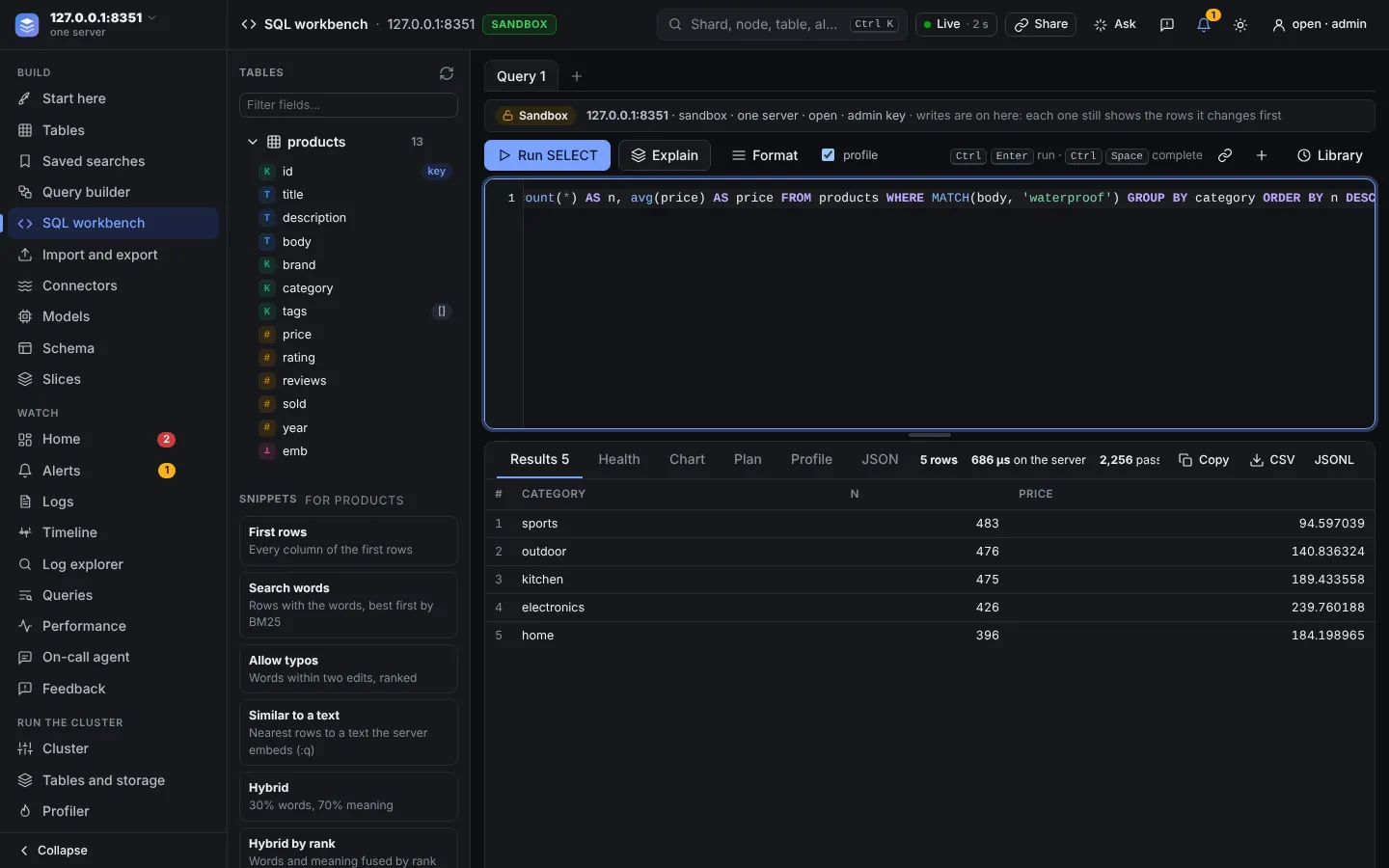
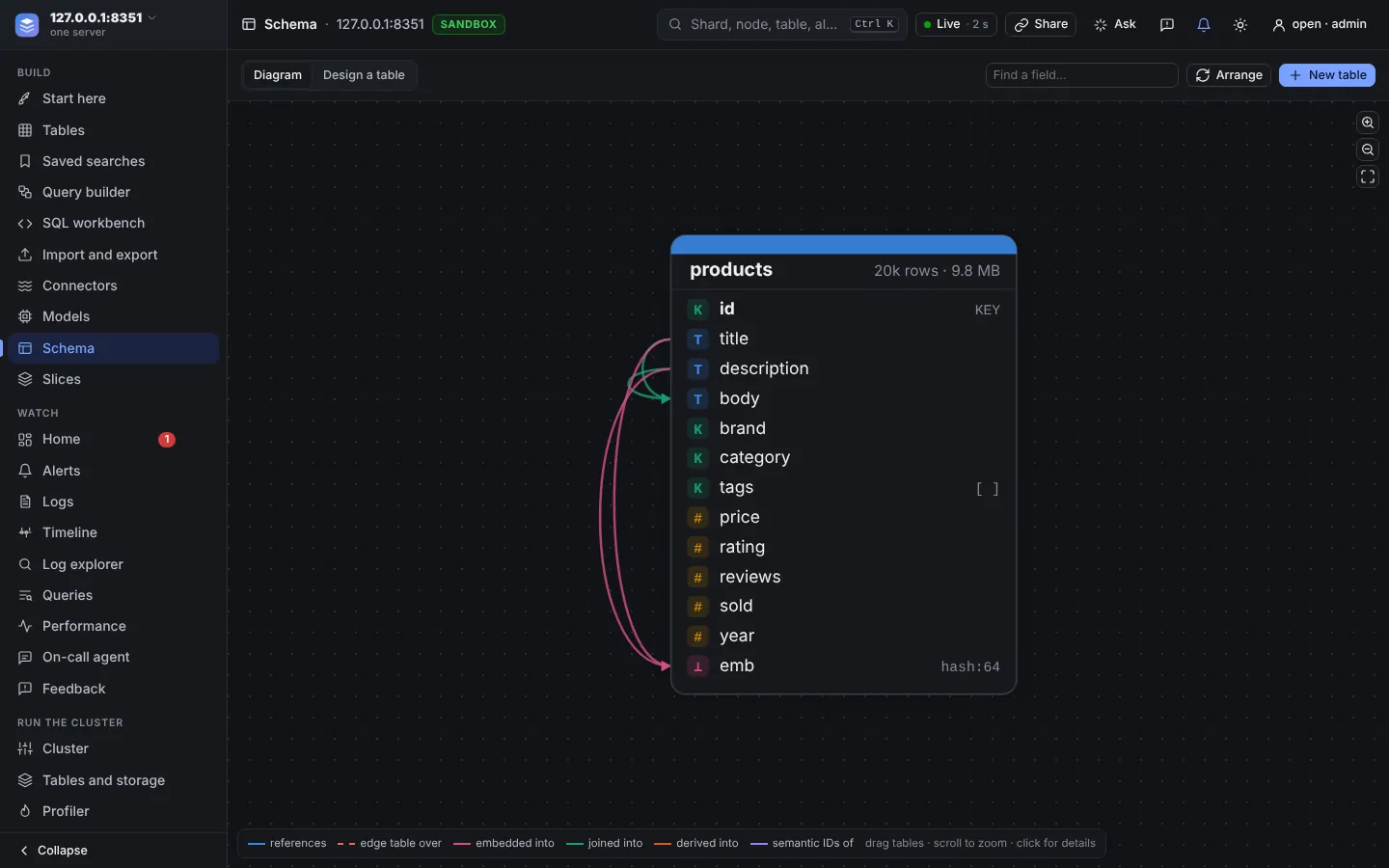
Labs
- Query builder builds a query as a flow of stages: drag blocks and fields onto Find (words, typos allowed, and meaning, fused by rank or by weights), Keep rows where (conditions by type, with a keyword's most common values to pick from), Boost (recency, closeness to a value, a number), Group and measure, Order and Show. The SQL is written as you build and runs as you build, and the links between stages count the rows each kept: the table's, those that pass the filters (counted with a
COUNT(*)of the sameWHERE, which the answer's header shows as "N match"), those scored and those shown. Group and measure groups a time by day, week (Monday weeks,date_trunc('week', t)) or month, in time order, and measures counts, distinct counts, sums, averages, the median (MEDIAN), minimums and maximums, of a number or of the hours from one time to another (date_diff('minute', a, b) / 60.0), and each group's share of the rows (COUNT(*)over a window'sSUM), of all of them or within each group of another field (each priority's share of its week). A keyword's condition is is one of, is none of (NOT IN) or is and is not one value; turning is one of with several picks into is not gives is none of of the same picks. The answer is a table or a chart, its series split by a column (a line for each priority), and Save as a view keeps the query, its chart and the builder's state as a team view, which opens in the builder again (#/builder?view=<id>). Changed: the count of rows that passed the filters, here, on a table's Search tab and in the workbench, was the executor'sfilter_docs, the rows of the segments it read before aLIMITstopped it, so it was below the rows that match; the header no longer shows it, and the workbench's plan calls it rows in materialised filters. "Edit as SQL" opens it in the workbench. AJSONfield's paths are listed under it as fields of their own (attrs.dims.w), each with the share of rows that hold it, to drop on any stage. - Relevance lab runs two rankings of a query side by side (BM25, typos allowed, vectors, rank fusion, a weighted hybrid, a boost, a rank profile, or any expression), with lines showing where each row moved. Grade rows 0 to 3 (kept in the browser), and each ranking gets its nDCG (with exponential gain, 2^g − 1, as the autopilot measures, or linear, g, as trec_eval and BEIR do), its share of good rows and its first good row; over every graded query, their means (the first good row as MRR@k) and the share of queries with a good row in the top k (trec_eval's success), and a bar per query shows which ranking won, with a paired randomization test of the difference, and a weighted hybrid's weight (or rank fusion's k) is tuned by trying each on half of the queries and measuring the best on the other half, with the same test. Import · export brings grades in from a TREC qrels file and its queries file (TREC's
qid 0 key gradeor BEIR'squery-id corpus-id score, withqid<TAB>textlines or BEIR'squeries.jsonl) or from a judgments table (relevance_judgments, as the autopilot reads it), and takes them out as qrels and queries files; a qrels file whose grades are only 0 and 1 (BEIR's) is read as binary, its 1 becoming good (2), so the good rows, the first good row and the queries with one count the relevant ones as trec_eval does (nDCG is the same either way). A vector field is offered only when a model embeds it, which the lab needs to embed the query. A ranking can be kept with its table as a rank profile. Grade with Claude grades the rows of both rankings not graded yet through/v1/judge; the measures then read your grades, Claude's or yours where you gave one, and the evaluation says how well your grades and Claude's agree (Cohen's linear-weighted kappa). - Blending keeps the blends of the server: each a card with its sources' share of the slate, its rules and its note, and a draft started from two queries. A blend opens on a canvas of its stack, the blend at the top and the blends stacked under it, each a card with its sources' share of the rows it places and its rules as chips, wired to its sources below, the wires as wide as each source's share. Pieces are dragged from the palette onto a card: a Query, a Blend (stacked under it, or on a query, which it then holds), a copy of another saved blend, a rule (a slot kept, a quota, spacing, a cap, diversity, near copies) or a head; a source dragged onto a card moves there, onto another source stacks a new blend on the two (named for both; a rule above that named either now names it through the new blend, as
via = 'node/source'), onto the bin removes it, and each card's menu does the same without a mouse. A click on a card selects it: its settings and its slate below are that node's; a source's swatch drags onto a slot, each source has its boost; each head's calibration, weight and what a source without it gets, with the utility written as a sum; the slots, dragged onto to keep one for a source; each quota as a range on a bar of the top rows, with where the slate is now; spacing, caps, diversity and near copies. Every change previews the draft against the server (POST /v1/blends/preview), with the query's parameters filled in above: each row's source, its utility as a bar of its heads' parts, how it got its slot and why, each quota's count, what each rule costs the slate, the rows passed over and what barred them, and the plan. Save as vn writes the next version with a note (an admin's), Versions lists them with what changed and opens an old one as a draft, and the SQL drawer shows theCREATE OR REPLACE BLENDit writes. Value on the log sets the draft against the serving version over the blend's exploring pages in a rank log (POST /v1/blends/:name/evaluate; the log, the table of clicks and its columns are picked at the top): each one's verdict and why, its value with its interval beside the logged blend's, SNIPS beside cascade doubly robust over the top slots, and slot by slot the value each slot adds with the searches behind it, paler where the log could not draw the page; Tune toward clicks tries blends near the draft on half the searches and shows the best on the other half, which opens in the editor. Without exploring pages it shows how to log them. - Recsys eval measures logged rankings against what users did next. It joins the rank log to an events table (pick its user, item, time and action columns), grades each served row by the actions within a window, and gives each variant its nDCG, hit rate, MRR and gain at k, with the lift of one over another and whether it is significant (Welch's test over requests). Interleaved requests count as a variant of their own, and a card says which of their two rankings the users preferred (team-draft credit and a sign test). Charts show the share of good rows by position, how well each logged feature alone tells good rows from the rest (its AUC), the measures over time and by a user segment; open a request for the user's history, the rows it served and their grades, and set a grade by hand. The settings download as training data (
POST /v1/rank_log/export) or copy ascurl. - Semantic IDs draws a table's codebook as a sunburst: the inner ring is one level of codes, the outer the next, each sized by its rows and coloured by a keyword field's commonest value (paler when mixed). Click a code to zoom into it, and a filter limits it to the rows that pass. The decoding columns are what
/v1/sid/nextanswers a generative recommender at each step, and each code lists its rows with their full codes and how many codes each level uses. - Autocomplete completes as you type from a table of queries and counts (
PREFIX, the most used first, then typos allowed withfuzzy), with the completion ghosted in the box (Tabtakes it). A timeline shows each keystroke's time on the server and round trip, and a benchmark measures the latency by prefix length, exact and with typos; a card says whether the table is clustered by its key (cluster_by), which lets anORDER BY ... LIMITread its best blocks first. - Understanding is what models make of each row and of each search, as two workflows, and where the understanding components are configured. Enrich rows adds fields that a model makes of a row's text when it is written. You pick the field the models read, then add steps: a language (
builtin:lang), main phrases, near duplicates, the names it mentions (dict:<table>.<field>), a classifier's class, a language model's text by a prompt, a vector for meaning, or a caption or transcript of a file. Each step is tried on sample rows before anything is added (/v1/derive/preview,llm(),embed()). The fields are added in oneALTER TABLE ... ADD COLUMN. Rows written before them are then filled in, 200 rows a write, by anUPDATEthat writes each row's source again so the writer makes the values (the server fills in vectors itself). A table of the fields made so far shows how many rows have each, their commonest values, and fills in the rest. Enrich queries reads a search in steps and adds what it reads to the request. Spelling (/v1/correct) changes the words, and a classifier's class, the language and the names it mentions become filters; the values the words name, synonyms, typo tolerance, expansion and a vector's similarity become options ofbm25andrrfthat the query runs itself. Context the caller knows (country = CL) adds filters too. The page shows the request as SQL with its parameters, runs it beside the words alone with the rows only it finds marked, and saves it as a search whose filters are parameters (NULLleaves one out). Inspect a row shows a row's text, its derived fields and classes, what each built-in model makes of it, and its chunks (chunks_of). Configure trains and drops classifiers (CREATE CLASSIFIER), edits the table's synonym list (CREATE SYNONYMS), and mines proposals for it (/v1/synonyms/mine). - Media search finds images (or sounds) by a description, by a file dropped on the page, or by a row (more like this), over a vector embedded from a
MEDIAfield, with the caption's words mixed in by a slider, a keyword field's values and the colours a model named as filters. Results are a grid of the files (GET /v1/media/<sha256>) with their rank and score; the map lays every row out by its vector's two main directions, the hits and the query among them. - Graph explorer draws rows as nodes and their links as edges (an edge table, an
EDGESfield, or a vector field's nearest rows), laid out by forces: drag a node to pin it, scroll to zoom. Search to add nodes, open one to add its neighbours (REACHABLE), rank the graph from it with personalized PageRank (ppr; PageRank eps is how far it walks, auto lowering it as the walk needs, and the ranking says when the walk stayed near the node), and shift-click another, or type its key, for the shortest path (PATH); colour and size follow fields, and each walk shows its SQL. - Query console is the earlier UI, below (
#/classic).
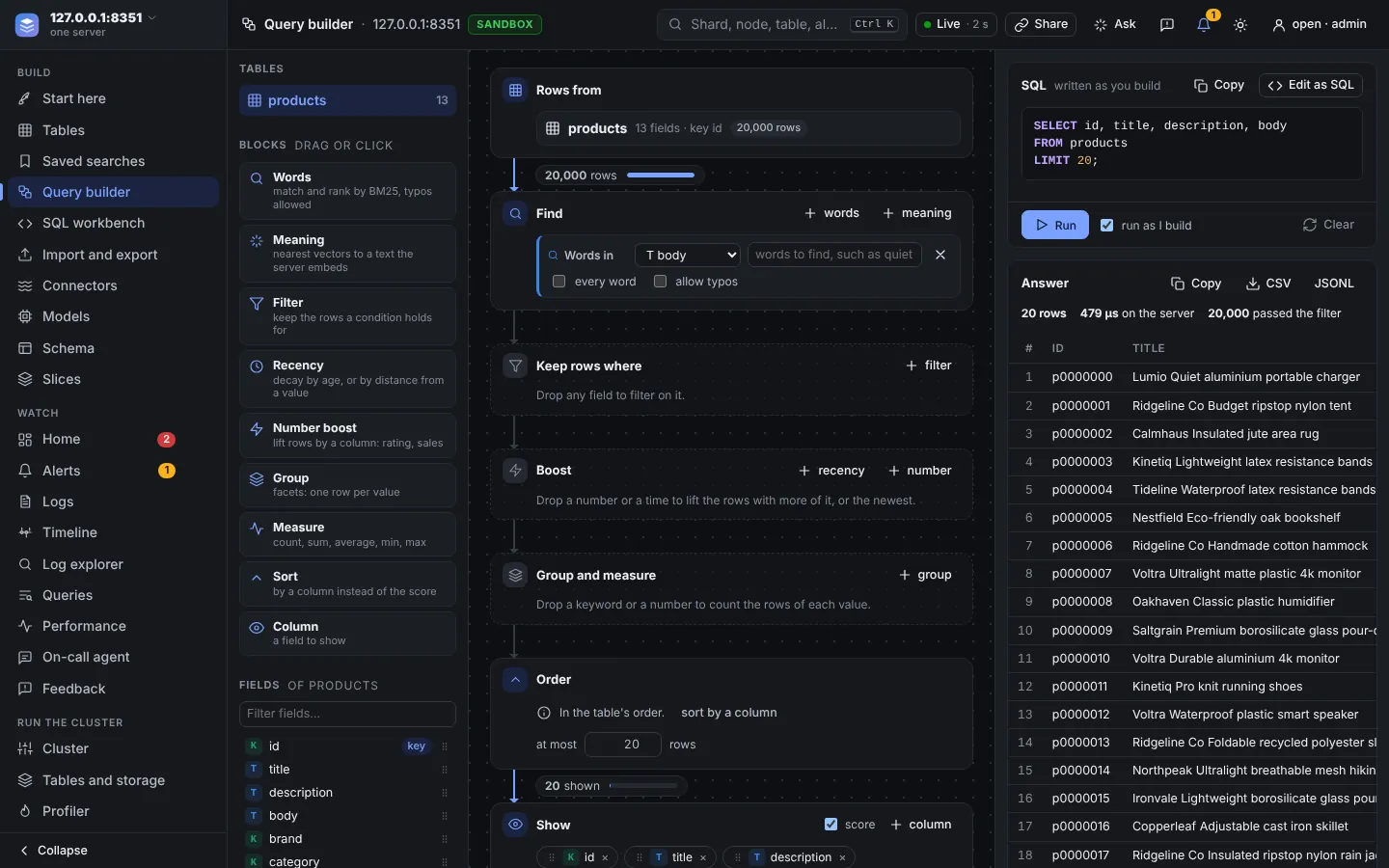
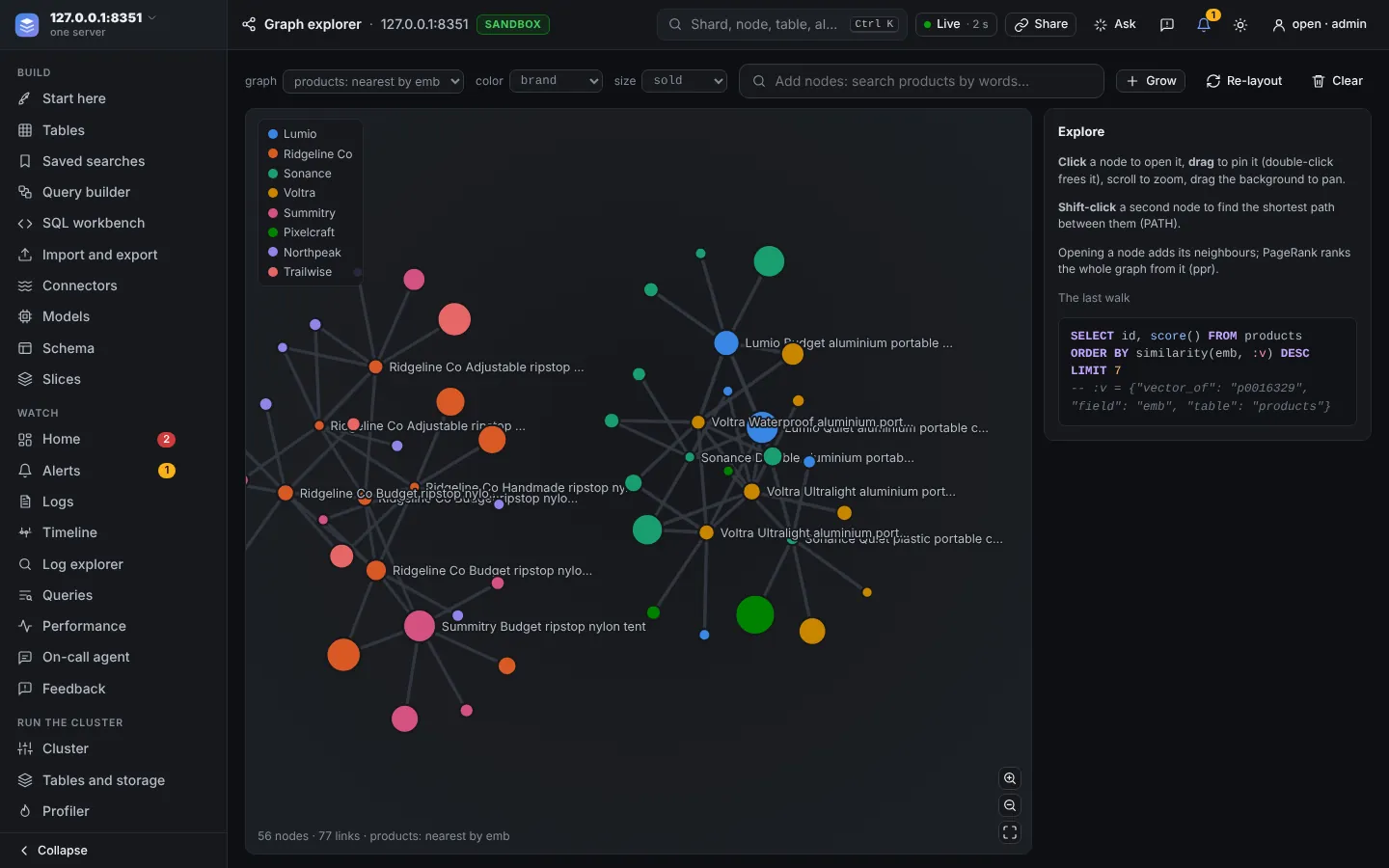
One time range applies to every view and is kept in the link: 15 minutes to 7 days, or a fixed window (past the last hour the series come from the log store's minutes). Views without a time axis (the SQL workbench, Schema, Labs) hide it. Share copies a link that opens the same view and window, paused; it never holds a key. When the API does not answer, the top bar says so and since when, and every panel says how old its data is. Ctrl K (⌘K) finds a shard, a copy (s9-2), a node, a table, a statement, an alert, a key or a view, and what to do about it; g then a letter goes to a view, and ? lists the shortcuts. On a phone the navigation is behind the menu button and panels open full screen. The page follows the system's light or dark theme unless you choose one.
The page and its modules (chloedb-server/ui/) are compiled into the binary. The page names them under /ui/v-<hash of them all>/, which the browser keeps for good, so a reload asks the server for the page alone; a new build's page names new paths. To work on them without rebuilding, start the server with CHLOEDB_UI_DIR=chloedb-server/ui: it then reads them from there on each request, and the page names them under /ui/ alone.
Feedback#
Any view sends feedback about itself: press f (or the speech bubble in the top bar, or "Send feedback" in the palette), and the view as it is becomes a picture to draw on, with boxes, arrows, a pen and text, each numbered, and black boxes over what must not be kept (a key, a customer's data). A note says what is wrong or what should change, and the item is a bug, a change, an idea or a question. It is sent with POST /v1/feedback (a write key) and kept as a row of the table cc_feedback, which the server makes the first time.
The picture is made in the browser, and nothing is sent anywhere but the server: From the page copies the page, puts its stylesheet beside it and draws the copy as an SVG image onto a canvas (no prompt; an app's frame shows as a box), and From the screen takes the tab with the browser's screen capture, which asks first and takes everything pixel for pixel. What is sent is one picture with the marks drawn on it, so a blacked-out part is not in what the server keeps. The marks go too: each with its number, tool, place on the picture in CSS pixels, what it says, and what was under it on the page (a CSS selector, its text, the card and the view's heading), which is what lets an agent find the code. So do the view and its address, the window's size and theme, the server's version, the sender's key name, and, if the sender agrees, the last errors of the page.
Feedback (#/feedback, g then f) lists the items, open ones first by priority (P0 now to P3 some day) or newest first, filtered by status, kind and words; each has its thumbnail, and opens with its screenshot, note, marks, the page's context and its triage: status (new, triaged, planned, doing, done, wontfix), priority, assignee and resolution. Copy for an agent copies a prompt that says what to change and how to mark it done.
| route | body | answer |
|---|---|---|
POST /v1/feedback |
{note, kind?, title?, page?, route?, url?, shot?, thumb?, shot_w?, shot_h?, marks?, context?}; shot and thumb are data: URLs of a PNG, JPEG or WebP image (6 MB and 256 KB at most); route is a route of the command center (#/ and a path), url an http or https address |
{id, ts}: write scope |
GET /v1/feedback?status=open&kind=&q=&assignee=&limit=100&thumbs=1 |
{feedback, counts, statuses, kinds, exists}, newest first, without the pictures (thumbs=1: with each thumbnail); status is open (new, triaged, planned, doing), all, or a list |
|
GET /v1/feedback/:id?shot=1 |
the item, its marks and context as JSON, shot_url; shot=1 adds the screenshot as a data: URL |
|
GET /v1/feedback/:id/shot, /thumb |
the picture, served inert as media files are | |
PATCH /v1/feedback/:id |
{status?, priority?, assignee?, resolution?, kind?, title?, if_status?} |
the item: write scope; if_status refuses with 409 when the status is another, so that two agents do not take one item (a server or coordinator triages one item at a time, so of two takers at once the second gets 409; two coordinators do not wait for each other) |
DELETE /v1/feedback/:id |
{deleted}: admin scope |
Agents read the same rows. With SQL, SELECT id, kind, priority, title, note, page, marks_text FROM cc_feedback WHERE status IN ('new', 'triaged', 'planned') ORDER BY priority, ts, where marks_text is the marks one a line (1. box "too small" on "Shards" (button.btn: Add shard)) and MATCH finds words of the note, the title and the marks. Over MCP, list_feedback, get_feedback (which answers the screenshot as an image the model sees) and update_feedback. An agent takes an item with {"status": "doing", "assignee": "<who>", "if_status": "new"} and closes it with {"status": "done", "resolution": "<the pull request>"}. A key limited to tables reaches these routes with a grant on cc_feedback: read to read, write to send and triage. A mark names what it points at by its label (a button's words, a field's label, a cell's column), never by a field's value or a cell's content, and names nothing that meets a blacked-out area: what is there stays in the picture, where the sender can black it out.
The index inspector#
GET /v1/index?table=T (admin scope) answers what the command center's Index inspector shows, for one table. On a server it is that server's (cluster, with shards empty); on a coordinator it asks every replica of every shard for its own, over the Profile call of gRPC with kind index (no change to the shard protocol: a server older than the coordinator answers that it has no such profile, and its replica shows that), and answers each replica's, each shard's and the whole cluster's:
{"role": "coordinator", "table": "products", "reads_on": true, "sample": 2000, "took_ms": 41.2,
 "cluster": {"stats": {...}, "freshness": {...}, "reads": {"docs": {...}, "keys": {...}}, "copies_bytes": 7340032},
 "shards": [{"shard": 0, "url": "...", "scope": {...},
             "replicas": [{"url": "...", "takes_writes": true, "behind": 0, "scope": {...}}, {"url": "...", "error": "..."}]}]}
A shard's statistics are its primary's (the first copy that answered, without one), and its reads its copies' added up; the cluster's are its shards' added up, with copies_bytes the bytes of every copy. behind is how many writes a copy is behind its shard's primary.
stats: documents live, deleted and in memory; bytes on disk and in memory, split into each field's index (by section), the doc store (compressed, andstore_rawbefore compression), the primary key and other sections, and segment overhead; each segment's documents and bytes; and per field its kind, how many documents have a value (present), the size of its values (size: a histogram of buckets[lo, hi, documents], four to an octave, withmean,p50,p90,p99), the items of a list, tokens per document of a text field, its share of the doc store, its distinct terms (terms:lowandhighbounds over the segments and anestimate), and the range of a number or a timestamp.doc_bytesis the same histogram for whole stored documents.freshness: when the table was last written (last_write_ms) and how many writes it took since the server started, and when the database's file last changed.reads: of documents retrieved (rows returned in query answers) and of keys asked for (GET /v1/kv,POST /v1/kv/get,Getover gRPC): the total, the distinct keys read, the share of the table read at least once (coverage), how often each was read (per_key), the concentration curve (curve: the share of reads taken by the most read fraction of the keys read, withtop1andtop10), the most read keys (top, each with its count, the most it may be too high,err, and its share), and, for keys, those no row has (missing).
GET /v1/index/tables lists every table at once: its documents, bytes and segments by shard (bytes are one copy's, each shard's primary), on a coordinator its bytes on every copy (copies_bytes, the sum of what each copy of each shard says it holds, with copies_measured and copies_missing, the copies that did not answer and are left out; also per shard), skew (the shard furthest over the mean, and by how much), writes and reads a minute, last_write_ms, the copies behind (stale), and its growth over a day and a week from the log store's hourly tables rows; totals adds the tables up (tables, failed, docs, bytes, segments, and on a coordinator copies_bytes and incomplete, the tables a copy did not answer for). It samples no document and is kept 30 s; the command center's Tables and storage reads it. Writes and reads a minute are measured against a look the server keeps every minute, so they are there on a first look once the server is 30 s old: over the last 5 minutes at most (rate_window_s), and for each shard (shards[i].writes_per_min, reads_per_min). The drill-down (GET /v1/index) measures over the same window (rates).
What is exact and what is estimated: documents, bytes, segments and index sizes are read from every segment; distinct terms too, but those of a large field are estimated with a HyperLogLog sketch, which also merges across shards. Value sizes, fill and document sizes come from sample documents (2,000 by default, at most 100,000) drawn at random from each server with seed, weighted to its whole table; the fill of a field that is not stored, and tokens per document, come from every document's length norm instead (exact below 24 tokens, rounded down by at most 12.5% above). terms=false skips the term sketches.
Reads are counted in memory, since the server started or since POST /v1/index/reads/reset, and are approximate: each table keeps its 256 most read keys (Space-Saving: a count is at most its err too high), and a hash sample of the keys read that halves itself to stay under 4,096 entries gives the distinct keys, the coverage and the frequencies (exact while it holds every key). The first 10,000 rows of an answer are counted by key and the rest in the totals (skipped). A coordinator counts what each replica served through it (by the shard and replica each row came from), and every server counts what it answers its own clients; a shard does not count the coordinator's questions, so nothing is counted twice. Profiling runs and the parts of a compound query are not counted. --no-read-stats turns counting off.
The query console#
GET /classic, and the command center's Query console, serve the query console, a single page with six tabs.
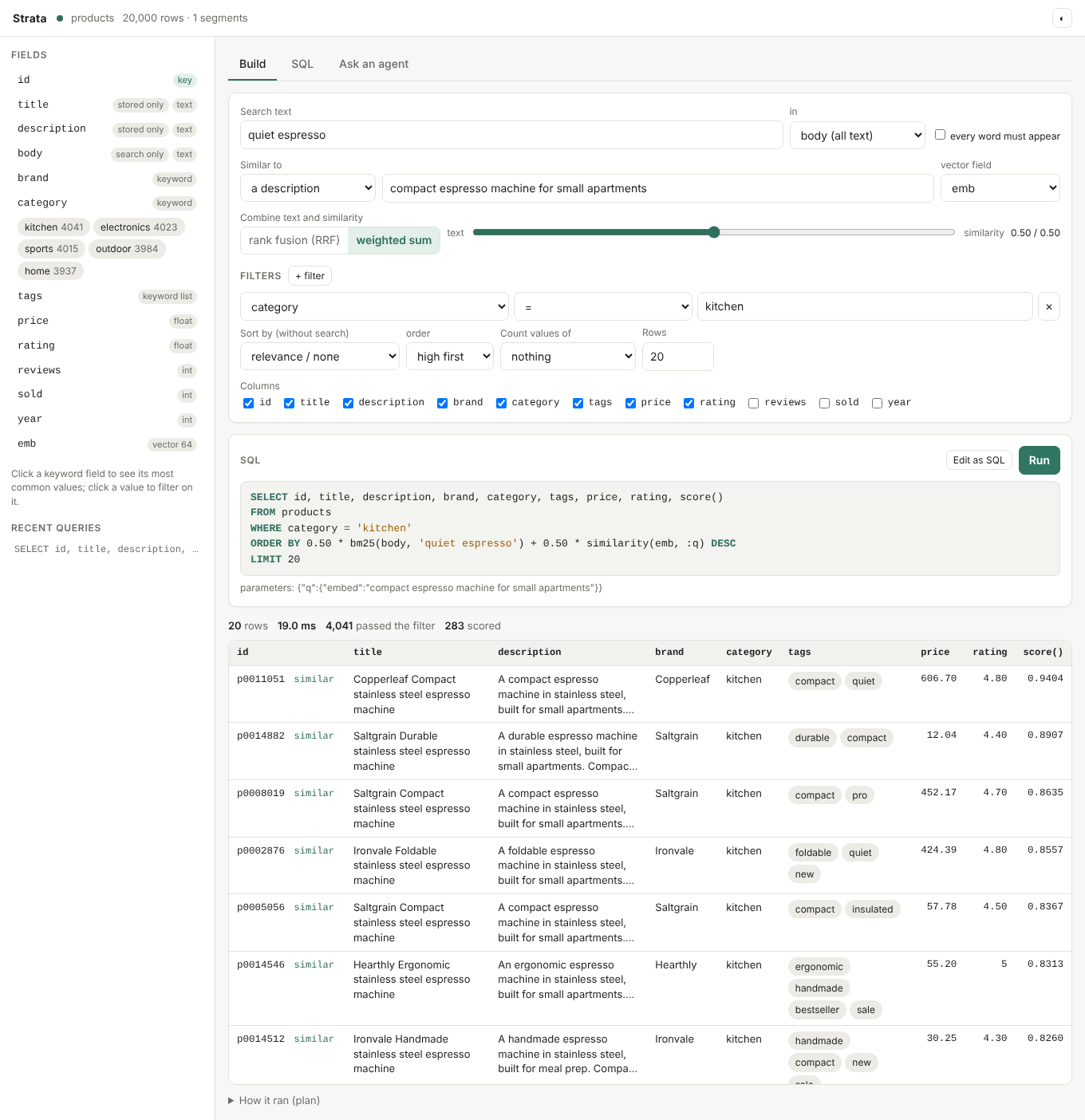
- Build writes SQL from a form: search text (ranked, or only matching rows, with typo tolerance and synonyms), "similar to" a stored row or a description, rank fusion or a weighted sum with a slider, conditions, a boost by closeness (
decay), a facet, the columns and the row count. Conditions nest in groups of all of (AND), any of (OR) and none of (NOT), and a condition can be "is among the field of the rows where …", anIN (SELECT ...)subquery. Join related rows pairs each row with the rows it links to, the rows linking to it (for eachEDGESfield) or the rows sharing a value, with conditions and columns for the related rows; Summarize groups by any fields of either side and computes counts, distinct counts, sums, averages, minimums and maximums, withHAVINGand an order. The SQL updates as you type; "Edit as SQL" takes it to the editor. Clicking a keyword field in the sidebar shows its most common values, and clicking a value adds a condition. Each result row has a "similar" link that searches for rows like it, and a "links" link that opens its neighbourhood in the Graph tab. A search that finds nothing offers to search again allowing typos, or with synonyms. - Graph (for a table with an
EDGESorVECTORfield) starts from keys, the top rows of a search or the rows matching a condition, follows links (out, in or both ways, optionally one label) or similarity (each row's k nearest), and finds the rows within some hops, the shortest path to other rows, or the rows ranked by personalized PageRank, with conditions on the rows found. The answer is a table and a picture: rings by hop distance, a path left to right, or PageRank as node size. Clicking a node shows its row, expands its links or starts a new walk from it. - SQL is an editor with parameters, results and the plan the executor recorded, segment by segment, with example queries one click away. It only reads (it sends
POST /v1/query, which takes only aSELECT): a write or a schema change opens in the SQL workbench, which checks it first. - Ask an agent takes a question in plain language.
- Schema and import uploads a JSON Lines, JSON, CSV or TSV file (or pasted rows) into the table, showing the upload's progress and the columns it skipped. It shows the table's schema in the short form, and designs new ones: fields by type with their options, vector fields embedding chosen text fields by a named model, a first draft guessed from a file's first rows (numbers, lists, vectors, short values as keywords and longer ones as text, a unique
id-like column as the key), JSON that edits both ways, a check against the server, a download, and the commands that create and fill a database with it. - Query language is a guide to the SQL with examples written against the table's own fields and words from its rows: boolean, phrase, prefix, typo and synonym searches, conditions, aggregates and
HAVING, subqueries andWITH, joins, graph queries, hybrid ranking and boosts, and what is not supported. "Try it" runs an example in the SQL tab. It also edits the server's synonym list.
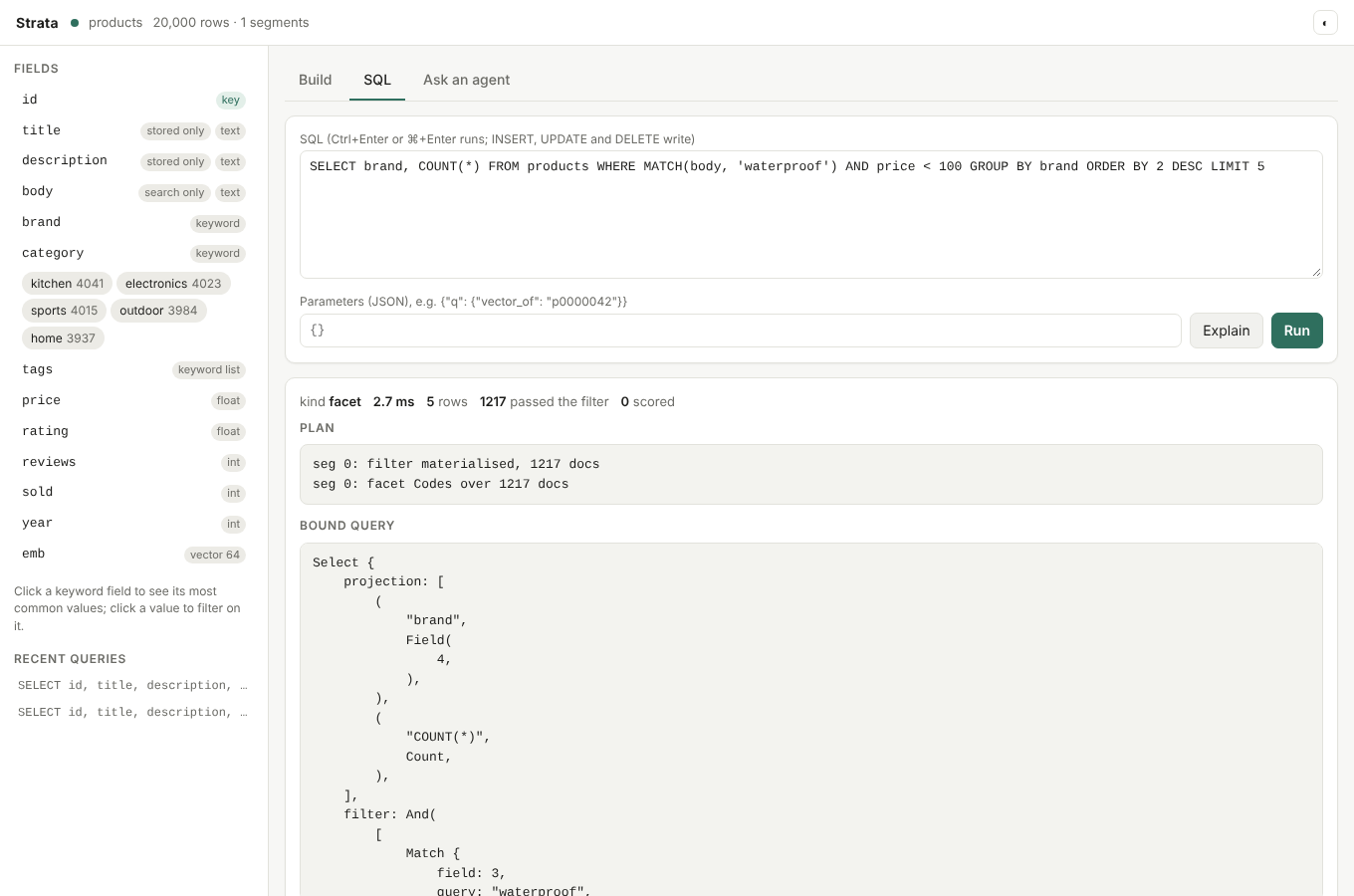
In a terminal#
chloedb-server cc [URL] is the command center in a terminal, for an SSH session or a machine without a browser. since 0.3.5 It reads the routes the command center reads (/v1/cluster, /v1/health/fleet, /v1/alerts, /v1/queries/stats, /v1/queries, /v1/logs, /v1/index/tables, /v1/events), every 2 seconds (--every), and sends its changes to the same routes with the same key, so a key may do there what it may do in the browser, and the audit log keeps each change with its reason and x-chloedb-app: chloedb-cc. Nothing new runs on the server.
CHLOEDB_KEY=sk_… chloedb-server cc https://db.example.com:7700
chloedb-server cc                                 # http://127.0.0.1:7700; it asks for the key
chloedb-server cc https://hub.local:7700/c/prod   # a cluster in a hub's book, with the hub's key
The key comes from CHLOEDB_KEY (or CHLOEDB_TOKEN), else from a prompt that does not show it; there is no flag for it, so it is never in the shell's history or the list of processes. --ca FILE trusts a CA for an https URL. The screens need 80 columns by 24 rows, and NO_COLOR draws them without colour. Without a terminal it exits, naming chloedb-server admin for scripts.
| key | screen | what it shows |
|---|---|---|
1, g h |
Home | the fleet's health: its headline, the copies that answer, p99 against the SLO, errors, replication lag, the fullest disk, the alerts firing, and each problem with what to do next |
2, g c |
Cluster | a map of the shards, or of the nodes (G), each tile coloured by the lens L picks (health, p99, CPU, disk, errors, lag, version); beside it the shard picked, each copy's role, node, lag, p99 and CPU, and why the shard is in its state |
3, g a |
Alerts | every rule, firing first; a acknowledges one, s silences it for the minutes typed with a reason, u lifts the silence |
4, g q |
Queries | the queries running now (x cancels one) and the statements of the last 15 minutes, by their share of the time, p99, calls or errors (o) |
5, g l |
Logs | the server's own newest lines, followed as they come; f sets the level and / the text they hold. They are an admin's (or an ops or propose key's): for another key, the screen says so and lists the log tables the key reads (those with a TIMESTAMP), and Enter shows one's newest lines in SQL |
6, g o |
Tables | each table's rows, size, segments, reads and writes a minute, skew and last write, and the one picked shard by shard |
7, g w |
SQL | a statement run as the key, its rows as a grid, ↑ ↓ its history |
8, g t |
Timeline | the events, newest first: changes, alerts, primaries and failures |
The g letters are the browser's. Space pauses the reading, r reads at once, : takes a command (a screen's name, lens p99, ctx, writes, sql SELECT …, q), and ? lists the keys.
Changes ask first, in a dialog that says what the change does, and on production (an environment that names no test or sandbox, or none on a server that is not this machine's or is reached through a hub, as the browser decides) for a reason the audit log keeps; Enter does nothing until it is given. On Cluster, p makes the copy picked its shard's primary, by its copies' votes (POST /v1/admin/shards/{i}/promote), refused for what the browser refuses it: it is the primary, does not answer, is being copied or is behind, or the shard has one copy, or the key is not admin. While a plan runs on the coordinator, a band names its step and S stops it after that step; it goes on when the terminal closes. On SQL, as in the SQL workbench, production is read-only until W allows writes for 15 minutes with a reason, which goes with each write; each write asks first, and an UPDATE or DELETE without WHERE, a DROP or a TRUNCATE needs its table's name typed. Draft and its plans (copies and shards added, moved and removed), the schema, the query builder, keys and the audit log, the profiler, rollouts, the cloud views and the apps stay in the browser.
Through a hub, the URL is the connection's, https://hub:7700/c/<name>, and the key is the hub's (an admin key of the hub): each call goes through the hub, which adds that cluster's key, so the terminal never holds it (many clusters from one command center). :ctx lists the hub's book and opens another of its clusters, and :ctx - the hub itself. A hub on another machine that listens on its loopback is reached through a tunnel: ssh -L 7700:127.0.0.1:7700 host, then chloedb-server cc http://127.0.0.1:7700/c/<name>.
Apps#
An app is a program of its own that the command center shows as a view: the crawler, the spreadsheets, network operations, ChloeCtx and the app engine are four. --app name=url (repeatable, or CHLOEDB_APPS=a=url,b=url) names each, and the server reaches it there; browsers never do, so the app needs no address of theirs and no keys (the app engine's studio is the exception: it runs code a model wrote, so it keeps an address of its own and signs browsers in with a link its view hands out). On Kubernetes, spec.crawler, spec.sheets, spec.chloectx and spec.apps of a StrataCluster have the operator run them beside the cluster and set this on its coordinators, and give each app a key limited to its tables and a token of its own (below) (the crawler on Kubernetes, the spreadsheets on Kubernetes, ChloeCtx on Kubernetes, the app engine on a cluster):
GET /v1/appslists the apps (read scope), each with its manifest, the app'sGET /app.json:title,description,icon_svg(the shapes of a 24-unit outline icon; only shapes and their geometry are drawn),version, andview, the path of its view module, as/v1/apps/<name>/<view>. An app that does not answer is listed withup: falseand why. Manifests are read again after 15 seconds./v1/apps/<name>/<path>is sent on to the app's<path>, with its query, body,content-type,accept,if-none-matchandif-modified-since, and the app's token asAuthorization: Bearerin place of the caller's key: its own, from the file of its name in--app-token-dir(CHLOEDB_APP_TOKEN_DIR, read as it is sent) or fromCHLOEDB_APP_TOKEN_<NAME>(its name in capitals,-as_), else the server'sCHLOEDB_APP_TOKEN. Give each app a token of its own, so that one app cannot call another as the server. The caller's key is checked first, read scope forGETandHEADand admin scope for the rest; a key limited to tables only reaches an app whoseapp.jsonsays"limited_keys": true(it holds such keys to their grants itself), with any grant that reads. The app is told who it was in headers the server sets (a caller's own of those names are not passed on):x-chloedb-principal(the key's name,tokenoropen),x-chloedb-key(its id),x-chloedb-scope, andx-chloedb-tablesfor a key limited to tables (crawl_*=admin,*=read). An app may trust them because they come with its token. The answer comes back with itscontent-type,content-disposition,etag,last-modifiedandx-app-*headers, andcache-control: no-cache: a browser asks again each time, and an app that tags its answers (its view, say) answers304with no body to one that holds it since 0.3.4. A request's body may be as large as an import's (--max-body-mb, 256 MiB), an answer is at most 32 MB, in at most 120 s, and an app that does not answer is a 502.
On Kubernetes no app holds the cluster's admin token once its coordinators make keys limited to tables (/v1/whoami's auth.app_keys): the operator keeps a Secret per app, <cluster>-<app>-credentials, with key, a key of the cluster limited to the app's tables (named <app>-app, made through the coordinators and made again when the tables change), and token, random, which the app's own API requires and the coordinators send it (their STRATA_APP_TOKEN_DIR, the Secrets mounted as a folder of files, so no restart is needed when one is made). spec.<app>.tables names the tables (table=scope, as above); by default network operations get netops_*=admin, the spreadsheets get sheets_*=admin, *=read (the cluster's tables open in them as sheets, read only), ChloeCtx ctx_*=admin, chloectx_memory=read, chloectx_mem_*=read (each project chloectx sync copies has a table of its own, chloectx_mem_<project>; its Seen before asks the on-call agent, which is the server's admin, and goes without), the app engine sa_*=admin, app_*=admin (from which it makes each of its apps a key of its own, apps-app/app-<id>, limited to app_<id>_*), and the crawler *=admin (a crawl fills the table it names). The crawler that grows the cluster (crawler.grow, the default) keeps the admin token as its key, since adding shards is the server's admin; its token is its own. Until an app's Secret is made, and with coordinators from before such keys, the app runs with the admin token, as it did before. An app taken out of the spec loses its key and its Secret. When an app's key is made again (its tables changed, or its Secret lost the key), the new key is made before the old one is revoked, and the key's id is on the app's pod template (strata.chloetech.ai/key-id), so its pod restarts with the new key rather than calling with a revoked one. When making the new key fails (a timeout, an error of the coordinators, coordinators rolling), the Secret keeps the key it has, with its id and tables, so the pod neither restarts nor gets the admin token, and the next reconcile tries again; an app with no key yet then gets no key at all (the Secret is marked strata.chloetech.ai/key-pending) until one is made. Only coordinators from before keys limited to tables give an app the admin token. The operator writes these Secrets only where the ClusterRole strata-operator-secrets is bound: operator.yaml (and the cloud view's install) binds it in the namespace strata; for clusters in another namespace, bind it there (kubectl -n NS create rolebinding strata-operator-secrets --clusterrole=strata-operator-secrets --serviceaccount=strata-system:strata-operator), or that cluster's apps keep the admin token. Its ClusterRole, bound everywhere, only reads Secrets (each cluster's tokenSecret).
Apps the server starts#
A server of its own, or a coordinator, starts the crawler (chloedb-crawl serve), Sheets (chloedb-sheets serve) and ChloeCtx (chloectx app) itself when their programs are installed in its own directory, as an install puts them (a build's target/ has none of them, so tests and cargo run start nothing). Each is a child process that listens on a loopback port of its own and is listed under its name, as if it had been given with --app:
- the server binds that port itself and holds it while it runs, and hands the listening socket to the app as file descriptor 3 (
CHLOEDB_LISTEN_FD=3) at each start, so no other process can take the port while the app starts or restarts; - it takes requests only with a token the server makes for it at each start, which no one else holds;
- it calls the server back with a key of its own, scoped to the tables it keeps (the crawler
crawl_*, Sheetssheets_*and reads of the rest, ChloeCtxctx_*and reads ofchloectx_memory), made at each start, held in memory only and never in the keys file; it is never given the server's token, cluster token or keys: its environment is the server's with every credential taken out (thePATH, the home, the locale, proxies, CA files,ANTHROPIC_API_KEYand the crawler'sCHLOEDB_CRAWL_CONTACTandCHLOEDB_CRAWL_ALLOW_PRIVATEstay); - it runs in a process group of its own and, on Linux, ends when the server ends; when it exits it is started again after a second, then up to a minute between tries; when the server stops it gets SIGTERM, and SIGKILL 10 s later;
- its output goes to the server's log, each line under
app=<name>, andGET /v1/appslists itsprocess:program,pid,running,restarts,last_exitand its last 40 lines, which the command center shows when the app does not answer.
The crawler a server starts does not grow the cluster (--grow off), and names the tables it fills crawl_<host>. A replica, a shard (a server with a cluster token and no --shards or --replicas), a shard with its coordinator beside it, a pod the Kubernetes operator runs (which runs the apps as Deployments of their own) and a server over TLS start none; --start-apps off turns it off anywhere, and an --app of the same name takes the app's place. The servers chloedb-crawl --local and chloedb-sheets serve --local start are given CHLOEDB_START_APPS=off, since those programs are their apps.
The navigation lists the apps under Apps, each at #/app/<name>. Its view module is JavaScript the command center loads through the server (with the signed-in key) and runs with its own helpers: the module's default export's render(el, ctx) draws into el and may return a function that stops it, and ctx holds core, charts and data (the command center's modules), app (its listing), api(path, opts) (the app's API through the server), path(), href(...) and onPath(f) for the view's own paths under #/app/<name>/. An app's view is trusted as the server's own pages are: an admin names the app on the server's command line.
The agent#
POST /v1/agent, and the query console's Ask an agent tab, give a Claude model one tool, run_sql, which runs a read-only SELECT on the table. The model sees the schema and a description of ChloeDB's SQL (it runs facet queries to learn a field's values), then searches, filters, ranks, counts and facets until it can answer, for at most max_steps model calls (8 by default, 20 at most). The answer lists every query it ran, with its row count and time, so you can check its work or open a query in the editor. Writes are refused.
The model is a setting: --model sets the server's default (claude-haiku-5-5), and a request or the UI can name any other model id and an effort level. The API key comes from ANTHROPIC_API_KEY on the server, or from the request (api_key, never stored by the server; the UI keeps it in the browser only if you tick "remember"). On Kubernetes, a StrataCluster's secretEnv gives it to every server and coordinator from a Secret (model keys).
Relevance judgments#
POST /v1/judge grades rows of a table against a query, 0 to 3, the scale of TREC's judgments and of the relevance lab's grades, with UMBRELA's prompt (Upadhyay et al., 2024: the open reproduction of the prompt with which Thomas et al., SIGIR 2024, found an LLM agreeing with Bing's searchers as well as its human labellers did, and the one TREC 2024's RAG track judged with). Each row is its own request, so a grade does not depend on the other rows or their order; the passage is the row's stored TEXT fields (or the fields named), each on a line after its name and cut at 4,000 characters. Up to 200 rows a request, eight at a time; an answer without a grade is asked once more for one, and a row still without one, or not in the table, gets grade: null and an error. The model and key are the agent's.
curl -s localhost:7700/v1/judge -H 'content-type: application/json' -d '{"query": "mrna vaccine side effects", "keys": ["d17", "d3", "d240"]}'
# {"grades": [{"key": "d17", "grade": 3}, {"key": "d3", "grade": 1}, {"key": "d240", "grade": 0}],
#  "model": "claude-haiku-5-5", "prompt": "umbrela", "fields": ["title", "body"], "usage": {"input_tokens": 2310, "output_tokens": 21}, "took_ms": 1840.2}
On 25 TREC-COVID queries, pooling the top 10 of BM25 and of dense retrieval (464 rows), claude-haiku-5-5's grades agreed with TREC's on "relevant" for 84% of the rows TREC judged (Cohen's kappa 0.57), were the more lenient (27% of the rows TREC judged not relevant got 2 or 3), and named the same winner of the two rankings on 21 of the 24 queries TREC's judgments decide; they reproduce the size of a gap less well (Kendall's tau 0.32 between the per-query differences). They are a good stand-in for telling which ranking is better on queries nobody has judged, and a weaker one for absolute nDCG. The study (chloedb-server/results/judge/) sent the prompts through Claude Code, where the model thinks before most answers; the endpoint asks without thinking.
The on-call agent#
Experimental. The on-call agent (
/v1/admin/oncall/*) has no compatibility promise yet: its routes, settings and what it stores may change in any release, with no upgrade path promised. Its answers carryx-chloedb-experimental, andGET /v1/catalogmarks its routes (compatibility).
POST /v1/admin/oncall (admin) has a Claude model look into a firing alert ({"alert": "<rule>"}) or a question about the cluster ({"question": "why did p99 double at 14:05?"}) the way an operator would, and report what it found and what it would do. It has the read-only views of this page as tools: health (fleet for every coordinator's), the cluster's shards and copies, each copy's load, the host, the alerts and one rule's events, the events timeline, the running, slow and recent queries and the statistics by statement, this server's log lines, the metrics series and the contain rules. Each tool call is a request to the server's own route with the caller's key, through the same checks and audit as any other, named oncall in the query log (x-chloedb-app), and the model sees at most 12,000 characters of each answer.
It changes nothing. What it would do is a proposal: a contain rule (limit or refuse a statement or a key for a while), removing one, cancelling a running query, or silencing an alert. Each is kept for an admin to approve or reject, and can be approved for an hour; after that it is expired, so an action seen fit then is not applied to a cluster that has moved on. Approving one makes its request with the approver's key and the proposal's reason (x-chloedb-reason: on-call proposal p3: <why>), so the audit log and the contain rule name the admin who approved it.
curl -s localhost:7700/v1/admin/oncall -H "authorization: Bearer $ADMIN_KEY" -H 'content-type: application/json' -d '{"alert": "p99_high", "note": true}'
# {"run": "oc1762557300112", "answer": "Summary: one statement holds every core ...\nProposed actions: p1 ...",
#  "proposals": [{"id": "p1", "action": "contain", "what": "limit statement 9f3c... to 2 at once for 15 min", "why": "...", "state": "pending", ...}],
#  "steps": [{"tool": "alerts", "input": {"rule": "p99_high"}, "ok": true, "took_ms": 1.9}, ...], "usage": {...}}
curl -s localhost:7700/v1/admin/oncall/proposals?state=pending -H "authorization: Bearer $ADMIN_KEY"
curl -s -X POST localhost:7700/v1/admin/oncall/proposals/p1/approve -H "authorization: Bearer $ADMIN_KEY"
curl -s -X POST localhost:7700/v1/admin/oncall/proposals/p1/reject -H "authorization: Bearer $ADMIN_KEY" -H 'content-type: application/json' -d '{"reason": "a deploy is rolling back"}'
The report comes as a summary, the evidence (what each tool showed), the likely cause and how sure the model is, the proposals, and what to watch. note: true also writes it as a note on the events timeline. A run takes at most max_steps model calls (12 by default, 30 at most); the model, effort and key are the agent's. Approval is a person's, with an admin key: an approval by an agent is refused (agents and administration).
A run goes on in the server whether or not its caller waits: "wait": false answers {"run": "oc...", "state": "running"} at once, and GET /v1/admin/oncall/runs/<id> shows it as it goes, with each tool call (what it asked, how long it took, and the first 4,000 characters of what the route answered), what the model wrote between them, and then its report and proposals. POST /v1/admin/oncall/runs/<id>/stop stops it before its next model call. {"question": "...", "follows": "<id>"} asks a follow-up in the same conversation, so the model remembers what it looked at. GET /v1/admin/oncall says whether the server has a Claude key and lists the runs kept, newest first. The server keeps the latest 50 runs and 200 proposals beside its audit log (<audit>.oncall.json, or the file CHLOEDB_ONCALL_STATE names), so a restart loses neither; a run under way when it stopped is marked failed.
In the command center#
On-call agent (under Operate, g n, an admin's) is the agent's page. Pick a firing alert and click Investigate, or ask a question (a few common ones are one click away); the options set the model, the effort, the model calls at most and whether the report goes on the timeline, and take a Claude key for the tab when the server has none (sent with each run, never kept). Each step shows as the agent takes it, with what it read in words, and a click opens what the route answered and a link to the view that shows the same. The report comes in its sections, each proposal as a card with what it does, why, the exact request it makes, and how long it can still be approved: Approve shows all that again before it applies it with your key, Reject takes a reason. Ask a follow-up under the report. The side lists the proposals waiting for an admin (the navigation counts them) and the investigations kept, with their follow-ups; Copy gives a conversation as Markdown, and the download as JSON. An alert's page has an Investigate button that starts a run on it.
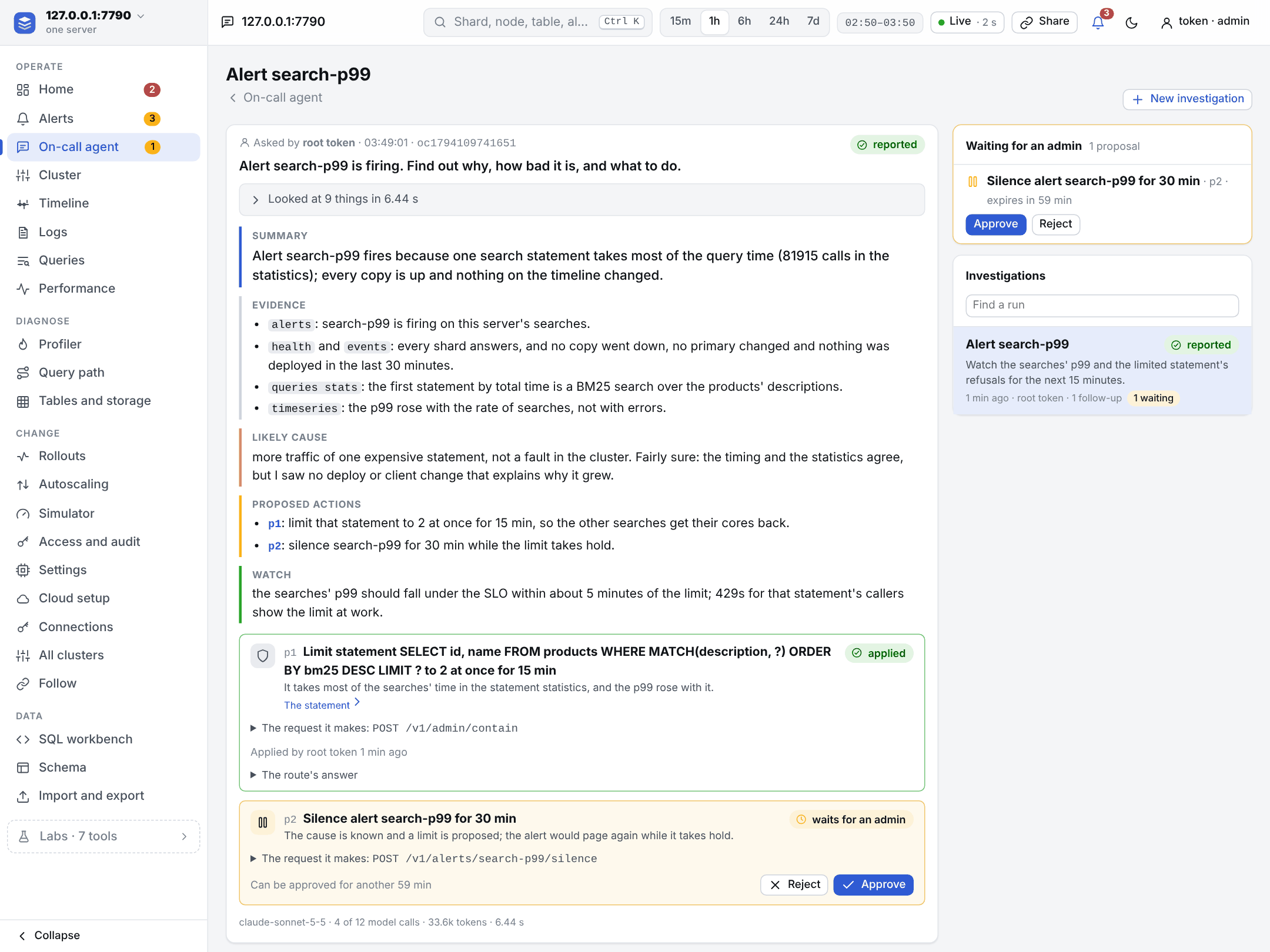
Agents over MCP#
An agent such as Claude Code, Claude Desktop or any client of the Model Context Protocol drives ChloeDB through tools: it lists the tables, reads their CREATE TABLE statements, checks a statement before it runs it, queries, writes, and looks up the syntax it needs in this documentation, which the server carries. POST /v1/mcp speaks the protocol's Streamable HTTP transport (versions 2025-06-18, 2025-03-26 and 2024-11-05), answering each message with JSON; chloedb-server mcp speaks it over stdin and stdout, for a client that starts its servers as commands, and sends each message to a server's /v1/mcp.
# Claude Code, over HTTP:
claude mcp add --transport http chloedb http://127.0.0.1:7700/v1/mcp --header "Authorization: Bearer $CHLOEDB_KEY"
# or over stdio (the key from the environment, never on the command line):
claude mcp add chloedb --env CHLOEDB_KEY=$CHLOEDB_KEY -- chloedb-server mcp --url http://127.0.0.1:7700
| tool | does | route |
|---|---|---|
list_tables |
every table's CREATE TABLE, primary and shard keys, rank profiles, models |
GET /v1/tables |
describe_table |
one table's schema in full | GET /v1/schema |
query |
one SELECT: its columns and at most max_rows rows (100 by default, 2,000 at most), saying when it cut them |
POST /v1/query |
explain |
how a SELECT runs, and with hits the top rows' scores and features |
POST /v1/explain |
check_sql |
binds a statement against the tables without running it: what it would do, or why it is refused | none: bound in the server |
execute |
INSERT, UPDATE, DELETE, CREATE, ALTER, DROP, rank profiles |
POST /v1/sql |
write |
rows as JSON operations, in one transaction | POST /v1/write |
import |
many rows at once into a table: CSV, TSV or JSON lines as text (data), or objects (rows); create: true makes the table from the rows first (admin key); answers how many it wrote and the columns it skipped |
POST /v1/import |
get_rows |
rows by primary key | POST /v1/kv/get |
json_paths |
the keys a JSON field holds, with counts, types and common values |
GET /v1/tables/<t>/paths |
list_models |
the embedding models a VECTOR field may name |
GET /v1/models |
judge |
grades rows 0 to 3 for a query, by a Claude model (relevance judgments) | POST /v1/judge |
search_docs |
sections of the query language and Build an app that match some words | none: the documents are compiled in |
list_feedback |
what people asked of the command center, with each item's marks as text (feedback) | GET /v1/feedback |
get_feedback |
one feedback item in full, and its screenshot as an image | GET /v1/feedback/<id>?shot=1 |
update_feedback |
an item's status, priority, assignee or resolution; if_status takes it only if no one did first |
PATCH /v1/feedback/<id> |
whoami |
the key's name and scope | GET /v1/whoami |
A tool's call is a request to the route in its last column, made inside the server with the caller's Authorization header, so it passes every check that route makes: the key's scope decides what an agent may change (a read key's execute of an INSERT answers the 403 that /v1/sql does, as the tool's error, which the model reads), contain rules apply, the audit log names the key, and the latest queries name the client's app as mcp (or mcp-stdio). Give an agent a read key to explore, a write key to load rows, and an admin key only to make tables. A failed call answers its route's status and error (403: ...), so a model can fix its statement and try again; an argument a tool does not take is the protocol's error (-32602). An answer longer than 200,000 characters is cut, saying so.
The server also offers the query language reference and the Build an app guide as resources (strata://docs/query-language, strata://docs/build-an-app) and, at initialize, a few lines of instructions on ChloeDB's SQL. It keeps no session (any coordinator answers any message), sends no requests of its own, and has no stream to open (GET /v1/mcp answers 405). A request from a browser page of another origin is refused, as on every route.
Agents and administration#
An agent administers ChloeDB the way a person does, through the same routes, with three things a person does not need: a key that says what it may do, a way to ask before it changes what it may not change alone, and answers it can act on without reading their sentences.
What a route risks: its tier. Every route has one, which GET /v1/catalog lists:
| tier | what | who may, alone |
|---|---|---|
| 0 | reads: views, plans, dry runs | a key of the route's scope; an ops or propose key the server's views too |
| 1 | bounded, and undone by itself: a contain rule (it expires), a query cancelled, an alert acknowledged or silenced (for a while), a note, a log filter, a profile, a scrub or verify | an ops or admin key, with a reason |
| 2 | changes the cluster or its data, and can be undone: a plan applied, a spec, an upgrade, rank profiles, synonyms, alert rules, keys, rows | an admin key (an agent's says why, in x-chloedb-reason); an ops or propose key files a change request |
| 3 | loses data or costs money: a shard removed, a promotion, a follow stopped, writes held, a key revoked, a tenant deleted, a cloud cluster made or deleted, vacuum, a DROP TABLE, a DELETE or UPDATE of every row |
as tier 2, and an agent never does it alone, even with an admin key: the server refuses it change_request_required |
Keys for agents. POST /v1/admin/keys {"name": "oncall-bot", "scope": "ops", "expires_minutes": 60, "on_behalf_of": "dana"} makes a key for an agent. Two scopes are for agents: propose reads what a read key reads and the server's views (health, the cluster, load, alerts, events, queries, logs, the audit log, plans and dry runs), and files change requests; ops does that, and the tier 1 actions alone. Neither writes a row nor calls a tier 2 or 3 route, nor the routes that copy every row out or carry other clusters' credentials (/v1/export, the hub, a tenant's SQL, a cloud's credentials). "agent": true marks a key of another scope as an agent's (a role key is one already), expires_minutes (5 at least) makes it last as long as one task, and on_behalf_of names the key the person it acts for, which the audit log keeps. A key an agent makes (with its admin key, or a person's key sent with an agent's headers) is an agent's too, for the person its maker acts for, expiring no later than its maker and within its maker's statement budget; an agent asking for "agent": false or for another person is refused (change_request_required), and it rotates agents' keys alone, since the new secret of a person's key would be a key outside its fence. A role key is kept as a read key with its role beside it, so a server from before roles admits it as a read key. GET /v1/whoami answers may: the tier a key may act at alone (act_alone_up_to_tier), whether it may file and approve change requests, and whether it must give a reason.
Who is an agent. A request is an agent's when its key is an agent's (agent, or a role), when it comes through MCP (/v1/mcp, chloedb-server mcp) or the on-call agent, or when it says so in x-chloedb-agent-model, x-chloedb-agent-session or x-chloedb-agent-run (each at most 120 characters, kept in the audit log's agent). An agent with a person's admin key and none of these looks like a person: give agents agent keys.
Reasons and caps. An agent's tier 1 request and up says why in x-chloedb-reason (or is refused reason_required), and an agent's contain rule lasts an hour at most, its silence two hours (limit_exceeded). The audit log names an agent's entries actor: "agent", with its model, session, run and app (agent), and the person it acts for (on_behalf_of).
Error codes. Every error answer carries, beside its sentence (error), a stable error_code, whether the same request may succeed later (retryable), a hint and the section of this page that explains it (docs):
{"error": "no such table: orders", "error_code": "table_not_found", "retryable": false,
 "hint": "list the tables the key may read (GET /v1/tables, or the list_tables tool)",
 "docs": "https://chloetech-ai.github.io/chloedb/site/docs/server.html#schemas"}
The codes are unauthenticated, scope_refused, table_refused, reason_required, limit_exceeded, change_request_required, approval_refused, change_not_pending, plan_stale, table_not_found, column_not_found, query_invalid, schema_invalid (the schema is refused), value_invalid (a row's value does not fit its field: a NaN in a vector, a word in an INT field), table_altered (an ALTER TABLE of the table committed while the statement ran, again until its deadline, and nothing was written: retryable), idempotency_conflict, contained, overloaded, query_too_large (422: the query alone needs half or more of --query-memory-mb, so sending it again fails the same way, where a query refused for what others hold is a 429 overloaded), deadline_exceeded, cancelled, unavailable, write_in_doubt (a write through a coordinator that may or may not be applied: send it again with the answer's idempotency_key; Failover), and a general one for each status (not_found, conflict, too_large, unsupported_media_type, unprocessable, rate_limited, not_implemented, bad_request, internal, upstream). The field is error_code, not code, which the Python and JavaScript clients read as their own class of error. A code is never renamed or reused, only added; GET /v1/catalog lists them with their hints. Errors answered before a route's handler runs have the same shape: a body that is not JSON (400), a missing or wrong content type (415), a body over its limit (413, naming the limits), a path no route matches (404), a method the route does not take (405), a connection past --max-connections (503 overloaded), and a write that failed partway through a coordinator, which also says partial and each shard's part (shards). Over gRPC the code travels in the metadata chloedb-error-code. since 0.3.10 A statement sent to POST /v1/sql or POST /v1/query that names a table, column or function that is not there, close to one that is, is answered with fixes too: [{"label": "title for titel", "sql": "SELECT title FROM movies"}], the statement with the name replaced where it stands as a name, for each name the error suggests; nothing is run. The MCP tools end such an error with the first one (Corrected statement: ...).
Dry runs. POST /v1/admin/changes/preview {"method": "POST", "path": "/v1/admin/plan/apply", "body": {...}} answers, for a change of any route, without changing anything: its tier, what it would do, whether it is reversible and its undo, its blast (what clients feel meanwhile), what it affects (for SQL, the rows a DELETE or UPDATE matches and a DROP loses, counted by the statement's own WHERE), the route's own plan where it has one (a plan of the cluster's shape, a Kubernetes spec, an upgrade, a statement bound against the tables), a plan_id and a fingerprint.
Change requests. POST /v1/admin/changes {"method", "path", "body"?, "reason", "what"?} files a change for a person to approve: its dry run is kept with it, and it waits pending for an hour (GET /v1/admin/changes?state=, GET /v1/admin/changes/<id>). A person with an admin key approves it (POST /v1/admin/changes/<id>/approve) or rejects it (.../reject {"reason"}), and whoever filed it may withdraw it (.../withdraw). An approval by an agent is refused (approval_refused), whatever its key: an agent never approves its own change or another agent's. Approving dry runs the change again, and when its plan differs from the one it was filed with (other steps, another table, twice the rows or half of them; a few rows more or less, up to 10, do not count), it is not applied but fails plan_stale, and the agent files it again. Applied, it is the approver's request, with the request's reason, audited as theirs and naming the change request (change_request). Every role key reads the change list, and the desk it is kept in (<audit>.oncall.json, readable by the server's user alone), so a change request carries no credential: the routes that make or show a key's secret (/v1/admin/keys, a key's rotation, /v1/keys/own, a connector's config, test and key), take another cluster's (the hub's connections) or a cloud's (its credentials and their checks), and those no role key calls, are refused as targets (scope_refused), and so is a body with a field named as a credential holds (a secret, token, password, Authorization, an API or private key). What it was answered is kept with any such field (hidden). Change requests live beside the on-call agent's proposals, in the same list (GET /v1/admin/oncall/proposals), and the command center's On-call agent page lists both under Waiting for an admin, with each change's tier, what it touches, its undo and who filed it.
An agent's SQL. An agent's DROP TABLE, DROP of a rank profile or function, ALTER TABLE ... DROP, and DELETE or UPDATE without a WHERE are refused change_request_required, even with an admin key: it dry runs the statement and files it.
The catalog. GET /v1/catalog?q= lists every route of the server (read from the router itself, so it lists exactly the routes there are) with its methods, scope, tier, whether a role key may call it, its dry run and its MCP tool, and every error code.
Jobs, and waiting. GET /v1/admin/jobs?kind= lists what runs in the background in one shape ({kind, id, state, running, started_ms, done, of, eta_s, url}): a plan being applied, slot moves, on-call runs, change requests waiting. GET /v1/events?after=<id>&wait_s=30 answers as soon as an event after that one comes, 30 seconds at most, so an agent waits on a job instead of polling.
Runbooks. The runbooks say what to do for each alert and fleet problem; the server compiles them in, GET /v1/runbooks?for=<alert or problem id> (or q=<words>) finds one, and each fleet problem's next names its runbook and the read it makes (api).
Over MCP. A role key or an admin key sees the operations tools beside the data tools: the reads (health, cluster, load, system, alerts, events, queries, logs, timeseries, contain_rules, audit, catalog, jobs, runbook), the plans (plan_reshape, plan_kube, plan_upgrade), change requests (dry_run, propose_change, list_changes, get_change) and the tier 1 actions, each with a reason (contain, remove_contain, cancel_query, silence_alert, ack_alert, note). A tool's error says its code and hint after the route's sentence (403: ... [code scope_refused: ...]). chloedb-server mcp names its session in x-chloedb-agent-session, and the model from CHLOEDB_AGENT_MODEL.
From a shell. chloedb-server admin makes one request and prints its JSON (--json on one line), for a script or an agent without MCP, with --url, --key (or CHLOEDB_URL, CHLOEDB_KEY) and --reason (CHLOEDB_REASON):
chloedb-server admin whoami
chloedb-server admin health
chloedb-server admin catalog contain
chloedb-server admin preview POST /v1/sql '{"sql": "DELETE FROM logs WHERE ts < 1700000000000"}'
chloedb-server admin --reason "old logs fill the disk" propose POST /v1/sql '{"sql": "DELETE FROM logs WHERE ts < 1700000000000"}'
chloedb-server admin changes --state pending
chloedb-server admin runbook disk-full
chloedb-server admin call GET /v1/admin/jobs
It exits 0 when answered 2xx, 1 when refused or failed otherwise, 2 when refused for who the key is (unauthenticated, scope_refused, reason_required, change_request_required, approval_refused, ...), 3 when stale (plan_stale, change_not_pending: look again), 4 to retry later (a retryable code), and 5 when the server was not reached.