
 Chloe
chloedb-crawl: a site into a table
Reference, rendered from docs/chloedb/crawler.md.
These docs describe release 0.3.11. The docs of main describe the code as it is now.
chloedb-crawl takes a URL, reads the site's pages, finds their fields, makes a table from them and fills it, and adds shards to the cluster as the table grows. It is a program of its own, in Rust, that talks to chloedb-server over HTTP only, so it runs on the machine next to the cluster or on another one; the command center shows it as an app.
Run it#
On one machine, install both programs, then start the crawler with a cluster of its own (on Kubernetes, one field of the cluster's resource starts it: below). since 0.3.2 The installer puts both in ~/.local/bin prebuilt, and the crawler finds the server beside it:
curl -fsSL https://chloetech-ai.github.io/chloedb/install.sh | sh -s -- --with crawl
~/.local/bin/chloedb-crawl serve --local ./crawl-cluster
Or build both from a checkout (any platform with Rust; the only way before release 0.3.2):
(cd chloedb-server && cargo build --release --bin chloedb-server)
cd chloedb-crawl && cargo build --release
target/release/chloedb-crawl serve --local ./crawl-cluster --server-bin ../chloedb-server/target/release/chloedb-server
Open http://127.0.0.1:7700 and go to Apps → Crawler. Type the site's address under New crawl and press Crawl, or Preview first to see the table it would make; Options holds the rest of the settings below. Each crawl gets its own page, where you watch it fill the table and grow the cluster, and pause or stop it.
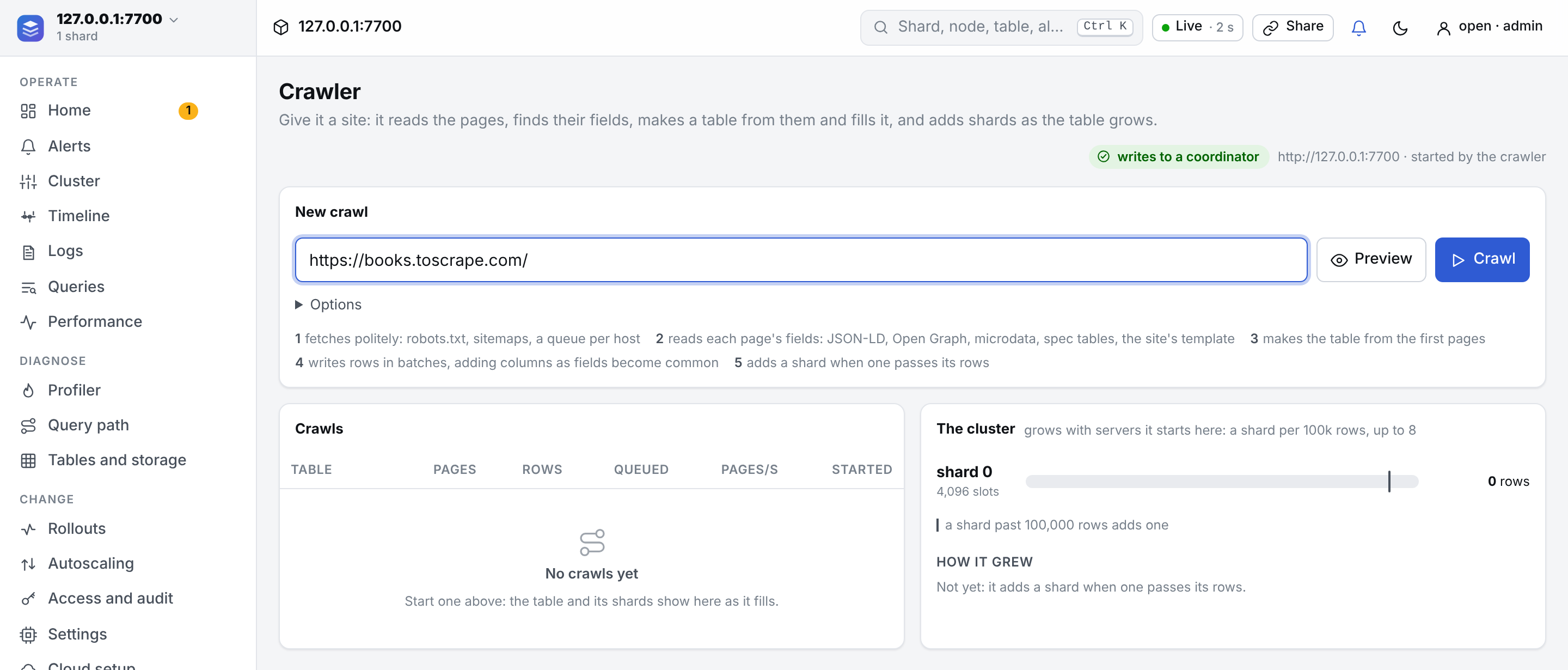
--local DIR starts one shard server and a coordinator on 127.0.0.1:7700 with their databases and logs in DIR, and adds a shard each time one holds more than --split-rows rows of a crawl's table (100,000 by default, at most --max-shards, 8). The same DIR again serves the same cluster, with the shards it grew.
From the command line#
The same crawl runs without the command center too. crawl takes the address, prints its progress every two seconds, then what it did (the table it made and why, the columns it added, the shards it added) and the CREATE TABLE it ran; add --stay to keep the cluster serving after the crawl. preview prints what the form's Preview shows, without ChloeDB:
target/release/chloedb-crawl crawl https://books.toscrape.com/ --local ./crawl-cluster \
  --server-bin ../chloedb-server/target/release/chloedb-server --max-pages 600
target/release/chloedb-crawl preview https://books.toscrape.com/ --pages 10
At the default pace, a page a second for one site (below), 600 pages take about ten minutes. books.toscrape.com is a sandbox made for crawlers, so --per-host 4 --delay-ms 100 is fine there; keep the defaults for sites you don't run.
Against a cluster that runs elsewhere#
The crawler writes to any chloedb-server, one server or a coordinator, with a key that can write (and an admin key to grow a cluster):
chloedb-crawl serve --server http://coordinator:7700 --key "$CHLOEDB_KEY" --token "$CRAWL_TOKEN" \
  --listen 0.0.0.0:7800 --grow kube --split-rows 5000000
--server was --strata before 0.3.2; the old name still works.
and the coordinator shows it as an app when told where it is, with the crawler's token:
CHLOEDB_APP_TOKEN="$CRAWL_TOKEN" chloedb-server --shards ... --app crawler=http://crawler-host:7800
--grow says how the cluster gets a shard: kube asks the Kubernetes operator for one more (POST /v1/admin/kube, the coordinator must run under the operator), servers=URL,URL adds empty servers started for it, by their gRPC URLs, one at a time, and off never grows. Each new shard gets its share of the slots by a rebalance (POST /v1/admin/rebalance) while the crawl keeps writing.
On Kubernetes#
A cluster the operator runs gets a crawler of its own from its StrataCluster, with nothing to start by hand:
kubectl -n strata patch strata demo --type merge -p '{"spec": {"crawler": {}}}'
The operator runs chloedb-crawl serve from the cluster's own image (it carries both programs) as a Deployment of one pod, <cluster>-crawler, behind a Service of that name, and restarts the coordinators so that they list it: Apps → Crawler appears in the command center, and a crawl starts from its form. The crawler writes with the cluster's admin token (tokenSecret), which its API requires too, so the coordinators send it that token and nothing else reaches it. It grows the cluster through the operator, a shard at a time:
spec.crawler |
default | |
|---|---|---|
grow |
true |
add a shard (one more in spec.shards) when a crawl's table holds more than splitRows rows on one |
splitRows |
100,000 | |
maxShards |
8 | the most shards it grows the cluster to |
paused |
false |
no crawler pod for now (the coordinators still list it, as an app that does not answer) |
args, resources |
more arguments of chloedb-crawl serve (as ["--contact", "ops@example.com"], whom site owners reach), and its container's resources (50m CPU and 64 MiB asked, 1 GiB at most) |
The upgrader moves the crawler with the servers, since it runs their image. Removing spec.crawler deletes its Deployment and Service and restarts the coordinators without it; the tables it filled stay. Its crawls live in its pod, so a pod started again (a new image, a node replaced) starts with none.
What it does with a page#
Fetching. One queue per host, read breadth first. robots.txt is read before a site's first page and again once a day (RFC 9309: the longest rule wins, * and $ in paths, its own groups, chloedb-crawl and strata-crawl (its old name), or else *); a 4xx answer for it allows everything, and a 5xx, a 429 or no answer keeps the crawler off the site until it reads it again, a minute later (or when its Retry-After says, up to 10 minutes). Sitemaps named there, or at /sitemap.xml, add their pages as seeds. Only HTML is kept, at most max_bytes a page; a URL is normalised once (no fragment, no tracking parameters, the query's parameters sorted) and fetched once, redirects included; a redirect (5 at most) is followed only to a page the crawl would follow as a link (its scope, include and exclude) and its site's robots.txt allows; robots.txt is read to 500 KB and a sitemap to 50 MB; a page whose text another page already had is counted as a duplicate and not written. Links are queued in turn from each shape of link on the page (/catalogue/*/index.html, /catalogue/category/...), so the first pages read are a site's items as well as its lists. rel="nofollow" links and pages with noindex or nofollow robots meta tags are honoured.
Reach. The crawler fetches the public internet only: an address on its machine (localhost, 127.0.0.1), a private network (10.x, 192.168.x, fd00::/8), a link-local one (169.254.169.254, cloud metadata) or another reserved range is refused, whether a page links to it, redirects to it or its name resolves to it (checked again as each connection is made). An intranet crawl says so when the crawler starts: --allow-host HOST[:PORT] (repeatable) for one site, --allow-private (or CHLOEDB_CRAWL_ALLOW_PRIVATE=1) for everything. A proxy named by HTTPS_PROXY is reachable whatever its address, and resolves the names it is asked for itself.
Politeness. A site gets at most per_host requests at once (1), and between the starts of two the longest of delay_ms (1 s), its robots.txt's Crawl-delay (up to 10 minutes; every site the crawl reaches, not only the seeds') and twice the time it has been taking to answer (up to 30 s), so a site that slows down is asked less often. A site that pushes back waits before its next request: a 429, 502, 503 or 504 as long as its Retry-After says, else 5 s, doubled at each refusal in a row up to 5 minutes, and the page is asked again later (4 times at most); a 403 or no answer waits the same, and the page is not asked again. After 10 refusals in a row, or when a site asks to wait more than 10 minutes, the crawl gives up on that site and drops its queued pages; the crawl's events say when a site was made to wait and when it was given up. The user agent names the crawler and links to the page for site owners, with the crawl's contact; a crawl's own user_agent keeps the crawler's name after it. Answers are asked compressed (gzip, Brotli).
Fields. Each page gives:
| from | as |
|---|---|
| the fetch | url (the key), host, depth, status, fetched, bytes, fetch_ms |
| the page | title, body (the main text: <main>, <article> or [role=main], else the body without navigation, headers and footers), words, links, and when the page has them description, headings, lang, canonical, published, modified, author, image, site_name, kind, keywords |
| JSON-LD | ld.*: the page's main entity (Product, Article, Recipe ...), @type as type |
| Open Graph and other meta tags | og.* (og:price:amount is og.price_amount) |
| microdata | md.* |
| tables and lists of terms | specs.*: rows of a key and a value (<th>UPC</th><td>a897...</td>, <dt>/<dd>) |
| the site's template | page.*: learned from the first pages (below) |
| your selectors | rule.*: name=selector, name=selector@attr, name[]=selector for every match |
The template. On the first pages (sample, 30), the crawler looks for an element of one tag and classes (p.price_color) that most pages have at most three times, whose text changes from page to page and is not the title. Those are the site's own fields, named from their classes (price_color, stock_level), and read from every page after.
The table. It is made from the first pages: the fetch's and the page's columns above, a column for each other field that at least promote_at (0.3) of the pages have, typed by its values (a type fits when 90% of the values read as it: BOOL, INT, FLOAT with currencies and thousands separators read, TIMESTAMP, KEYWORD for short values, else TEXT, and lists), and data JSON holding every field of the page, so a field that is not a column is still a path to query (WHERE data.specs.isbn = '...'). An existing table is used as it is, with the columns it lacks added. With embed, a vector field emb is embedded from the title and body by that model.
As it grows. Every 100 pages the crawler looks again at the fields the pages since the start have had: one that has reached promote_at (over 50 pages at least) gets a column (ALTER TABLE ... ADD COLUMN IF NOT EXISTS), and the rows written before it get its value from their data (a set by key for each). Rows are written in batches of batch (200) through POST /v1/write, each under an idempotency key, so a batch sent again after a lost answer writes once; a 429 waits as the server asks, a partial write is sent again with the key it returns, and rows a server refuses are found by halves and listed as problems.
The command center's view#
Apps → Crawler lists the crawls and the cluster's shards, each a bar of its rows against the split threshold, with the shards it added and the rebalances. New crawl takes a URL and the options above. Preview reads the URL and up to nine pages it links to and shows the table they would make: its columns with their types and where each comes from, the CREATE TABLE, the pages read, the template learned, every field found with the share of pages that had it, and three rows as they would be written. Crawl starts it.
A crawl's page shows pages fetched and rows written a second, with the moments the table was made and shards were added; the shards filling and splitting; the table's columns, with when each was added, and the fields found so far with the column each went to; a search of the table through ChloeDB (MATCH and bm25 over the body, or the latest rows); what it did, with the SQL it ran; the last pages read; and problems (robots.txt, timeouts, answers that were not HTML, refused rows). Pause, Resume and Stop act at once; a stopped crawl writes the pages it has read.
The view is a module the crawler serves (chloedb-crawl/ui/view.js, compiled in; CHLOEDB_CRAWL_UI_DIR=chloedb-crawl/ui reads it from disk), loaded and run by the command center as the apps section describes.
Options#
The same names are the JSON fields of POST /v1/crawls and POST /v1/preview, and the command line's options (--max-pages, --no-robots, --rule, ...).
| option | default | |
|---|---|---|
seeds |
the URLs to start from | |
table |
from the first seed's host (books_toscrape_com) |
the table to fill |
scope |
host |
which links to follow: host (the seeds' hosts), domain (their sites, subdomains included), prefix (under the seeds' paths), any |
include, exclude |
regular expressions on URLs: follow only links that match one of include, never those that match exclude |
|
keep |
regular expressions: write rows only for pages that match (the others are read for their links) | |
max_pages |
1,000 | URLs to fetch at most |
max_depth |
5 | links from a seed; a list's next page (a link with rel="next", or named "Next", "Next page", "Older posts" or an arrow) is as deep as the list, so a long list is read to its end. A crawl that ends says why: its page limit, its depth (with the links it left out, also in the status's beyond_depth), or no links left |
concurrency, per_host |
16, 1 | requests at once, and to one host |
delay_ms |
1,000 | between the starts of two requests to a host (longer when its robots.txt asks, or when it is slow to answer) |
robots, sitemaps |
on | obey robots.txt; read sitemaps |
sample |
30 | pages the table is made from |
promote_at |
0.3 | the share of pages a field needs to be a column |
rules |
fields from CSS selectors, as above | |
learn |
on | learn the site's template |
embed |
a model to embed the title and body with, into emb |
|
user_agent |
chloedb-crawl/0.3.11 (+https://chloetech-ai.github.io/chloedb/chloedb/crawler-bot.html) |
a crawl's own is sent with that after it, unless it names chloedb-crawl (or strata-crawl, its old name) |
contact |
--contact of chloedb-crawl serve (or CHLOEDB_CRAWL_CONTACT) |
whom a site's owner reaches about the crawl, an email address or a URL, sent in the user agent: chloedb-crawl/<version> (+https://...; ops@example.com) |
timeout_ms, max_bytes, batch |
20,000, 5 MB, 200 |
API#
chloedb-crawl serve answers on --listen (127.0.0.1:7800). It takes no request that carries an Origin header, so no web page can drive it from a browser, and with --token (or CHLOEDB_CRAWL_TOKEN) none without Authorization: Bearer <token>; with --local and no token it makes one and gives it to the coordinator it starts.
| request | |
|---|---|
GET /v1/info |
the crawler's version, the ChloeDB it writes to and what it is, the growth policy and the default options |
POST /v1/crawls |
starts a crawl from the options: {id, table}; two crawls may not fill one table at once |
GET /v1/crawls |
the crawls, newest first |
GET /v1/crawls/:id |
one crawl: its phase, counts, rates and a second-by-second series, the table's plan and SQL, the fields found, the last pages and problems, what it did, and the cluster's growth |
POST /v1/crawls/:id/pause, /resume, /stop |
|
DELETE /v1/crawls/:id |
forgets a crawl that has ended (its table stays) |
POST /v1/preview |
the options and pages (6, at most 20): the preview, nothing written |
GET /v1/grow |
the shards' rows of the crawls' tables, slots moving, and the shards added |
GET /app.json, GET /ui/view.js |
the manifest and view the command center reads |
Through chloedb-server the crawler checks its callers ("checks_callers": true in its manifest): a key that may write starts crawls, which are its own, and pauses, resumes, stops and forgets only those (an admin of every table steers any); a key limited to tables lists only its own crawls. A crawl writes its table as the key that started it: the crawler sends its token narrowed to that key's grants (x-chloedb-as-tables, server), so a key limited to crawl_* crawls into crawl_* tables only, and a table it may not write is the server's 403. Called directly with its token, it answers as before.
Limits#
- Pages are read as their HTML arrives: a page built by JavaScript in the browser shows only what its HTML holds (JSON-LD and meta tags often carry its fields anyway).
- A crawl lives in the process: its queue and seen set are in memory, and a restarted crawler starts again (rows are written by URL, so a page written twice is one row).
- A site's scope (
domain) takes the last two labels of a host, or three when the second last is short (example.co.uk), without the public suffix list. - The growth policy counts the rows of the crawls' tables on each shard, not their bytes, and adds a shard at a time; it does not remove shards.
- A list column added during the crawl is filled from the rows written after it only (a
setby key takes one value).